King Amenhotep III: The Pharaoh of Prosperity and Artistic Splendor
Amenhotep III stands out as one of ancient Egypt’s most iconic and influential pharaohs. His reign occurred during the powerful 18th Dynasty, a period widely celebrated as a Golden Age in Egyptian history.
This era was defined by exceptional characteristics:
- Stability and Prosperity: Egypt enjoyed unprecedented domestic peace and immense wealth.
- Diplomatic Zenith: The nation reached the peak of its international diplomatic power, maintaining relations across the Near East.
- Artistic Brilliance: The period saw a tremendous flourish in art, architecture, and craftsmanship.
This comprehensive guide is dedicated to exploring the life, major achievements, colossal monuments, jubilee festivals, and enduring legacy of King Amenhotep III. We highlight the decisive factors that lead historians to consistently rank his rule among the very greatest in the history of ancient Egypt.

Key Takeaways – Amenhotep III
- Ruled during the 18th Dynasty at age 12.
- Oversaw Egypt’s peak prosperity and artistic achievement.
- Built around 250 temples, statues, and monumental structures.
- Father of Akhenaten and grandfather of Tutankhamun.
- Famous for diplomacy, international alliances, and political marriages.
- Commissioned the Colossi of Memnon and major expansions at Luxor & Karnak.
Who Was Amenhotep III?
King Amenhotep III is universally recognized as one of the most significant Egyptian kings of the New Kingdom period. As the ninth pharaoh of the illustrious Eighteenth Dynasty, he ascended to the throne at the young age of twelve and ruled for an exceptional 38 years, approximately from 1386 to 1349 BC, following the death of his father, Thutmose IV.
Under his long and powerful reign, the kingdom of Egypt maintained extraordinary stability and influence. This era of prosperity was so profound that historians commonly refer to his time on the throne as “Egypt’s Golden Age”. While the foundation of this stability was partially inherited from his father, Thutmose IV, Amenhotep III made a crucial choice: rather than primarily focusing on military conquest to expand Egypt’s influence, he successfully employed diplomacy and strategic alliances as his primary means of maintaining and strengthening power across the Near East.
King Amenhotep III’s Family
- His father was Pharaoh Tuthmosis IV, and his mother was Queen Mutemwiya, the daughter of the Mittani king.
- He was married to Queen Tiye and had a son named King Akhenaten.
- He was also the grandfather of Tutankhamun.

Marriage and Children of Amenhotep III
The reign of King Amenhotep III—one of the most successful Egyptian kings of the New Kingdom—was defined by his primary marriage to Queen Tiye. She was elevated to the status of Great Royal Wife in the second year of his rule, an unprecedented honor given she was not of direct royal blood.
Tiye hailed from a highly prominent, wealthy family of Upper Egypt:
- Her father, Yuya, was a powerful courtier who held top military and religious offices, including “Master of the Horse” and “Father-of-the-god.”
- Her mother, Tuya, was also a noblewoman with high religious titles, such as “Chief of the Entertainers” of Amun and “Superintendent of the Harem” of Min.
Tiye’s status was exceptional; she was often depicted on the same scale as the pharaoh and actively engaged in diplomacy, helping to manage the vast empire.
Diplomatic Marriages and Children of King Amenhotep III
King Amenhotep III’s Marriage With Queen Tiye
To secure Egypt’s diplomatic supremacy and maintain peaceful relations across the Near East, King Amenhotep III also engaged in numerous political marriages with foreign princesses from powerful kingdoms like Babylon and Mitanni. However, Tiye remained the supreme royal consort.
Children of King Amenhotep III
Amenhotep III and Queen Tiye produced at least six children, including four daughters and two sons:
- Thutmose: The eldest son and Crown Prince, who served as a sem-priest but sadly passed away young.
- Amenhotep IV: The second son, who succeeded his father and is famously known for changing his name to the controversial religious reformer Akhenaten, ushering in the revolutionary Amarna period.
Through Tiye and these strategic alliances, Amenhotep III consolidated a powerful lineage that led directly to one of the most transformative, yet turbulent, eras in ancient Egyptian history.

Diplomacy of King Amenhotep III
King Amenhotep III was a master of diplomacy. During his reign, he solidified alliances through strategic political marriages, taking daughters and sisters from the rulers of Mitanni, Babylon, and the Hittite Empire as his wives.
Furthermore, he embarked on diplomatic missions that took him as far as Cyprus and Assyria, fostering strong ties with neighbouring nations.
His generosity and diplomatic finesse played a pivotal role in nurturing profitable relationships with all his neighbouring countries.
The king also supported all kinds of art; his peaceful rule enabled him to invest in craftsmanship, creativity, and architecture.
He always welcomed artists and musicians into his court and encouraged sculptors and painters by purchasing their works.

The Heb-Sed Festival Celebration
The King upheld the time-honoured tradition of the Heb-Sed festival during the 30th, 34th, and 37th years of his reign.
This ceremonial event featured a series of mental and physical challenges designed to demonstrate the king’s ability to fulfil his duties as ruler of Egypt.
What Is the Heb-Sed Festival?
This tradition celebrated the unity of the new kingdom of Egypt; it was held after the king’s 30th regnal year and repeated every three years thereafter.
The accomplishment was originally credited to King Menes, who united Upper and Lower Egypt.
Ceremonial Rituals of the Heb-Sed Festival
This tradition symbolises the king’s strength and right to rule. The king proves his vitality by running a ritual race.
It was believed that the kingdom’s peace relied on the ruler’s own strength.

King Amenhotep III’s Legacy
King Amenhotep III left behind a remarkable legacy in the form of an awe-inspiring array of constructions in ancient Egypt.
His reign witnessed the creation of around 250 temples, structures, statues, and stelae, all designed to commemorate his era.
Temple of Luxor
He expanded and embellished the Luxor Temple in Thebes, adding a grand colonnade and colossal statues at the entrance.
The temple showcases intricate reliefs and carvings depicting the pharaoh’s reign and religious scenes.
Temple of Karnak
The king made significant contributions to the Karnak Temple Complex, particularly the Fourth Pylon and the Colonnade of Amenhotep III. The complex boasts impressive obelisks, sanctuaries, and intricate decorations.
Colossi of Memnon
These colossal statues, originally part of Amenhotep III’s mortuary temple, depict the pharaoh seated on his throne.
Each figure stands approximately 18 meters tall and is carved from a single piece of stone.
Mortuary Temple of Amenhotep III
Also known as the Temple of Millions of Years, this grand funerary complex was dedicated to the worship of the pharaoh.
Although largely ruined, its original magnificence is evident in the remnants of colossal statues, colonnades, and decorative reliefs.
Kom el-Hettan Palace Complex
Located near Luxor City, this vast palace complex served as the pharaoh’s residence.
It featured extensive gardens, artificial lakes, and various buildings that showcased the pharaoh’s opulence and architectural vision.
Art and Sculpture
Amenhotep III patronised and encouraged artistic expression during his reign.
His era witnessed the creation of numerous exquisite statues, reliefs, and other art forms that showcased a refined style and attention to detail.

The Legend of the Colossi of Memnon

Singing Statues Phenomenon
Crafted around 1350 BC, the monumental Colossi of Memnon—two massive stone statues of Amenhotep III—remained famous for over a millennium. These colossal figures were designed to express the pharaoh’s greatness and served as a powerful political symbol at the entrance of his vast mortuary temple in Thebes (modern Luxor).
An intriguing legend surrounds these statues, giving them their fame:
- The Song of Dawn: The northern statue was claimed to emit a haunting, ethereal whistle or “song” at the break of dawn.
- The Scientific Explanation: This phenomenon was most likely the result of a significant fissure in the statue’s structure, damage believed to have been caused by the powerful earthquake of 27 BC.
- The Traveler’s Belief: Remarkably, ancient Greek and Roman travelers who journeyed to Egypt believed that hearing this enigmatic sound brought them good fortune.
These statues are considered the largest exhibited examples of their kind and are a cornerstone of Egyptian monumental art. You can discover the greatness of this phenomenon firsthand with specialized Luxor Tours, witnessing the timeless power of these breathtaking statues.
Royal Statues of Amenhotep III and Queen Tiye
The two primary statues depict King Amenhotep III and his Great Royal Wife, Queen Tiye, seated side-by-side on a high-backed throne. Near their legs are three standing daughters, symbolizing the continuity of the royal line.
Amenhotep III is adorned with the complete regalia of a pharaoh:
-Headdress: The Nemes headdress, complete with the protective royal cobra (Uraeus) on his forehead.
-Beard and Kilt: The iconic royal false beard and the pleated royal kilt, the Shendyt.
The sculptor expertly captured the king’s serene authority, conveying his refined features: a calm expression, prominent eyebrows, wide eyes, a delicate nose, high cheekbones, and a fine mouth, reflecting the sophisticated artistic style of the 18th Dynasty.
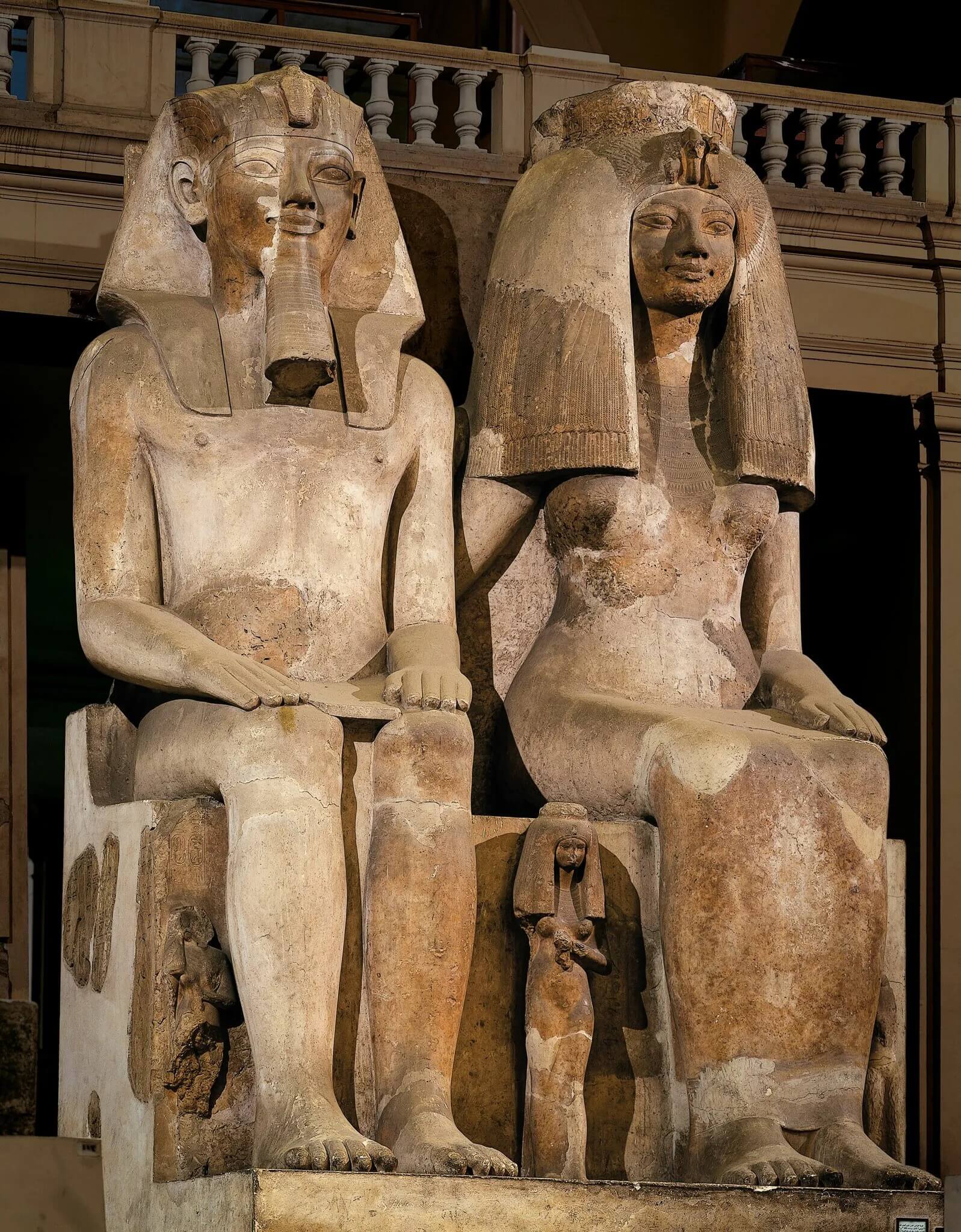
Queen Tiye is shown extending her right arm behind the King’s back, symbolising love, care, and tenderness.
She is also considered the hidden power behind the throne.
The facial features of the queen are shown beautifully. She is wearing a heavy tripartite hair wig decorated with the body of the vulture goddess “Nekhbet” of Upper Egypt.
Upon the wig is a cylindrical base, which was supposed to be surmounted by two feathers.
On the forehead, there are two cobra goddesses representing “Wadjet” of Lower Egypt and one vulture representing “Nekhbet” of Upper Egypt.
The queen is wearing a long dress.
Amenhotep III Religious Beliefs and Devotion
The king upheld traditional Egyptian religious beliefs and worshipped the pantheon of gods.
He declared himself the son of the god Amun-Ra, emphasising his divine lineage.
The pharaoh commissioned the construction and expansion of temples dedicated to various deities, reinforcing his status as a representative of the gods on Earth.
The King’s Divine Birth
Several temple inscriptions claim that Amun Ra, disguised as the biological father of Amenhotep III, visited Queen Mutemwiya (the king’s mother), leading to the king’s divine birth.

Amenhotep’s Death & the Reign of Akhenaten

He suffered from severe dental problems, arthritis, and possibly obesity in his final years.
He died in 1349 BC and was buried in the Valley of the Kings in the tomb (KV22).
Upon the king’s death, his son Amenhotep IV ascended to the throne and commenced his rule.
Foreign rulers, such as Tushratta, sent letters to Queen Tiye expressing their grief at his passing and their condolences.
These letters show that these monarchs hoped to continue the same good relations with Egypt under the new king as they had with his predecessor.
Conclusion
Amenhotep III, a prominent pharaoh of ancient Egypt’s 18th Dynasty, left an enduring legacy of prosperity, diplomacy, and artistic achievement. His reign, marked by numerous temples and the iconic Colossi of Memnon, showcased his greatness. His devotion to traditional Egyptian religion and his diplomatic skills solidified Egypt’s standing on the world stage. The king’s reign paved the way for his son, Akhenaten, to bring about significant changes in Egypt’s history.
Let our expert team help you plan visits to Luxor, Karnak, and the Colossi of Memnon — curated tours that bring Amenhotep III’s world to life.
FAQs – Amenhotep III
Who was Amenhotep III?
Amenhotep III was the ninth pharaoh of the Eighteenth Dynasty, ruling during a period of unprecedented prosperity and cultural expansion.
Why was Amenhotep III important?
He was a powerful pharaoh known for prosperity, diplomacy, and monumental building projects.
What did Amenhotep III build?
He constructed over 250 temples and monuments, including Luxor Temple expansions, parts of Karnak, and the Colossi of Memnon.
What are the Colossi of Memnon?
Two gigantic seated statues of Amenhotep III that once guarded his mortuary temple.
Who succeeded Amenhotep III?
His son, Amenhotep IV (Akhenaten), succeeded him.
Where is the mummy of Amenhotep III?
His mummy is currently displayed at the National Museum of Egyptian Civilisation (NMEC) in Cairo.