
Sultan Al Mansur Qalawun Mosque in the Qalawun Complex
Sultan Al Mansur Qalawun Mosque in the Qalawun Complex
Sultan Al Mansour Qalawun Mosque is part of a Mamluk complex on Al Muizz Street in Historic Cairo. Commissioned by Sultan Al Mansour Qalawun, the complex was built between 1284 and 1285 CE and brought several important functions together within one architectural foundation.
The complex brings together a prayer hall, a madrasa for education, a mausoleum for royal burial, and the remains of a bimaristan, a traditional hospital. These spaces show how worship, learning, burial, and medical care were brought together during the Mamluk period.
The site stands in Bayn al-Qasrayn, along a historic stretch of Al Muizz Street lined with Islamic monuments. You can combine your visit with nearby Mamluk buildings and continue towards Khan El Khalili to explore more of Historic Cairo.
Where is Sultan Al Mansur Qalawun Mosque situated?
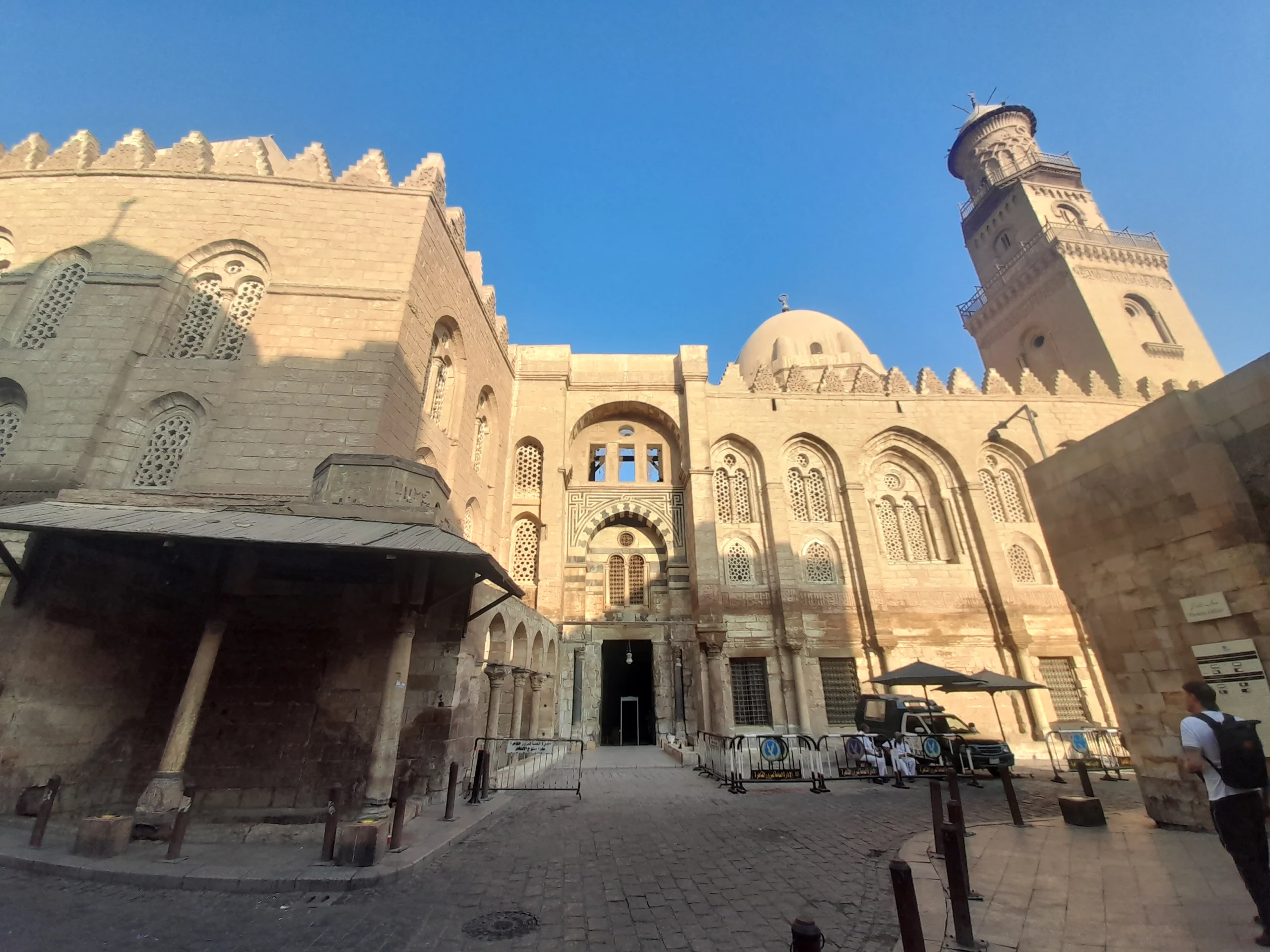
The mosque stands on Al Muizz Street in Bayn al-Qasrayn, within the historic Gamaliya district of Cairo. This part of the street is known for its concentration of medieval Islamic monuments, making it easy to combine a visit with nearby historic buildings. Al Muizz Street runs between Bab al-Futuh in the north and Bab Zuweila in the south, passing through several historic lanes and market areas along the way.
The site is part of the Mamluk architectural heritage of Cairo, not a building from the Fatimid period. Nearby landmarks include the Madrasa of Al-Nasir Muhammad ibn Qalawun and the Mosque and Madrasa of Sultan Barquq, both located along Al Muizz Street. If you are exploring the Qalawun complex in Cairo, you can visit these neighboring monuments as part of a wider walk through Islamic Cairo and continue towards Khan El Khalili Bazaar.
Sultan Al Mansur Qalawun complex
The complex brings together four main functions: a mosque and prayer hall for worship, a madrasa for education, a mausoleum for royal burial, and a bimaristan for medical care. These connected spaces reflect how religious, educational, funerary, and medical activities existed within one Mamluk architectural site.
The Entrance Corridor and Sabil
As you approach the entrance, look closely at the richly decorated portal. The Ministry of Tourism and Antiquities describes its use of gold and silver gilding alongside geometric and floral motifs. Beyond the entrance, a corridor connects the main parts of the complex. The mausoleum lies to your right as you enter, while the madrasa is on your left, and the passage continues towards the former hospital at the rear.
Near the entrance, you can also see the remains of a sabil, or public drinking fountain. It replaced an earlier watering basin for animals during renovation work carried out in 1325–1326 CE under Sultan al-Nasir Muhammad. From the entrance corridor, you can choose which section to explore first.
The Mausoleum
The mausoleum is one of the most distinctive spaces within the complex. Its soaring dome is supported by four columns and four piers arranged in an octagonal pattern. Historical accounts identify Sultan al-Mansur Qalawun, his son Sultan al-Nasir Muhammad, and his grandson Sultan al-Salih Isma’il among those buried beneath the central area. As you look around, notice the mihrab, which marks the direction of prayer, and its marble and mother-of-pearl decoration. Wooden lattice panels enclose an empty symbolic tomb at the centre of the floor. Together, these features show how the building combined royal burial with the architectural traditions of the Mamluk period.
The Madrasa and Prayer Hall
The madrasa served as a place of education, while its prayer room provided space for worship. Its layout centres on an open courtyard, with the prayer room on the eastern side and an iwan, or vaulted hall open towards the courtyard, on the western side. A smaller iwan and student accommodation occupied the northern side, while an arcade runs along the southern side. This arcade was added during later alterations in the eighteenth century.
As you explore, notice how the courtyard connects the surrounding spaces. The madrasa was used to teach the four Sunni schools of Islamic jurisprudence, alongside lessons in reading the Quran. Its layout reflects the building’s combined role as a place of worship and learning.
The Bimaristan
The word bimaristan comes from Persian and means “house of the ill.” This part of the complex was established to provide medical care, and the Ministry of Tourism and Antiquities notes that it treated patients with neurological and psychological conditions. An eye and dental hospital now occupies part of the former bimaristan site, so visitor access may be limited.
The historic hospital included four iwans, or vaulted halls open towards a courtyard, which formed important parts of its layout. If access is available during your visit, follow the permitted visitor route and respect areas used for medical services.
How the Complex Was Built
Construction of the complex took only 13 months, from around June–July 1284 to July–August 1285 CE, according to the inscription above the entrance and the Qalawun VR Project. This was an unusually short period for such a large architectural project. Amir Alam al-Din al-Shuja’i supervised the construction on behalf of Sultan al-Mansur Qalawun.
The site lay in Bayn al-Qasrayn, a name meaning “Between the Two Palaces,” in an area associated with the former Fatimid palaces. The new Mamluk buildings occupied part of these earlier palace grounds, reflecting how Cairo’s urban landscape changed as new rulers established their own monuments.
Historical accounts describe harsh methods used to speed up construction, including the eviction of residents and the forced labour of people recruited for the work. These details come from medieval accounts discussed by the Qalawun VR Project and should be understood as historical reports rather than features visible at the site today.
Restoration and Preservation
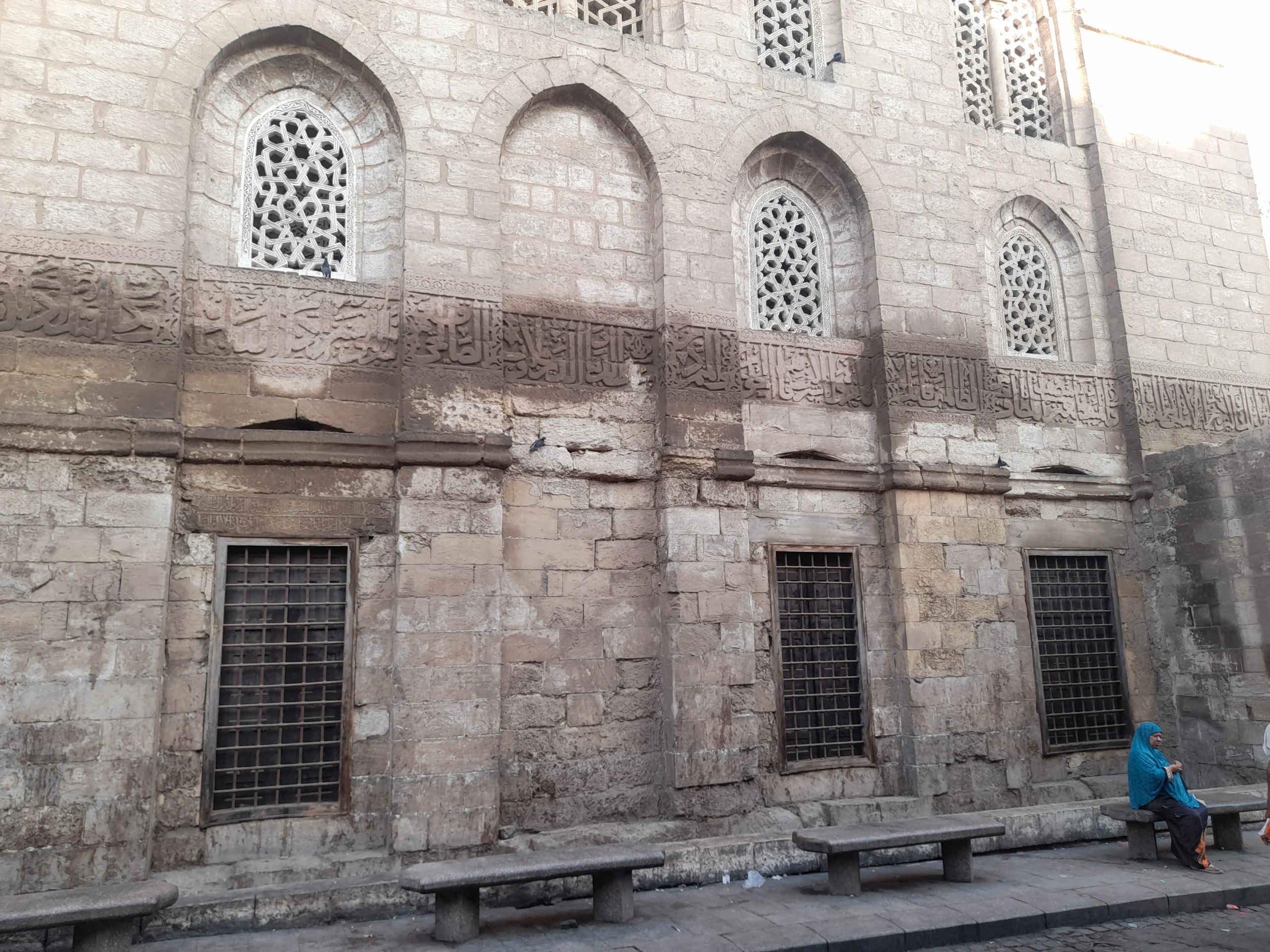
The complex underwent major alterations in 1776 under the supervision of hospital administrator Abd al-Rahman Katkhuda. According to the Qalawun VR Project, the work included removing the domes above the entrance chamber and mausoleum, demolishing residential buildings along the southern side of the madrasa, and adding an arcade in their place.
Major renovations followed in the early twentieth century under the Committee for the Conservation of the Monuments of Arab Art. A concrete dome was installed above the mausoleum, which had stood without a roof for more than a century, and its interior was restored.
A later restoration and development project, listed by the Arab Contractors as completed in 2007 under the supervision of the Supreme Council of Antiquities, included lowering groundwater levels, strengthening the foundations, and restoring architectural elements, mosaics, and decorative details. These works helped address structural problems and preserve the complex’s historic fabric.
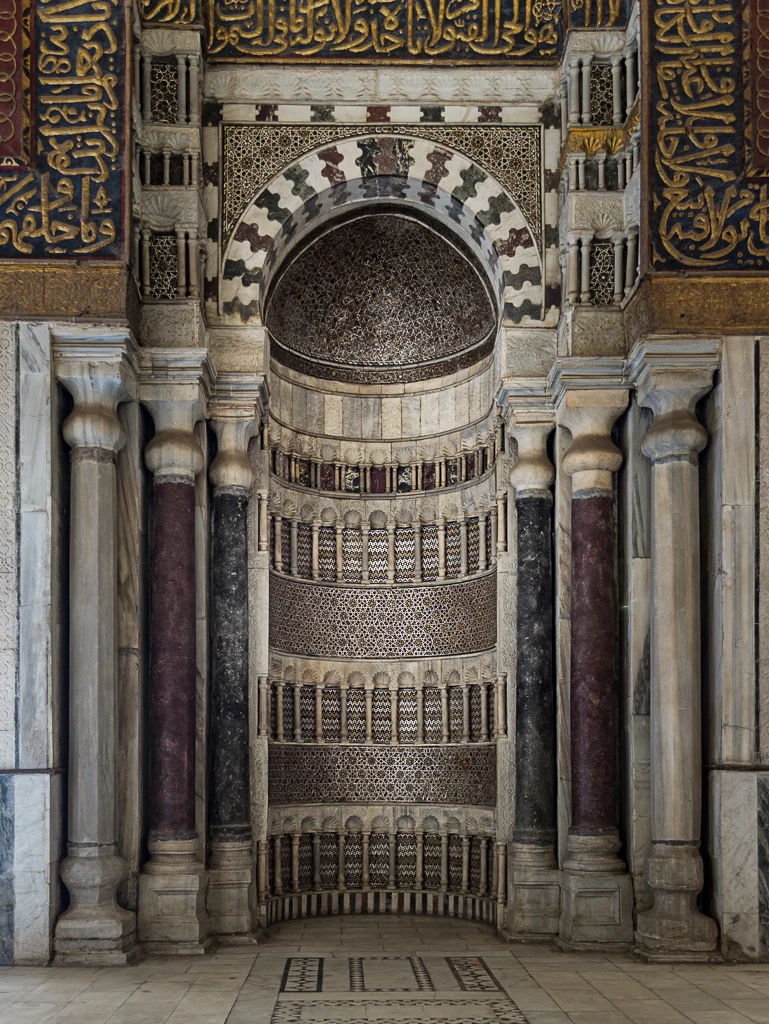
The decorated mihrab in the mausoleum of Sultan Qalawun. Photo: Keladawy, CC BY-SA 4.0. Converted to WebP.
Tickets, Opening Hours & How to Visit
The complex of Qalawun is covered by the combined area ticket for historic monuments along Al Muizz Street. The Ministry of Tourism and Antiquities currently lists the following opening hours and ticket prices.
| Item | Details |
|---|---|
Opening hours | From 9 AM; confirm the closing time before visiting. |
Area ticket, foreign visitors | Adult EGP 220 / Student EGP 110 |
Area ticket, Egyptians | Adult EGP 20 / Student EGP 10 |
Hours checked on 27 October 2026: Egypt’s Monuments lists 9 AM–4 PM, while the official Ministry of Tourism and Antiquities listing gives 9 AM–5 PM (9 AM–4 PM during Ramadan), with last entry one hour before closing. Confirm the current hours and prices before visiting.
The area ticket includes the Qalawun Group, Suleyman Agha Al-Selehdar Mosque and Sabil, Al-Kamil School, the Mosque and School of Al-Nasir Muhammad ibn Qalawun, Sultan Barquq Mosque, the Temple of Musa bin Maimun, Hammam Inal, and Amir Bishtak Palace. It does not cover Wekalet Bazaraa or Bayt Al-Suhaymi, which have separate ticket arrangements.
Not every part of the complex is necessarily accessible to visitors, as the former bimaristan is now used as an eye and dental hospital. Wear modest clothing for religious spaces and comfortable shoes for walking along the historic street. For a guided walk through the area, consider the Cairo Day Trip to Museums, Citadel & Bazaar, and combine your visit with Khan El Khalili Bazaar.
Next Door: Al-Nasir Muhammad and Barquq Complexes
Just a short walk away, the Madrasa of Al-Nasir Muhammad ibn Qalawun stands between the mausoleum of Qalawun and the Madrasa of Sultan Barquq. Look for its distinctive marble entrance, carved plaster mihrab, and Andalusian-style decorations on the minaret. The building was begun under Sultan Zayn al-Din Katbugha and completed during the reign of Al-Nasir Muhammad, Qalawun’s son.
Further along Al Muizz Street, the Madrasa and Khanqah of Sultan Barquq features an open courtyard surrounded by four iwans, a marble mihrab, and a decorated wooden pulpit. It served as a school for the four Sunni schools of Islamic jurisprudence, a mosque, and a Sufi lodge. Both monuments are included in the area ticket. Note that the nearby Madrasa of Al-Nasir Muhammad ibn Qalawun is different from the Mosque of Sultan al-Nasir Muhammad inside the Salah El Din Citadel.
Conclusion
The complex brings together spaces for prayer, education, royal burial, and medical care in one Mamluk site on Al Muizz Street. You can combine your visit with the nearby Madrasa of Al-Nasir Muhammad ibn Qalawun, the Barquq complex, and Khan El Khalili Bazaar as part of a walk through Historic Cairo.
For more than 20 years, Egypt Tours Group has arranged Cairo day tours that include Al Muizz Street alongside Khan El Khalili and the Citadel, with licensed Egyptologist guides. Explore the Islamic Cairo Day Tour.
FAQs
Where is the complex located?
The complex is located on Al Muizz Street in Bayn al-Qasrayn, within Historic Cairo. It stands in the Gamaliya district among medieval Islamic monuments, making it a practical stop on a walking route through the area. See the location section above for nearby landmarks and the street’s position between Bab al-Futuh and Bab Zuweila.
How old is Sultan Al Mansur Qalawun Mosque?
The complex was constructed during the late thirteenth century, with work documented between 1284 and 1285 CE. It dates to the Mamluk period and is more than seven centuries old. Its combination of worship, education, royal burial, and medical care reflects the range of functions brought together within one architectural foundation in medieval Cairo.
What is inside the complex?
The site contains a mosque and prayer space, a madrasa, a mausoleum, and a historic bimaristan. These buildings served worshippers, students, royal burials, and patients. Part of the former hospital area remains associated with medical services and is used as an eye and dental hospital, although visitors should not assume every section is accessible.
What is the entrance fee for Sultan Al Mansur Qalawun Mosque?
The combined area ticket is listed at EGP 220 for foreign adults and EGP 110 for foreign students. Egyptian adults pay EGP 20, while Egyptian students pay EGP 10. The ticket also covers several nearby historic monuments along Al Muizz Street. Prices may change, so check the official Ministry of Tourism and Antiquities listing before visiting.
What are the opening hours?
The complex opens at 9 AM, but official sources differ on the closing time. Confirm the current closing and last admission times before visiting; the source links are in the opening-hours note above.
What should I wear to visit Sultan Al Mansur Qalawun Mosque?
Choose modest clothing that covers your shoulders and knees, and wear comfortable shoes for walking over stone floors. These choices are practical when exploring historic religious buildings and moving between different sections. If you plan to visit other mosques nearby, modest clothing is a sensible choice for the entire walking route.
Is it the same as the mosque of Sultan al-Nasir Muhammad in the Citadel?
No. The Qalawun Complex is on Al Muizz Street, while the Mosque of Sultan al-Nasir Muhammad is inside the Salah El Din Citadel. The nearby Madrasa of Al-Nasir Muhammad on Al Muizz Street is a third, separate monument.
How long does a visit take?
Allow enough time to explore the entrance corridor, mausoleum, madrasa, and any accessible remains of the bimaristan. The exact duration depends on which areas are open and how closely you examine the architecture and decoration. If you also visit the neighboring Mamluk monuments along Al Muizz Street, your walking tour will take longer.