Unleash the adventure with Egypt Tours Group! Explore amazing tour packages, cruise the Nile River, and embark on captivating shore excursions. Your unforgettable experience starts here!
Travel with us to a place where history comes alive and the past speaks through stone. The Abu Simbel Temples, with their colossal statues and remarkable stories, offer an unforgettable glimpse into ancient Egyptian grandeur. In this guide, we’ll take you through the wonders of these iconic temples and the fascinating tales they preserve.
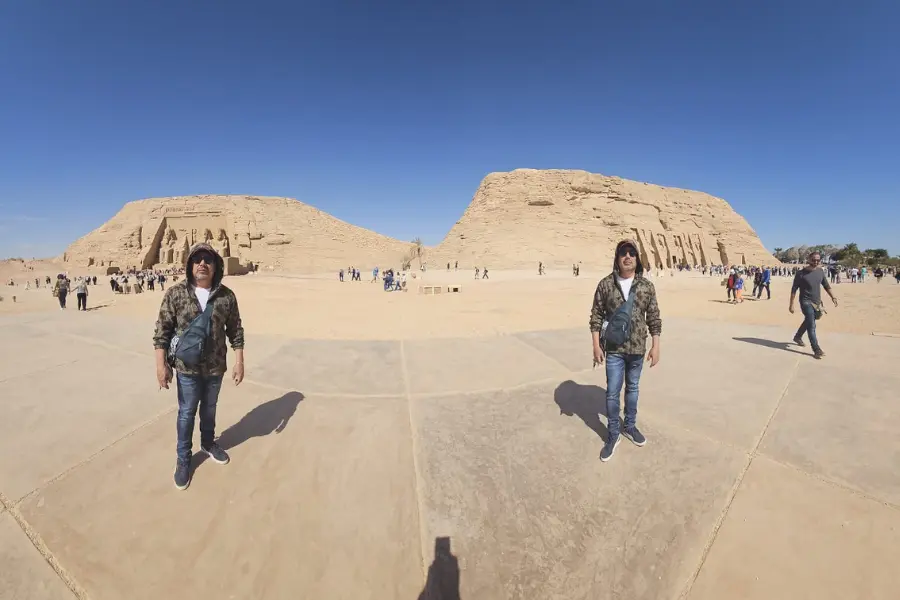
Carved into a massive rock, the Great Temple took approximately 24 years to complete. It is dedicated to the God Amun, Shepherd Harakhty, Ptah, and Ramses II, reflecting the grandeur and devotion of the era. The temple’s facade spans 35 meters and is guarded by four majestic statues, each towering 20 meters high.
Inside, eight additional statues, each 10 meters tall, line the temple, accompanied by detailed inscriptions celebrating the Battle of Kadesh and Ramses II’s victories. The interior features a series of rooms and corridors adorned with intricate carvings and vivid depictions of Ramses II alongside numerous Pharaonic deities, offering a breathtaking journey through ancient Egyptian history.
Iconic view of Abu Simbel Great Temple
Abu Simbel smaller temple:
It is also called the Temple of Hathor and Nefertari. It was dedicated to goddess Hathor, the goddess of love, beauty, and sky, and also to Ramses II and his wife Queen Nefertari. It is 150 meters from the largest temple. This temple is considered the second one in history to be dedicated to a Queen. The first time was dedicated to Queen Nefertiti, and it was built for her by King Akhenaten. Throughout history, the statues of wives were much smaller than the statues of kings, but in Abu Simbel, the statues of Nefertari are almost the same size as the statues of Ramses II, which shows his great love and respect for her.
King Ramses II commissioned a magnificent temple dedicated to his beloved wife, Queen Nefertari, and the goddess Hathor. The temple’s facade spans 28 meters in width and rises 12 meters high, adorned with six monumental statues. Two of these statues depict Ramses II wearing the double crown of royal authority, flanked by two statues of Queen Nefertari. On the north side, a statue shows the king in the form of the god Ptah, while on the south side, he is depicted wearing the double crown once more. At the center of the facade, six intricately carved columns are crowned with representations of the goddess Hathor, making the temple a stunning tribute to love, divinity, and pharaonic grandeur.
The entrance leads to a square pillared hall with a lady’s face and a cow’s ear. And on the side of the entrance in the hall is King Ramses II beating the enemies in front of Amun Ra and RA’s sister. The scenes depicting the King and Queen making offerings in front of the gods are distributed in the temple, and on top of them, The goddess Hathor is at the vestibule and the hall leading to the Holy of Holies. Another Hall follows it with the same previous views, then the Holy of Holies, where there is a statue of the goddess Hathor.
Hidden gem: Abu Simbel Smaller Temple
The sand covered the temples of Abu Simbel over time.
Over time, the Abu Simbel Temples became almost entirely buried under the sands, with the colossal statues at the entrance covered up to their knees. These magnificent temples were forgotten for centuries until 1813, when Swiss scholar GL Bochardt first attempted to uncover them with the help of Italian explorer Giovanni Pelonzi. Their initial efforts were unsuccessful, but Pelonzi returned to Egypt in 1817 and finally managed to enter the temples, revealing their grandeur after hundreds of years of obscurity.
Legend has it that a young local boy named Abu Simbel guided the explorers through the shifting sands, and the temples were later named in his honor for his role in the discovery. To protect these treasures from the rising waters of Lake Nasser following the construction of the Aswan High Dam, the Egyptian government, in collaboration with UNESCO, carefully dismantled and relocated the temples in 1964 to a new plateau 60 meters above the original site, preserving them for future generations.
The theory of the sun’s orthogonality on the face of Ramses II
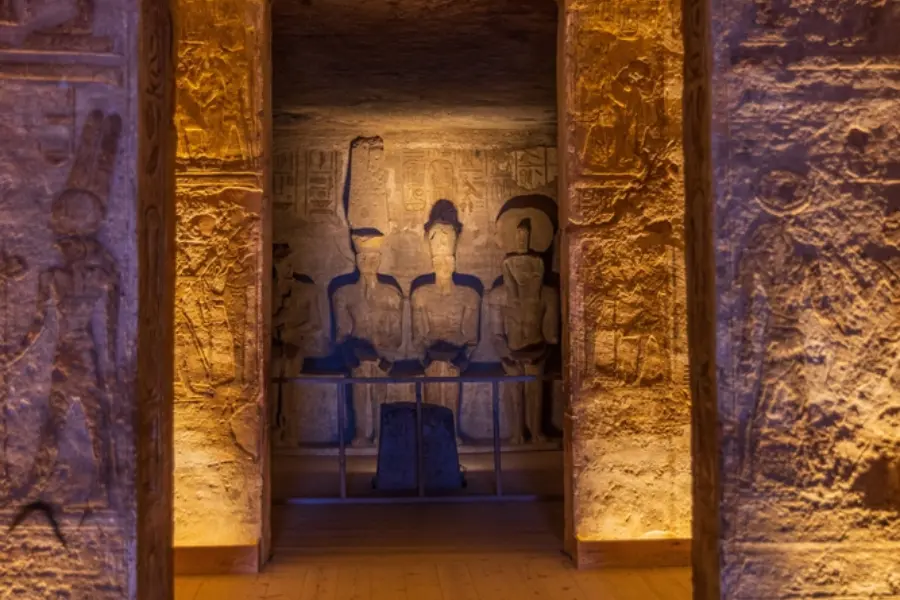
Sunlight aligns on Ramses II’s face
Dr. Ahmed Saleh Abdullah, Director General of Abu Simbel Temples Antiquities and Nubian temples, said that the sun’s perpendicular to the face of King Ramses II inside his temple in Abu Simbel on October 22 coincides with the beginning of the farming season in ancient Egypt as the beginning of the farming season in the days of the Pharaohs begins on the 21st of the month, and the sun’s perpendicular to the King’s face on February 22 occurs on the occasion of the beginning of the harvest season.
Precise sunlight on Ramses II’s visage
It is often claimed that the solar alignment phenomenon at Abu Simbel Temples occurs on the King’s birthday and coronation day, but historians emphasize that this has no scientific basis. Ancient Egypt did not record precise birth dates or coronation days, making it impossible to confirm these claims. According to Scottish Egyptologist Kyiv Kechgen, a specialist in the era of Ramses II, the King’s coronation likely fell on June 18. The temple’s Hall of the Holy of Holies features inscriptions and carvings depicting the birth of the God Amun, symbolically marking the start of the planting and harvest seasons, connecting cosmic events with agricultural cycles.
The discoverer of the Sun’s Orthogonality Phenomenon at Abu Simbel Temples
The remarkable solar alignment at Abu Simbel Temples was first observed during the winter of 1874 by British writer Emilia Edward and her team. They documented this extraordinary phenomenon in her acclaimed book “A Thousand Miles Over the Nile”, published in 1899.
Emilia Edwards: Uncovering history’s secrets
Moving Abu Simbel temples
UNESCO received an official request from the Egyptian and Sudanese governments In 1959 regarding the rescue of the unique temples of Abu Simbel. During the construction of the Aswan High Dam, the hypothesis of flooding two ancient temples with water resulting from the project and irreparably damaging them emerged. These two identical temples, one large and the other smaller, were built more than 3,200 years ago by Ramses II as a monument to him and Queen Nefertari. International fundraising for the project began in 1960.
When the construction of the Aswan High Dam threatened to submerge the temples, a Swedish engineering company, Vattenbyggnadsbyrån, led the intricate relocation project. Unlike traditional structures, these temples were carved directly into a cliff, making the move extremely complex.
To save them, engineers first stripped off the rock above the temple roofs. The walls, facades, and ceilings were then meticulously cut into blocks weighing 20–30 tons each. Swedish companies, including Sandvik, Skanska Cement, Sintap, and Atlas Copco, played a crucial role. Explosives could not be used because the porous sandstone would have been damaged. Instead, bulldozers removed overlying rock, and specialized tools like Atlas Copco pneumatic crushers, compressors, and drills facilitated precise cutting. Sandvik hand saws were used to ensure the temple’s external appearance remained intact.
The new site of Abu Simbel Temples is located about 200 meters from the original location and elevated 65 meters above the Nile. The temples were reassembled with extreme accuracy to preserve their original alignment, ensuring the solar rays continued to illuminate the inner statues at the same times during spring and autumn. Tolerances did not exceed ±5 mm. Reinforcing bars, drilled holes, and synthetic materials secured the stone blocks, while 30,000 cubic meters of stone were removed to prepare the site for reassembly.
Giant domes were later constructed above the temples’ roofs, and natural-looking mounds were created using stone from previous excavations, totaling around 330,000 cubic meters. The relocation project concluded on September 22, 1968, celebrated with a grand opening ceremony. The total cost of the operation was approximately SEK 200 million (around SEK 1.7 billion today). In 1979, the Abu Simbel Temples were proudly inscribed on the UNESCO World Heritage List.
Moving history: Abu Simbel Temples
Conclusion
In the shadow of colossal giants, the Abu Simbel Temples stand as a testament to the enduring spirit of human ingenuity and artistry. As we conclude our journey through this timeless masterpiece, we are reminded that history’s echoes can still be heard in the hallowed halls of these ancient wonders. Abu Simbel remains an extraordinary tribute to Egypt’s rich past and an everlasting source of awe and inspiration for all who are fortunate enough to visit.