Abu Simbel Temples: Where Time Stands Still
Published: | Updated:
The Abu Simbel Temples are two rock-cut temples built by Ramses II in the 13th century BC, in Nubia in southern Egypt. Today they overlook Lake Nasser: the Great Temple honours the king and major Egyptian gods, while the Small Temple is dedicated to Hathor and Queen Nefertari. In this guide, we’ll take you through the wonders of these iconic temples and the fascinating tales they preserve.
Abu Simbel Great Temple
Carved into a massive rock, the Great Temple was built during the reign of Ramses II. It is dedicated to Amun-Ra, Ra-Horakhty, Ptah, and the deified Ramesses II, reflecting the grandeur and devotion of the era. The temple’s facade is guarded by four majestic seated statues of the king, each approximately 20 meters high.
Inside, eight Osirid figures of Ramesses II line the first hall, accompanied by detailed inscriptions celebrating the Battle of Kadesh and Ramses II’s campaigns. The interior features a series of rooms and corridors adorned with intricate carvings and vivid depictions of Ramses II alongside numerous Pharaonic deities, offering a breathtaking journey through ancient Egyptian history. For a closer look at the halls and sanctuary, see our guide to inside Abu Simbel Temples.
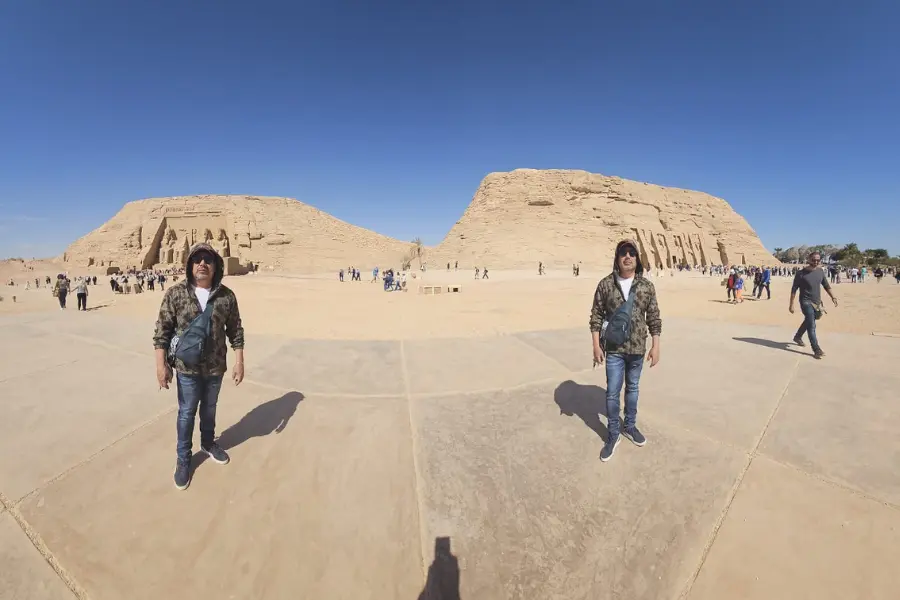
Iconic view of Abu Simbel Great Temple

Abu Simbel smaller temple:
It is also called the Temple of Hathor and Nefertari. It was dedicated to goddess Hathor and Ramses II’s wife Queen Nefertari. At Abu Simbel, the statues of Nefertari are almost the same size as the statues of Ramses II, an unusual emphasis on the queen’s importance.
The temple’s facade is adorned with six monumental standing statues: four of Ramses II and two of Queen Nefertari. On each side of the entrance, two statues of the king flank one of the queen. Inside, six Hathor-headed pillars support the hall. Scenes depicting the King and Queen making offerings before the gods decorate the temple.
Hidden gem: Abu Simbel Smaller Temple

The sand covered the temples of Abu Simbel over time.
Over time, the Abu Simbel Temples became partly buried under the sands. Swiss traveller Johann Ludwig Burckhardt recorded the site in 1813. Italian explorer Giovanni Battista Belzoni and his team reached the interior of the Great Temple in 1817 after clearing the entrance. These accounts brought the temples to wider European attention; they do not mean the site had been unknown to local people.
More than a century later, the rising waters of Lake Nasser threatened the temples. Their relocation during the 1960s, described below, preserved them for future generations.
Sun alignment at Abu Simbel
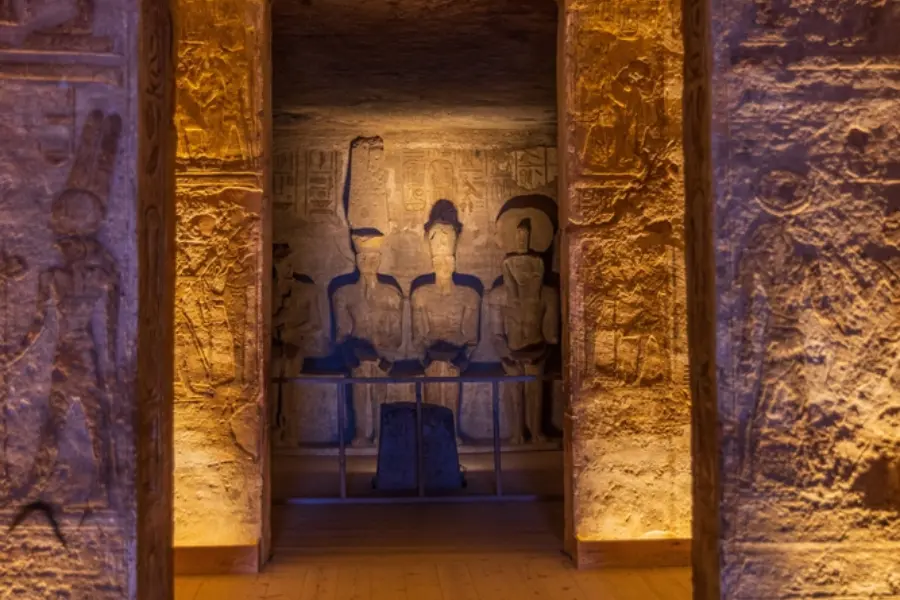
Sunlight reaches the seated sanctuary figures in the Great Temple.

Twice a year, sunlight reaches into the Great Temple’s inner sanctuary, where seated figures include the deified King Ramses II. The alignment is one of the temple’s most remarkable architectural features, but popular explanations linking it to the king’s birthday or coronation should not be presented as established fact.
Visitors photographing the Great Temple sanctuary at Abu Simbel.

For the dates, evidence and distinction between the phenomenon and its popular stories, read the Abu Simbel sun alignment guide.
Amelia Edwards at Abu Simbel
British writer Amelia Edwards travelled to Egypt in 1873 and described her journey in A Thousand Miles Up the Nile, first published in 1877. Her account is part of the temples’ modern travel history; it should not be used to credit her with the first discovery of the solar alignment.
Amelia Edwards, whose Egyptian travel account was first published in 1877.

Moving Abu Simbel temples
UNESCO received an official request from the Egyptian and Sudanese governments in 1959 regarding the rescue of the unique temples of Abu Simbel. Construction of the Aswan High Dam would create a reservoir that threatened to flood the temples. These two distinct temples, one large and the other smaller, were built more than 3,200 years ago by Ramses II. International fundraising for the rescue began in 1960.
When the construction of the Aswan High Dam threatened to submerge the temples, the Swedish engineering company Vattenbyggnadsbyrån developed a solution for saving them as part of an international effort. Unlike traditional structures, these temples were carved directly into a cliff, making the move extremely complex. The main dismantling and reassembly work took place from 1964 to 1968.
To save them, engineers first stripped off the rock above the temple roofs. The walls, facades, and ceilings were then meticulously cut into large blocks. Swedish companies, including Sandvik, Skanska, Sentab, and Atlas Copco, contributed expertise and equipment. The fragile sandstone required careful cutting: saws and pneumatic equipment helped workers dismantle the stone while protecting the carvings. The blocks were numbered so they could be reassembled in the correct positions.
The new site of Abu Simbel Temples is roughly 65 meters higher than the original site and about 200 meters farther inland; published accounts give slightly different measurements. The temples were reassembled with extreme accuracy to preserve their orientation and maintain the solar illumination phenomenon. Atlas Copco’s account describes a permitted deviation of just ±5 mm. Reinforcing bars, drilled holes, and synthetic materials secured the stone blocks.
Giant domes were later constructed above the temples’ roofs, and natural-looking mounds were created using stone from previous excavations. The relocation project concluded on September 22, 1968, celebrated with a grand opening ceremony. Atlas Copco’s historical account puts the project cost at approximately SEK 200 million. In 1979, the Abu Simbel Temples became part of the UNESCO World Heritage property Nubian Monuments from Abu Simbel to Philae.
Moving history: Abu Simbel Temples

Planning a visit
For admission information, consult the Abu Simbel ticket-price guide. If you would like help fitting Abu Simbel into a wider trip, you can request a tailor-made Egypt itinerary.
Conclusion
In the shadow of colossal giants, the Abu Simbel Temples stand as a testament to the enduring spirit of human ingenuity and artistry. As we conclude our journey through this timeless masterpiece, we are reminded that history’s echoes can still be heard in the hallowed halls of these ancient wonders. Abu Simbel remains an extraordinary tribute to Egypt’s rich past and an everlasting source of awe and inspiration for all who are fortunate enough to visit.