
Bent Pyramid Egypt – Unique Design & History of Sneferu’s Tomb
Bent Pyramid Egypt – Unique Design & History of Sneferu’s Tomb
The Bent Pyramid was built by King Sneferu, the first king of Egypt’s 4th Dynasty. It is called the Bent Pyramid because its angle changes partway up the structure, reflecting an engineering problem during construction. The lower section was built at 55°, then the angle was reduced to 43° as the weight of the stone blocks created instability.
This guide explains where the pyramid stands, how its unusual design developed, what lies inside, and how you can visit it as part of a day tour from Cairo. It is also referred to as the Curved Pyramid or Crooked Pyramid.

Unveiling the history: Who built the Bent Pyramid and when?
Key Takeaways – Bent Pyramid (Dahshur)
- Location: Dahshur, within the Memphis and its Necropolis World Heritage property.
- Builder: Built by King Sneferu, the first king of Egypt’s 4th Dynasty.
- Design: Its lower section rises at 55°, changing to 43° higher up because of structural instability caused by the weight of the stone blocks.
- Height: About 101 m (332 ft), with a base measuring approximately 188 m per side.
- Purpose: Built as a royal pyramid for King Sneferu and an important stage in the development of smooth-sided pyramids.
- Also known as: Curved Pyramid, Crooked Pyramid.
What Is the Bent Pyramid?
The Bent Pyramid is a 4th Dynasty royal pyramid built for King Sneferu at Dahshur, south of Cairo. It is known for the unusual change in the angle of its sides, which gives the monument its distinctive profile. The pyramid rises to about 101 meters (332 feet), and much of its original limestone casing remains in place, offering a rare view of the smooth outer finish used on Old Kingdom pyramids.
The change in slope reflects a problem that developed during construction. The builders began with a steep angle of 55 degrees, but the increasing load of the stone blocks caused instability, so the upper section was built at a gentler angle of 43 degrees. This adjustment left the pyramid with its characteristic double-angled form and made it an important example of the experimentation that shaped the development of smooth-sided pyramids.
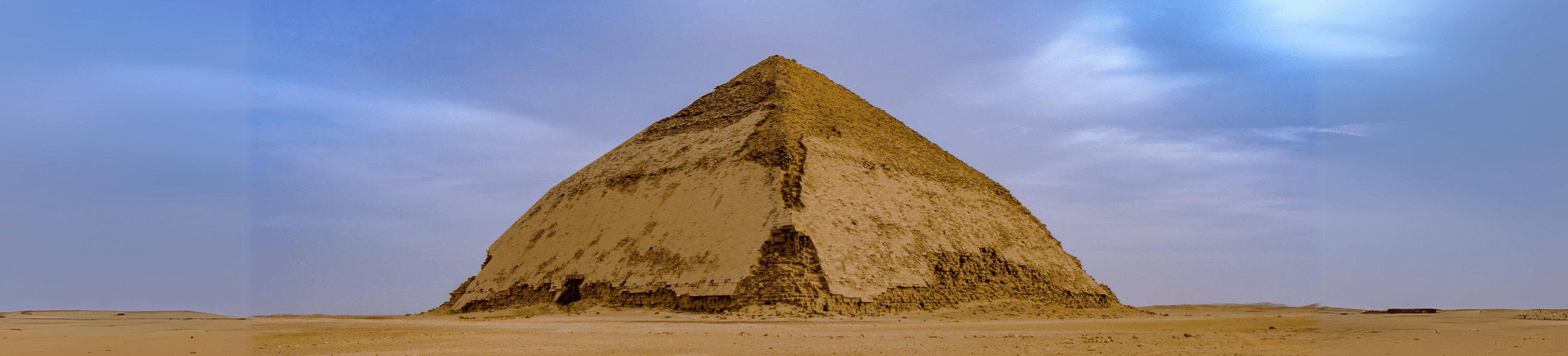
Aerial perspective of the Bent Pyramid, a testament to ancient innovation.
Bent Pyramid Location
Where is the Bent Pyramid located? The Bent Pyramid stands at Dahshur, about 40 km south of Cairo, within the ancient Memphis necropolis and the Memphis and its Necropolis UNESCO World Heritage Site. The Red Pyramid is about 1,8 km north of the Bent Pyramid, while Saqqara, home to the Step Pyramid of Djoser, lies farther north. Unlike the busy Giza Plateau, Dahshur generally receives far fewer visitors, offering a quieter setting for exploring Egypt’s ancient pyramids.
History of the Bent Pyramid
The Bent Pyramid was built during the reign of King Sneferu, the first king of Egypt’s 4th Dynasty who ruled from 2613 to 2589 BC. It followed the earlier Step Pyramid of King Djoser at Saqqara, which marked the beginning of monumental pyramid construction in Egypt. By Sneferu’s reign, royal builders were moving toward a new design with smooth, rather than stepped, outer faces.
The Bent Pyramid at Dahshur represents an important stage in this architectural development. It was intended to be a complete smooth-sided pyramid, but changes to its design during construction prevented it from achieving the planned form. Sneferu then commissioned another pyramid nearby, the Red Pyramid, which became Egypt’s first successfully completed true pyramid. Together, Sneferu’s pyramids document a crucial period of experimentation that led to the fully developed pyramid form seen later at Giza.

The iconic Bent Pyramid of King Senefru, a marvel of ancient Egyptian architecture.
Unique Design and Architecture
The Bent Pyramid’s unusual profile comes from the way its builders changed the slope of the structure during construction. The lower section rises steeply, while the upper section has a noticeably gentler slope. Rather than treating this change simply as a visual feature, the design provides evidence of how ancient Egyptian builders responded to structural challenges while developing the smooth-sided pyramid form.
The Ministry of Tourism and Antiquities explains that the original 55-degree angle had to be reduced to 43 degrees because the increasing load of the stone blocks caused instability. The change altered the shape of the monument but allowed construction to continue, leaving the Bent Pyramid as an important example of the engineering decisions made during the transition from stepped pyramids to later smooth-faced designs.
Pharaoh Sneferu – The Builder
King Sneferu was the first king of Egypt’s 4th Dynasty and one of the most important figures in the development of pyramid architecture. He is associated with three major pyramid projects: the Meidum Pyramid, the Bent Pyramid at Dahshur, and the Red Pyramid. Together, these monuments show how royal builders experimented with different designs and construction techniques during his reign. Egypt’s Ministry of Tourism and Antiquities describes Sneferu’s reign as a pivotal period in the development of pyramid-building technology.
The Bent Pyramid was part of this wider architectural experimentation. After the Meidum Pyramid, which he is generally credited with completing, Sneferu commissioned the Bent Pyramid and later the Red Pyramid at Dahshur. The Red Pyramid ultimately became Egypt’s first successfully completed true pyramid.
Sneferu was also the father of King Khufu, who succeeded him and built the Great Pyramid of Giza. The architectural experience gained during Sneferu’s reign helped establish the foundations for the monumental pyramid building that reached its greatest scale under his son.
Taken together, Sneferu’s Pyramid projects show how experimentation in design and construction gradually led to the smooth-sided pyramids of the Old Kingdom.

Pharaoh Senefru: The founder of the Fourth Dynasty of ancient Egypt.
Inside the Bent Pyramid
The Bent Pyramid has two entrances, one on the northern side and another high on the western side. The northern entrance has modern wooden stairs for visitor access, while the western entrance is positioned higher in the pyramid. Each entrance leads through its own internal route to a chamber with a corbelled roof. The chamber reached from the northern entrance lies below ground level, while the chamber associated with the western entrance is built higher within the body of the pyramid.
The different levels of the two chambers reflect the unusual internal arrangement of the monument. The corbelled roofs were formed by successive layers of stone projecting inward as they rise, creating the stepped appearance of the ceilings. The upper chamber also contains remains of cedar wood beams placed against its walls, providing physical evidence of structural measures used within the pyramid. Their precise purpose should not be assumed without further evidence.
Visit the Bent Pyramid on a Guided Day Tour
Most visitors see the Bent Pyramid as one stop on a wider day trip from Cairo rather than as a standalone visit. The Saqqara, Memphis & Dahshur Day Tour from Cairo covers the Step Pyramid at Saqqara, the open-air museum at Memphis, and both the Bent and Red Pyramids at Dahshur. The tour includes a private Egyptologist guide, private transfers, entrance fees, and lunch.
View Full Itinerary & Prices
Interesting Facts About the Bent Pyramid
- Much of its original limestone casing survives: The Bent Pyramid retains a substantial portion of its original outer limestone casing, allowing visitors to see more of the smooth finish that originally covered the monument.
- It has a small satellite pyramid: A smaller pyramid stands south of the Bent Pyramid as part of Sneferu’s pyramid complex. Its exact original purpose remains a subject of archaeological interpretation.
- Its complex included temples and a causeway: Archaeological remains associated with the Bent Pyramid include a pyramid temple and a causeway connecting the pyramid complex with the valley area. These remains provide evidence of the wider funerary complex that once surrounded the pyramid.
- It is part of a UNESCO World Heritage Site: The Bent Pyramid at Dahshur forms part of the Memphis and its Necropolis – the Pyramid Fields from Giza to Dahshur, a UNESCO World Heritage property inscribed in 1979. The property includes the major pyramid fields and associated archaeological remains stretching from Giza to Dahshur.

Discover intriguing facts about the Bent Pyramid.
Visiting the Bent Pyramid (Tickets & Info)
The Bent Pyramid is open to visitors as part of the Dahshur archaeological site. You can reach the area by private car, taxi, or a guided day tour from Cairo.
Bent Pyramid Tickets & Entry Fees
| Ticket | Foreigners | Egyptians |
|---|---|---|
Adult | EGP 200 | EGP 10 |
Student | EGP 100 | EGP 5 |
Prices checked August 2026. Ticket prices can change, so check the official Ministry information before your visit.
Opening Hours
Entry: 8:00 AM – 4:00 PM
Site closes: 5:00 PM
The archaeological area is spread across the desert, so comfortable shoes and water are recommended, especially during warmer months. Arriving before the final entry time gives you enough time to explore the site before closing.

Visiting the Bent Pyramid in Dahshur Egypt with tickets and travel info
Comparison with Other Pyramids
The Bent Pyramid stands out among Egypt’s best-known pyramids because of its unusual double-slope design. Comparing it with Sneferu’s Red Pyramid and the Great Pyramid of Khufu shows how pyramid construction developed from experimentation at Dahshur to the monumental form perfected at Giza.
| Pyramid | Location | Unique Feature | Builder |
|---|---|---|---|
Bent Pyramid | Dahshour | Double-slope design, changing from about 55° to 43° | Senefru |
Red Pyramid | Dahshour | First true pyramid successfully completed | Senefru |
Great Pyramid | Giza | Largest of the three Giza pyramids and the only surviving Wonder of the Ancient World | Khufu |
Why the Bent Pyramid Is Worth the Detour
The Bent Pyramid represents an important turning point in the development of Egyptian pyramid architecture, with its unusual change in slope and substantial surviving limestone casing. It can be visited alongside the Step Pyramid at Saqqara and the open-air museum at Memphis as part of the Saqqara, Memphis & Dahshur day tour.
Frequently Asked Questions about the Bent Pyramid
Why is the Bent Pyramid bent?
The Bent Pyramid is bent because its builders changed the slope from about 55° in the lower section to 43° in the upper section during construction. The Ministry of Tourism and Antiquities attributes this change to the excessive load of the stone blocks, which caused structural instability.
Why was this pyramid built?
This pyramid was built as a royal monument for King Sneferu during Egypt’s 4th Dynasty. It was part of the development of the smooth-sided pyramid and represents an important stage in the transition from earlier stepped designs.
When was the Bent Pyramid built?
The Bent Pyramid was built during the reign of King Sneferu, traditionally dated to around 2613–2589 BC. It was one of the major pyramid projects associated with his reign.
Who built Sneferu’s pyramid?
King Sneferu commissioned the Bent Pyramid, while his architects and builders carried out its construction. His pyramid projects at Meidum and Dahshur document important developments in pyramid-building techniques.
Can visitors enter the Bent Pyramid?
Yes, visitors can enter the Bent Pyramid through its northern entrance.
Where is the Bent Pyramid located?
The Bent Pyramid is located at Dahshur, about 40 km south of Cairo, within the Memphis and its Necropolis World Heritage property.
What makes the Bent Pyramid special?
Its distinctive double-slope profile and surviving limestone casing make it unusual among Egypt’s pyramids. Its design also records an important stage in the development of the smooth-sided pyramid.
What was found inside the Bent Pyramid?
The interior contains chambers with corbelled roofs, reached through the pyramid’s two entrances. The northern entrance leads to a chamber below ground level, while the western entrance leads to a higher chamber within the pyramid.
Was anyone buried in Sneferu’s Bent Pyramid?
There is no confirmed evidence that Sneferu was buried in the Bent Pyramid. Although the pyramid was built for him, the surviving evidence does not establish that his burial took place there.
Was the Bent Pyramid the first true pyramid?
The Bent Pyramid was an early attempt to create a true smooth-sided pyramid, but it was not completed in that form. Sneferu’s later Red Pyramid is generally recognized as the first successfully completed true pyramid.