The Book of the Dead: Meaning, History, Spells & Myths
The Book of the Dead
Have you ever read or even heard about the Book of the Dead?
What comes to your mind when you hear its name? Is it a book about death and the afterlife, a horror book, or a magical one?
“What is the Book of the Dead?” The Book of the Dead is a term referring to funerary texts, spells, and magical rituals that ancient Egyptians recorded on sanctuaries and on the walls of tombs, mainly to help the deceased and protect them in the afterlife.
Although the term “Book of the Dead” is most closely associated with ancient Egypt, similar concepts appeared in other cultures, each reflecting different beliefs about death and the afterlife.
Many people search for and ask about the Egyptian Book of the Dead, especially travelers. They usually see its name in museums, on the walls of ancient tombs, or hear about it from tour guides during their visits.
This curiosity makes visitors eager to understand its meaning, so their visits to tombs and temples become more meaningful. Instead of seeing the carvings on the walls as strange pictures, they begin to understand the stories and beliefs behind them.
It reflects ancient Egyptian thoughts about death and the world beyond. It shows their deep respect for death, as they carefully arranged everything related to it — judgment, the weighing of the heart, and the hope for immortality.
If you are keen to know more about the Book of the Dead, this article will explore its real meaning, history, content, how it was used, and where you can still see it today.
What is the Book of the Dead? (Definition & Meaning)
It is a set of funerary and mortuary texts that ancient Egyptians wrote on and carved on walls and tombs. The main purpose of these texts was to help and protect the dead in their journey to the afterlife. It was considered a guide or a spiritual map for the spirit in the underworld.
Asking what the Book of the Dead was or how they used it? These texts were used during the funerary rituals before burial, as the priests read certain texts to protect the dead.
Every deceased had their own copy of funeral texts that included spells and drawings that suited their case and social position.
The main purpose of these texts was to guarantee a safe transfer for the soul to its judgment in the afterlife and have a comfortable eternal life.
In some other cultures, there are other books of the dead, like the Tibetan Book of the Dead, but they completely differ from the Egyptian Book of the Dead as they focus on the philosophy of death and the instruction of it in different ways.
The Egyptian Book of the Dead concentrates on the journey to the afterlife itself, its rituals, and how it goes.
History & Origins of the Book of the Dead
Ancient Egyptians believed that life doesn’t end with death, they thought that the soul takes a long journey to the afterlife. So, they wrote the ancient Egyptian Book of the Dead to act as a guide and protector for the soul in its journey.
It contains magic and funerary texts and spells that help the dead to pass the judgments and reach their eternal life safely.
Ancient Egyptian Beliefs About Death
Ancient Egyptians believed that the soul is formed from some parts, like “Ka” and “Ba”, and they thought that every part has its role in the afterlife.
The Egyptian Book of the Dead included spells and texts that help the soul and guide it to successfully pass the judgments in the afterlife, protect the deceased from evil souls, and transfer him to a calm and comfortable place in the underworld to completely enjoy his eternal life with the body preserved as a reference for the soul.
When & Why it was written
The texts of the Book of the Dead didn’t suddenly appear, but they were developed over time:
- In the Ancient Periods: the funerary texts were simple and somewhat primitive; they were written on stone and papyrus. They were only for nobles.
- In the Middle Kingdom: they were more used, the priests and scribes wrote it accurately for everyone according to their social position. They also added some drawings to it.
- In the New Kingdom: the funerary texts reached their known shape, containing a complete set of spells and drawings. Everyone has a book that helps them and guarantees a safe journey to the afterlife for them.
Priests and scribes were responsible for writing these texts and collecting them accurately, as every simple word and spell has its certain role in the soul’s journey.
This made the Book of the Dead not just some texts, it’s a whole spiritual guide for the dead to guarantee protecting his soul after his death.
What Did It Contain? (Content & Spells)
The Egyptian Book of the Dead included a massive collection of magic texts and rituals that aimed to help the soul and protect it through its journey to the underworld. These texts contained spells to protect the deceased from evil souls, ways to help him successfully pass the afterlife judgment, and even to open the doors of the Duat (Egyptian underworld) safely.
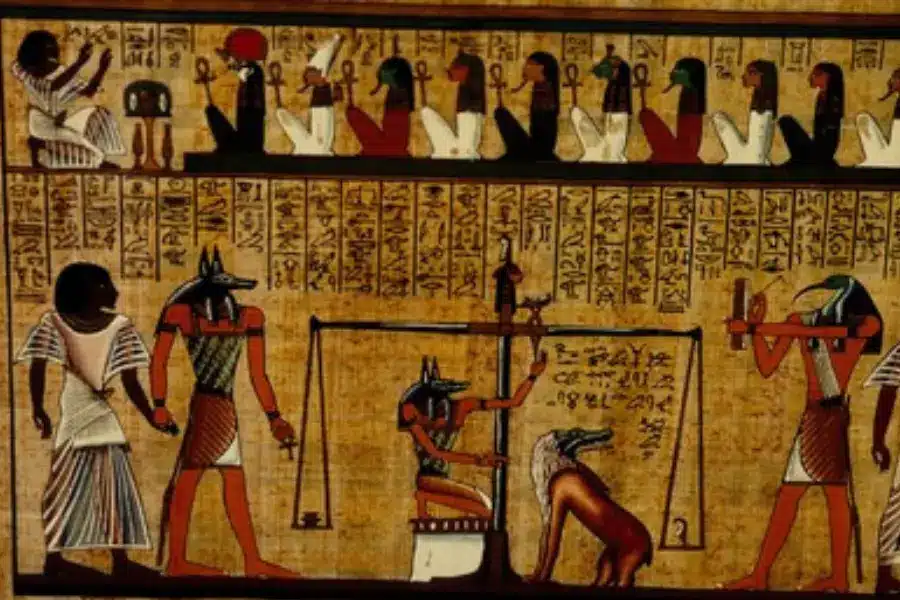
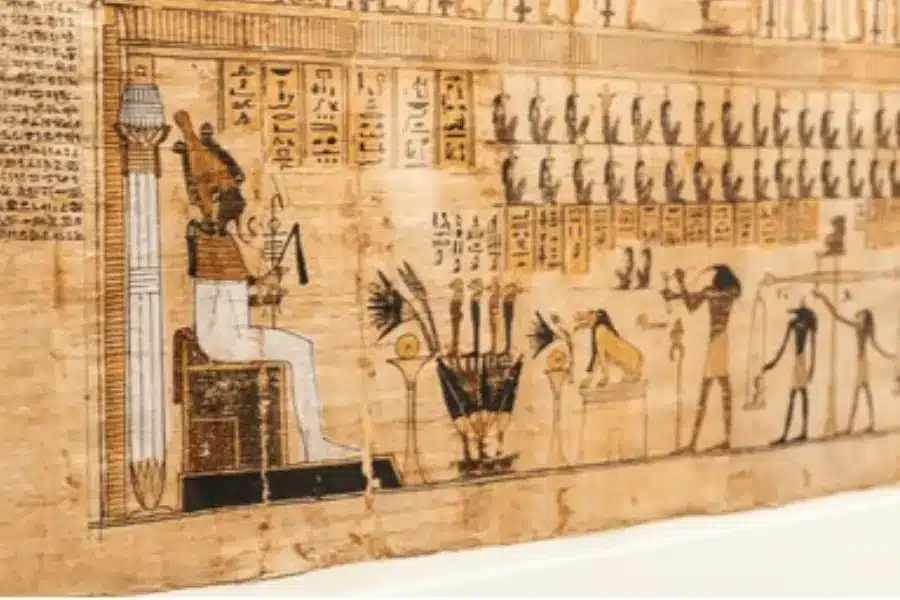
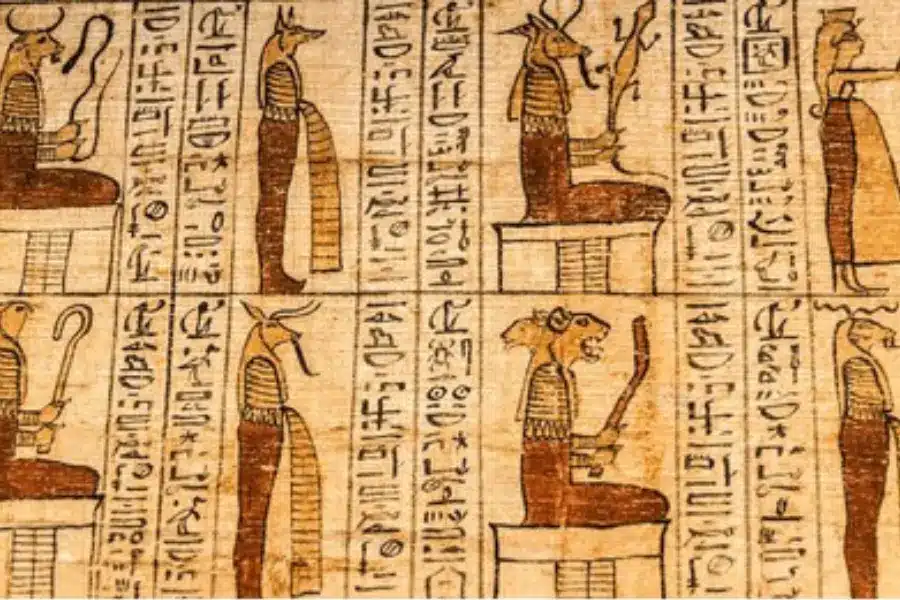
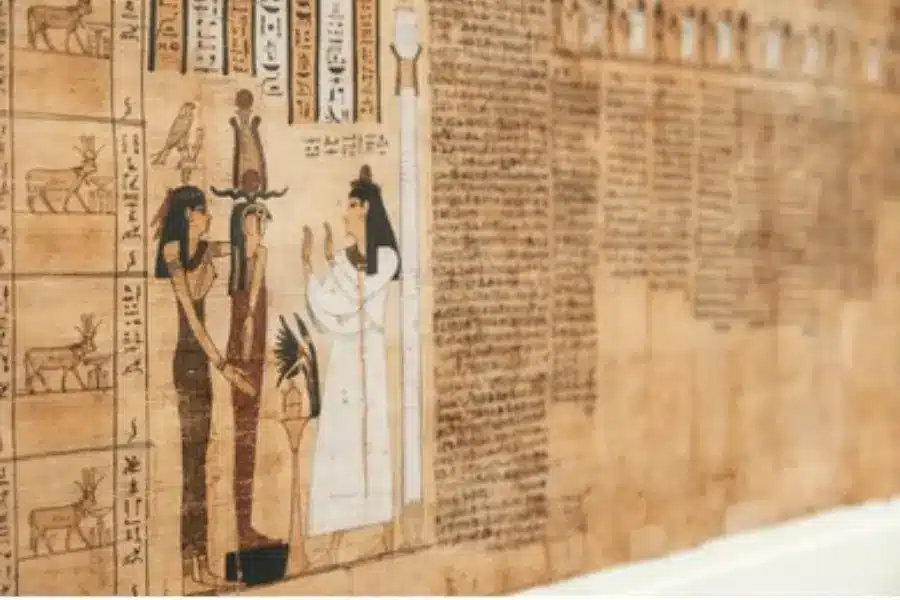
In addition to texts, the Book of the Dead also contained some small illustrations and vignettes representing scenes of the soul’s journey, like encounters with the gods, scenes of weighing the heart, or scenes of the soul’s passage through the sacred rivers of duat.
These vignettes were not just for decoration; they were a vital part of the spells’ power, as they help the soul to realize the situation and rightly act through the different situations in the afterlife.
In ancient Egypt, everyone had their own Book of the Dead according to their social position and status. Nobles and Pharaohs had their complete books that were luxury-ornamented, while normal people had books that were smaller with fewer spells and vignettes.
But, in all ways, all the books with their different shapes aimed at the same spiritual purpose. In this way, everyone had their own plan that guaranteed the protection of their souls and brought them safely to eternal life.
How It Was Used in Ancient Egypt
The ancient Egyptian Book of the Dead wasn’t a book for knowledge or enjoyment, it was a vital and practical part of the funerary rituals of death and resurrection. Its use started before burial and continued as an attachment for the dead inside the tomb to act as a method of protection and guidance for the soul in its journey to the Duat.
During the funerary rituals, priests used certain texts from the funerary texts during the preparation of the body and before closing the tomb. Some spells were spoken, and some others were written on papyrus or carved on the walls of the tomb and the sanctuary. The main purpose of these texts wasn’t only for protection, but also for preparing the soul spiritually to face the afterlife judgment, open safe ways inside the duat, and defend itself before the gods.
The Book of the Dead wasn’t in one copy or available for all in one shape. In the beginning, only nobles and kings could have it because of its high cost, then it became more available over time and provided for Egyptian society. Everyone had their own copy of it according to their social status, wealth, and spiritual needs. Some had a complete set of spells, while others had just some of them.
But in all ways, the main purpose of these texts was one; guaranteeing a safe crossing for the soul and reaching a comfortable and stable eternal life after the judgment.
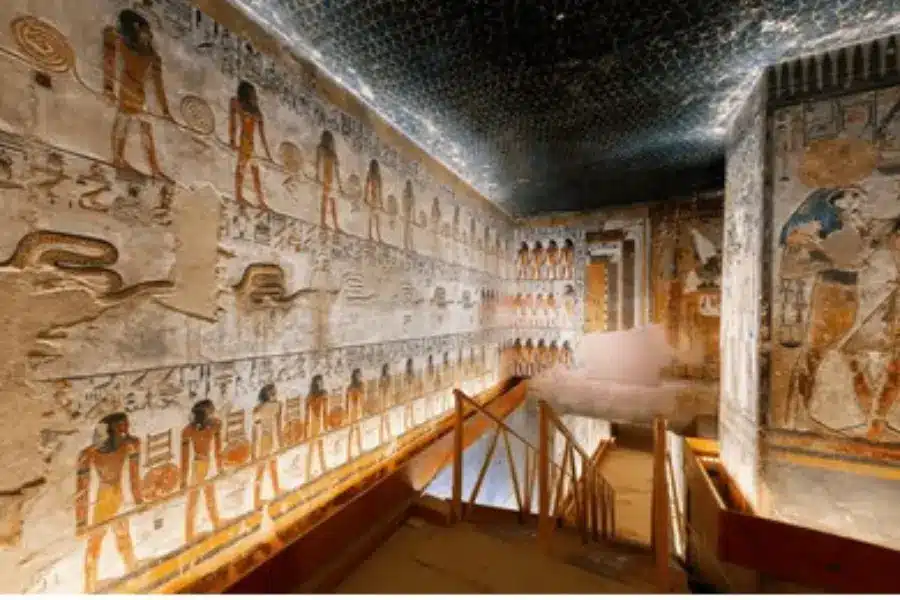
Archaeological discoveries proved that the Book of the Dead wasn’t just a theoretical text, it was a real practice. They also found rolls inside the tombs, written texts on the sanctuaries, and decorated walls with scenes from the book, like scenes of weighing the heart before Osiris, or the journey to the duat.
These discoveries show how the ancient Egyptians used this book as a main part of the after-death rituals, not as a single book, but as a complete set of texts that were used according to status and belief.
Common Misconceptions about Book of the Dead
Many people have a wrong idea about the Book of the Dead because of its name and translation. This made people understand that it’s a mysterious and horrible book.
The fact is that most of the common concepts of it came from movies and modern novels, not from history or even the archaeological sources. Ancient Egyptians themselves didn’t treat it as a book about death with its horrible meaning, they took it as an important guide for the afterlife, full of hope, organization, and strong belief of justice and immortality.
So, it’s very important to differentiate between the historical facts and the image that was made by modern culture.
Is It a Magical or “Evil” Book?
Is the Book of the Dead real? Is it a magical or evil book? Most people ask these questions and search for the answers.
In fact, the Book of the Dead is a real archaeological book whose texts are preserved on papyrus and on the walls of tombs in the world’s museums. But it’s not a magical or evil book as the movies show it.
This wrong idea about it came from the horror movies like the series of “Book of the Dead Evil Dead” or “Evil Dead Book of the Dead” which used its name and connected it with evil souls, spells, and rituals.
But it is all wrong and has no relation to the real Egyptian Book of the Dead, which aimed for protecting the deceased, guiding him, and helping his soul to successfully pass the afterlife judgements and reach the comfortable eternal life after death, not for destruction or harming.
The Book of the Dead contained texts that confirmed justice, weighing of the heart, and judging humans for their acts. This reflects good manners and deep spiritual philosophy.
So, linking the Book of the Dead to the movie that shares its name is a modern cultural association with no roots in history or archaeology.
Book of the Dead in Modern Culture
The Book of the Dead is no longer connected only to the ancient Egyptian civilization, it is still strongly available in the modern age.
The modern interest of the book came from its mystery, symbolism, and being one of the most important keys to understanding the ancient Egyptian’s vision of life and death.
This made it appear in the global museums and in modern popular culture.
Museums & Exhibitions
This allows visitors to view original papyri in world-famous institutions in Europe and the United States, such as the British Museum and the Louvre Museum.
In Egypt, original examples of the Book of the Dead are also preserved and studied in major national museums, including the Egyptian Museum in Tahrir, the National Museum of Egyptian Civilization, and the Grand Egyptian Museum, where papyri and funerary texts are displayed within their authentic archaeological context.
These exhibitions are usually accompanied by illustrations and explanatory displays that highlight the role of these texts in ancient Egyptian beliefs and the soul’s journey to the afterlife, transforming the visit into a rich cultural and educational experience rather than simply viewing monuments.
Pop Culture Influence
The Book of the Dead had a clear effect in popular culture, especially in movies and games. In cinema, its name was always used as a symbol of mystery and immense power far away from its real meaning.
The same idea also appeared in games, as the name of these texts was always connected to magic practices and ancient mysteries.
Although this is not an accurate idea according to history, it had a big role in spreading the name of the Book of the Dead and increasing people’s interest in knowing its original reality.
Book of the Dead in Video Games
Although the Book of the Dead is religious and historical texts from the ancient Egyptian civilization, its name strongly appeared in video games.
Using its name in these games has no relation to its real historical content, but is basically for the mystery and power that is related to this book, especially in modern culture.
So, it’s important to know the difference between the real Book of the Dead and the imaginary copy of it in these games.
Examples:
- OSRS Book of the Dead
In the game of Old School RuneScape (OSRS), there is a label taking the name of Book of the Dead as a part of the game that is used for certain purposes inside it.
The Book of the Dead OSRS has no relation to the ancient Egyptian beliefs, but it is just a tool in an imaginary world that was designed to serve the game and the player’s progress through the missions.
- How to recharge/charge the Book of the Dead (OSRS)
Players in OSRS always search for how to charge or recharge the Book of the Dead OSRS because using it is related to certain sources inside the game.
Charging it is part of the gaming mechanics, and it requires certain elements defined by the game system. The most important aspect is that all of this is just gaming mechanics and has no historical or archeological roots.
- Why Is It Popular in Gaming?
The popularity of the Book of the Dead in gaming stems from the effect of the name itself; the name gives a strong feeling of power, mysteries, and ancient knowledge.
Gaming developers use this symbolism to add depth and excitement to the gaming experience, regardless of introducing accurate historical content. This explains why this name is repeated in different games despite their different stories and worlds.
Note: The Book of the Dead that is used in video games is a full imaginary copy and has no relation to the Egyptian Book of the Dead or its use in ancient Egypt.
FAQs About the Book of the Dead
What is the Egyptian Book of the Dead really about?
The Egyptian Book of the Dead is a collection of funerary texts and spells created to guide and protect the soul in the afterlife. It focuses on judgment, moral balance, and safely reaching eternal life, not on death itself.
Was the Book of the Dead only Egyptian?
Yes, the Book of the Dead is uniquely Egyptian and rooted in ancient Egyptian beliefs about the afterlife. Other cultures had different texts about death, but they served very different spiritual and philosophical purposes.
Is the Book of the Dead a real ancient book?
Yes, it is a real ancient funerary text. Archaeologists have found its spells written on scrolls and carved on the walls of tombs dating back thousands of years.
What is the purpose of the Book of the Dead?
The purpose of the Book of the Dead was to help the deceased navigate the dangers of the after death, pass divine judgment, and achieve eternal peace. It acted as a spiritual guide rather than a book meant for reading or study.
Where can I see the Book of the Dead today?
Original Book of the Dead papyri and inscriptions can be seen in major museums such as the Egyptian Museum in Cairo, the British Museum, and the Louvre. Many examples are also preserved inside ancient Egyptian tombs.
Conclusion
The Egyptian Book of the Dead isn’t just an ancient text or something displayed in the museums, it’s the real key to understanding how the ancient Egyptians thought of life, death and immortality.
Through this book, we can understand how they thought of justice, judgment, and the importance of balanced manners in one’s journey after death.
For travelers and visitors of Egypt, knowing the real meaning of the Book of the Dead completely changes their experience of visiting Egypt. Instead of seeing pictures and images that have no meaning for you, you will be able to understand the stories and purposes behind these pictures and images.
These drawings were created by ancient Egyptians as messages to guarantee safety for the soul in the Duat. This deep understanding makes visiting the tombs, especially at the Valley of the Kings, more deep and meaningful.
Today, anyone can see original parts of these funerary texts in grand museums like the Egyptian Museums, the British Museum, the Louvre, and even inside the tombs in Luxor.
So, knowing about the Book of the Dead isn’t just for science purposes, it’s a real way to keep in touch with a civilization that had messages written for immortality, and its voice is still heard until now.
If reading about the Book of the Dead sparked your curiosity, seeing these texts and scenes in their original setting is an entirely different experience.
With Egypt Tours Group, you can explore the temples, tombs, and museums where the Book of the Dead was written, carved, and preserved. From the tombs of the Valley of the Kings to ancient temples and world-class museums in Cairo and Luxor, our expertly guided tours help you understand the meaning behind the scenes, not just look at them.
Discover Egypt through journeys that connect history, belief, and real archaeological evidence exactly where it all began.