Egypt Travel Safety: Is Egypt Safe to Visit?
In the midst of planning a trip to a unique country like Egypt, you will naturally be bombarded with questions such as: Is it safe to travel to Egypt? Are its cities safe? Will I be exposed to fraud or deception? Is insurance something you would recommend?
Many mainstream Egyptian tourist destinations continue to receive visitors, but conditions and official advice vary by region. Some areas and routes carry stronger restrictions. Check your own government’s current advice for your exact itinerary before booking and again before travel. This is practical travel information, not an official safety clearance or a guarantee.
Is Egypt safe to visit?
Published: May 14, 2025 · Updated: September 15, 2026
Practical preparation tips
For general planning, see our Egypt travel tips.
- Health precautions
Make sure to have your medications with you and a first-aid bag. Check Egyptian rules for your medicines before departure and carry any required prescription or supporting documentation.
- Stay connected
Make sure to always have a connection with your tour guide/ company in case of any emergencies. Also save emergency-service, embassy and insurer contacts so you are not dependent on one person.
- Be cautious, specifically in crowded areas
A crowded area might be a problem for some people who don’t pay enough attention to their belongings. Keep valuables secure and stay aware of your surroundings; staying with a group does not remove the risk of theft.
Current official travel advice for Egypt
National advisories use different systems and boundaries. As checked on September 15, 2026:
- U.S. State Department: Level 2 overall, with stronger advice for Northern and Middle Sinai, border areas and the Western Desert. Its Western Desert advice includes a professionally licensed tour-company condition.
- UK FCDO: advice against all travel or all but essential travel applies to specified regions and routes, with detailed exceptions.
- Australian Smartraveller: a high degree of caution overall, with higher levels for specified areas.
- Government of Canada: a high degree of caution overall, with advice to avoid all travel to specified regions.
These are not interchangeable ratings. Read your government’s complete advice and check airline updates; regional tensions can disrupt travel.
Tourist areas and regional differences
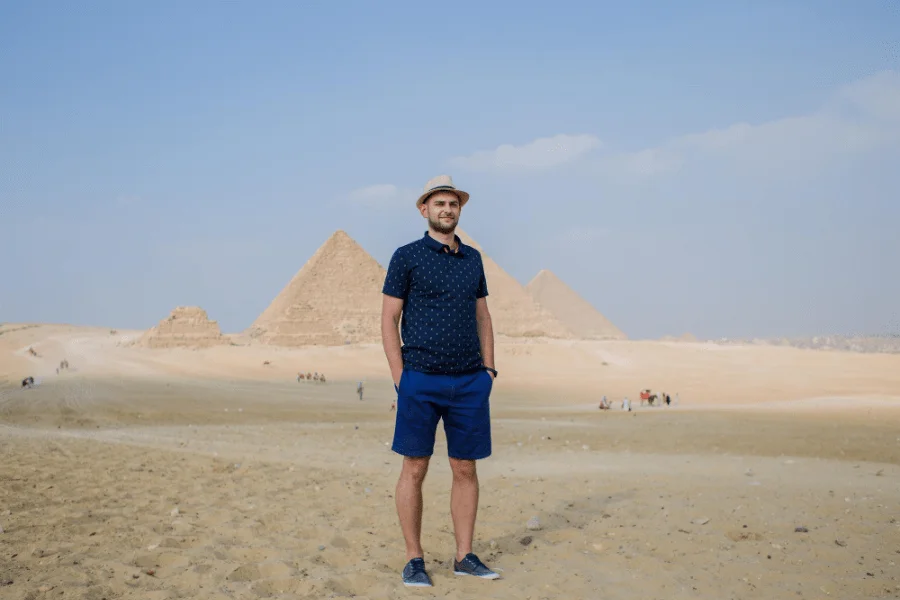
A visitor at the pyramids of Giza.
Cairo and nearby Giza are established sightseeing destinations. Busy streets, transport and crowded attractions call for ordinary precautions; their popularity is not proof that there is no risk.
- Luxor City and Aswan
Their temples and Nile-side sites are regular tourist stops. Check the route separately if your trip extends into remote desert or border areas.
Alexandria offers many Greek-Roman sites. Plan transport and keep belongings secure in busy areas, without assuming every tourist spot has the same security arrangements.
- Hurghada and Red Sea tourist areas
A resort stay, boat excursion and long road journey have different practical risks. Verify the activity and transfer arrangements as well as the destination. Sinai and desert excursions require their own route-specific advisory check.
Areas and routes with official travel restrictions
Do not dismiss government restrictions as personal opinions or treat all of Sinai or Nubia as one risk category.
- Sinai: the U.S. advises against Northern and Middle Sinai; the UK identifies North Sinai and specified parts of South Sinai separately. Resort exceptions do not make every approach road or excursion unrestricted.
- Border areas: national boundaries differ. The UK Libya-border buffer is 20 km with an El Salloum exception; Australia specifies 40 km and Canada 50 km. Check the advice that applies to you rather than choosing the smallest buffer.
- Western Desert: advice includes route-specific exceptions and conditions. Under UK advice, Siwa town and the Marsa Matruh–Siwa road are exceptions, but the Bahariya–Siwa road is not. Do not infer that access to one oasis clears every connecting road.
Read the FCDO regional-risk details alongside your own national advisory for the exact route, permits and guide requirements. Do not enter military or restricted areas.
Sometimes, even when in a safe place, you feel something is off, it’s okay to leave the place. Personal caution is useful, but it does not replace official restrictions.
Security checks and practical precautions
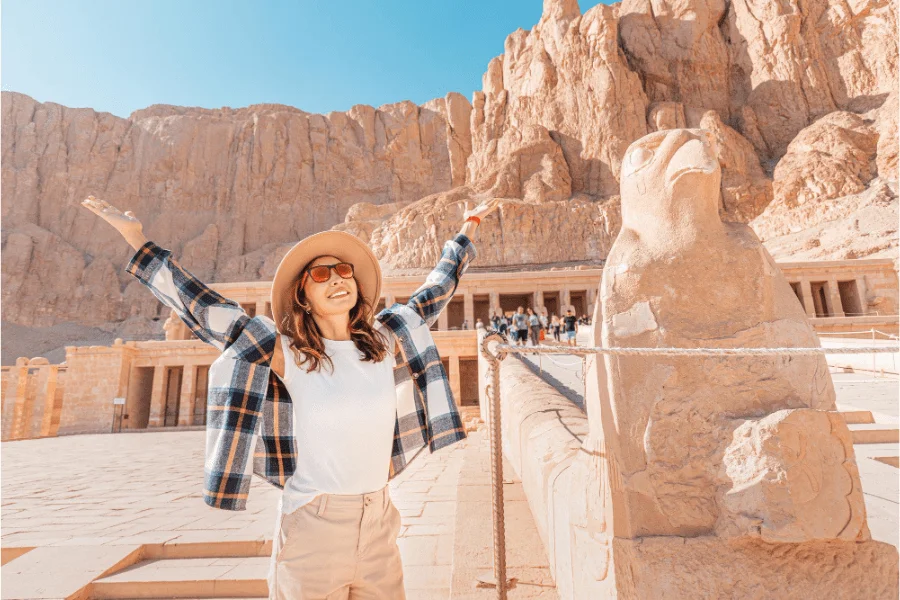
A visitor at the Temple of Hatshepsut in Luxor.
Security personnel and checks are present at many airports, resorts and major sites, but procedures vary. Expect possible baggage or identity checks, follow instructions and allow time. Security measures cannot eliminate every risk, and police availability or assistance cannot be guaranteed.
Tips
- Follow local instructions
- Keep emergency contacts with you anywhere
- Enroll in your embassy’s travel-alert service where available
Avoid demonstrations and do not photograph military or security installations. See the official safety and security guidance.
Scams and harassment precautions
In any tourist destination, scams can happen, and Egypt is no exception. Here are practical precautions:
- Unsolicited gifts: a “gift” may be followed by a demand for payment. Decline clearly if you do not want it.
- Guides: verify the guide and agree the service and price before accepting an offer.
- Help with the ATM: do not share your PIN or accept unsolicited help. Use an ATM in a bank or another secure, staffed location.
- Taxis: agree the fare or check the meter/app details before travelling, and confirm the driver and vehicle.
No booking channel guarantees safety. If an approach becomes persistent or uncomfortable, move to a staffed place and ask identifiable staff or police for help.
Transport and activity safety
Check the transfer provider and vehicle, use seatbelts where fitted and consider the risks of long journeys or night driving. For boating, diving or other activities, check the safety briefing, appropriate equipment, weather conditions and whether your insurance covers the activity. Do not take part if the arrangements are unclear or exceed your experience.
What to wear and local customs
Dressing modestly in Egypt is about respecting local culture and site rules. Clothing does not guarantee safety or make a traveler responsible for harassment.
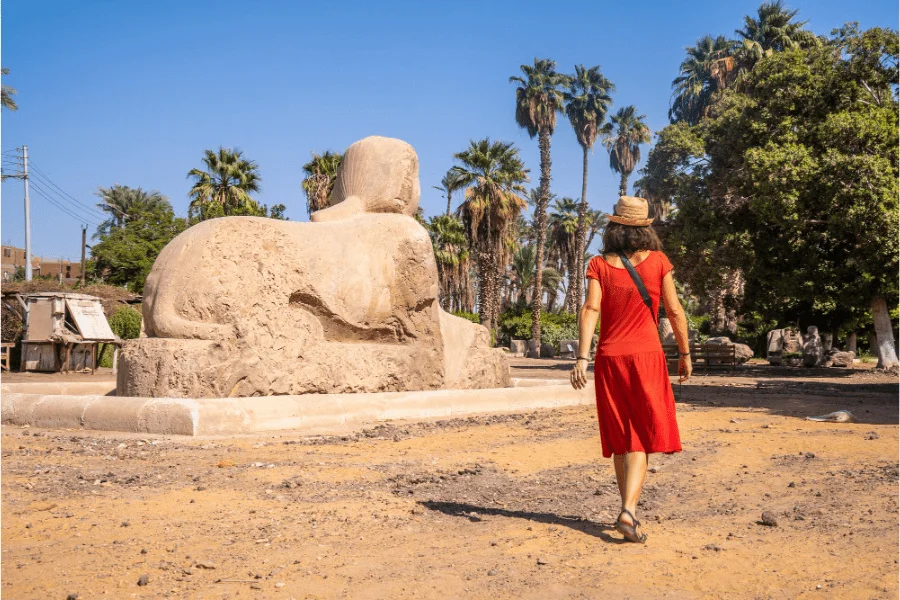
A visitor beside a sphinx statue at an archaeological site.
What to wear for Women
- Breathable fabrics
- Light scarves
- Long skirts/trousers
- Resorts may have different dress expectations from towns or religious sites; follow each venue’s rules.
- Avoid wearing clothes that are too revealing on religious sites
What to wear for men
- T-shirts
- Lightweight pants
- Avoid wearing shorts in religious buildings
Check the dress requirements of religious buildings and individual sites before visiting.
For places like the pyramids or the desert, make sure to bring sunglasses, closed-toe shoes, and hats.
Here’s a complete guide on what to wear in Egypt
Solo and female travelers
Solo and female visitors need practical planning rather than a blanket promise of safety. Official advice reports harassment and sexual assault, including incidents affecting tourists. Check accommodation and transfers, keep someone informed of your plans and seek help from identifiable staff or police if needed.
Safety Tips
- Avoid walking alone at night
- Dress modestly
- Choose well-reviewed accommodation and check transport arrangements
- Use a verified guide when needed
- Check reviews on companies before booking
- Always have a charged phone
- Always have a copy of your passport
- Learning simple phrases in the Egyptian language will help you go a long way
- Cairo’s metro has women-only cars, which may help reduce harassment; they are not a guarantee of safety
Health and travel insurance
Travel insurance is strongly recommended, but cover and payouts depend on the policy. Check exclusions for government-advised-against areas, planned activities, cancellation, theft and medical evacuation. Private treatment and evacuation can be expensive; do not assume every loss is covered.
Seek professional travel-health advice before departure and check medication rules, prescriptions and documentation. Carry drinking water and plan for heat exposure. The official health guidance includes medical and insurance preparation.
Emergency contacts and preparation
Here are some emergency numbers you need to know
- 126, tourist police
- 122, general police
- 123, ambulance
- 180, fire department
Save these numbers offline with your embassy, insurer, hotel and operator contacts. If you need help, seek identifiable police, hotel staff or medical personnel. Response and medical facilities vary, especially in remote areas.
Advice for American travelers
American travelers should follow the current U.S. advisory linked above, including its regional restrictions and consular limitations, and consider enrolling in STEP for alerts. Travelers with other passports should consult their own government.
For nationality-specific planning, see precautionary measures for Americans.
Egypt travel safety FAQ
Is Hurghada, Egypt, safe to visit?
Hurghada continues to receive tourists, but a resort stay does not remove all risk. Check current advice and the arrangements for your transfers and water activities; there is no basis for promising that every person entering the city is screened.
Is it safe to travel to Egypt during regional conflict?
Conflict elsewhere can affect flights, borders and travel conditions in Egypt. Check current official advice and your airline close to departure; do not assume that being outside the conflict area prevents disruption.
Is Alexandria, Egypt safe?
Alexandria is a tourist destination, but safety is not guaranteed at every site. Follow current advice, plan transport and take precautions against theft and harassment.
Are Luxor and Aswan safe in Egypt?
Both are established tourist cities. Use normal practical precautions and check official advice; a city visit should not be treated as clearance for remote desert or border routes.
Official sources and last checked
Official guidance checked September 15, 2026: U.S. State Department (advisory issued July 15, 2025), UK FCDO (updated August 4, 2026), Australian Smartraveller (updated September 14, 2026), and Government of Canada (updated September 9, 2026). The source links above lead to their live advice, which may change after this article is updated.
For help planning an itinerary, you can request a Tailor Made Egypt trip. Planning assistance does not replace official travel advice or your own insurance checks.