Who Was the First Pharaoh of Egypt?
In the ancient records of Egypt, the figure of Menes, traditionally cited as the founder of the centralized Egyptian state, remains largely elusive to archaeologists. Due to the scarcity of this name in the early archaeological record, experts debate his identity, strongly suggesting that “Menes” most likely refers to either King Narmer or King Aha, two powerful monarchs from Egypt’s foundational First Dynasty who are directly credited with the pivotal unification of the country.
The First Pharaoh of Egypt: Uniting Upper and Lower Egypt
King Narmer began his reign over the southern kingdom, known as Upper Egypt. However, his ultimate vision extended far beyond regional control. Determined to forge a singular, powerful nation under his dynasty, Narmer launched decisive military campaigns specifically designed to conquer and fully subjugate the northern region of Lower Egypt. This strategic, forceful conquest is what ultimately established him as the true founder of the centralized Egyptian state and the first pharaoh.

The First Pharaoh of Egypt, Narmer
The Narmer Palette: Ancient Tale in Stone
The Narmer Palette stands as the single most compelling piece of archaeological evidence confirming King Narmer‘s monumental achievement: the unification of Egypt. This magnificent, shield-shaped ceremonial artifact, which was discovered at the ancient religious site of Hierakonpolis, graphically portrays the pharaoh in the decisive act of conquering his enemies.
Its intricate carvings depict the historic merger between Upper and Lower Egypt, the two distinct regions of the Nile Valley. A key feature is the depiction of Narmer wearing both the White Crown of the South and the Red Crown of the North. This display of the dual crown signifies his successful dominion and undisputed royal control over the newly unified territory, setting the visual standard for pharaonic authority that endured for the next three millennia.

NARMER (The first Egyptian pharaoh).
Legacy of Narmer, the First Pharaoh of Egypt
Narmer‘s successful unification of the Two Lands marks the commencement of Egypt’s Early Dynastic Period (c. 3100–2686 BC) and firmly laid the critical groundwork for millennia of ancient Egyptian culture, governance, and spirituality.
This era saw the establishment of the pharaonic system, where the pharaoh was fundamentally understood as both a divine leader and the ultimate political ruler, a concept central to Egyptian society thereafter. It was also during this period that many fundamental beliefs about life, death, and the cosmos originated and evolved.
Administrative and Cultural Achievements
Narmer’s powerful legacy as a transformative leader was cemented not only by conquest but by the crucial administrative and cultural systems he instituted. Key achievements include:
-
The establishment of Memphis City (or Inebu-hedj) as the first centralized capital of the newly unified state.
-
The creation of formalized administrative structures essential for governing a cohesive nation.
-
His influential patronage of the earliest forms of Egyptian art and architecture, which defined the aesthetic of the Dynastic Age.
Conclusion: Narmer’s Visionary Leadership
The tale of The First Pharaoh of Egypt is more than a record of conquest; it is an inspiring testament to visionary leadership and humanity’s eternal drive for unity. While academic debate continues regarding the precise timeline and events that led to Egypt’s unification, Narmer stands as the iconic, undisputed figure embodying ancient Egypt’s indomitable spirit and the profound, enduring legacy of its early rulers.

Narmer Palette An Ancient Tale in Stone
Facts on The First Pharaoh of Egypt,Narmer
One of the most crucial primary sources for understanding the earliest phases of the Egyptian monarchy is the Palermo Stone. This ancient black granite slab is inscribed with records detailing the names of Egyptian kings up to the 5th Dynasty, alongside relevant historical and administrative events, including annual war accounts, construction projects, flood height records, and festival schedules. Unfortunately, only fragments of the stone remain today, housed in various international locations including Palermo, Italy, Cairo, Egypt, and London, Britain.
The section of the Palermo Stone that originally inscribed the name of the very first king of the 1st Dynasty—and that of his successor—has since been lost, contributing to the historical uncertainty. While the consensus among most Egyptologists is that Narmer was indeed the first pharaoh, closely followed by Aha, definitive proof remains elusive. This lack of complete evidence fuels ongoing discussion among scholars regarding whether Narmer permanently founded and secured the dynasty alone, though it remains the most probable scenario based on current evidence.

A drawing of The Narmer Palett.
The Chisel-Fish Symbolism of Pharaoh Narmer
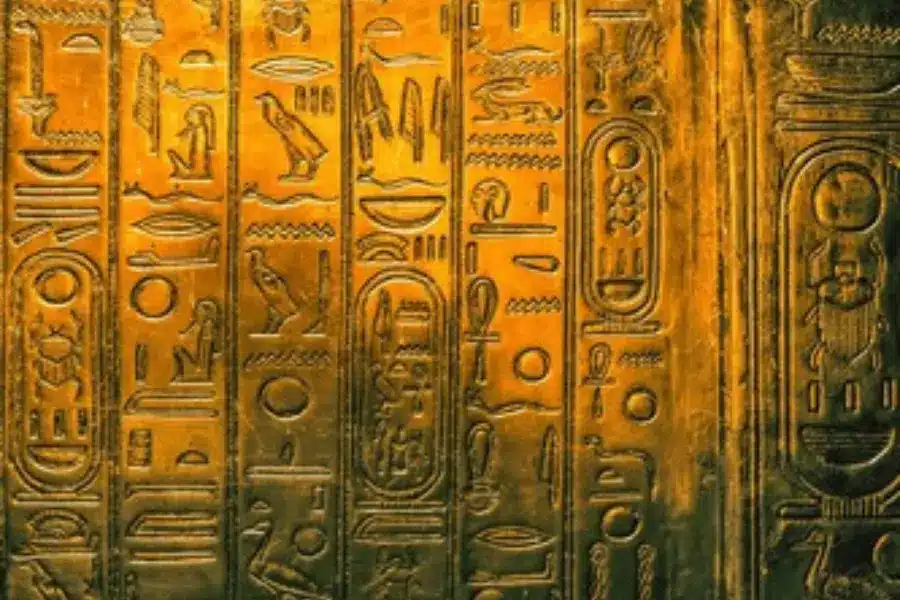
Ancient Egyptian utilized a sophisticated ideographic writing system, where pictures (hieroglyphs) could function both as representations of ideas and as phonetic sounds (phonemes). The name of Narmer, The First Pharaoh of Egypt, is a prime example, constructed using the rebus principle from two distinct ideograms:
-
Nꜥr (Nar): Represented by a catfish.
-
Mr (Mer): Represented by a chisel.
These two symbols, frequently engraved onto the famous Narmer Palette and other royal artifacts, phonetically combine to identify the king. In ancient Egyptian belief, the name and the person were intrinsically linked, reinforcing the pharaoh’s identity. Thus, other depictions—such as cylindrical ivory seals discovered at Abydos—visually depict Narmer as a powerful catfish actively fighting the enemies of Egypt, often with the accompanying chisel hieroglyph nearby to confirm his royal authority and name.

Chisel-Fish.
The Mystery of Narmer’s Unfound Tomb in Saqqara
Despite his monumental status as the unifier of Egypt, archaeologists have never conclusively located the body or tomb of King Narmer. During this era, known as the Early Dynastic Period (before the Third Dynasty), ancient Egyptian pharaohs used mastabas for burial. These flat-topped, rectangular mudbrick structures (named after the Arabic word for ‘bench’) predated the pyramids. It has long been speculated that Narmer might be buried among the vast mastaba fields of Saqqara. However, since none of these extant tombs definitively bear his name, this compelling theory remains historically unverified.
Menes vs. Narmer: The Identity Debate
The question of whether Menes and Narmer are two distinct individuals or two names for the same person is one of the most enduring debates among Egyptologists. There is no conclusive proof they are synonymous, and scholarly opinion remains divided.
-
The Case for Synonymity (The Greek Record): The Greek historian Herodotus, visiting Egypt around 445 BCE, recorded a list of kings, prominently naming Menes as the first ruler. Given that this account was written approximately 2,500 years after Narmer (or Menes) lived, some scholars logically assumed they were the same person.
-
The Challenge (Multiple Names): Complicating the issue is the fact that ancient Egyptian pharaohs adopted multiple names throughout their lifetimes, often changing their name to reflect different periods or aspects of their reign. This practice, combined with the late dating and potential confusion in Herodotus’ Histories, means that the claim of Narmer being Menes remains uncertain and hotly debated.

The Narmer Palett: An Ancient Tale in Stone
Pharaoh Menes’ Death – the Hippopotamus Legend
Hippopotamuses were, and remain, among the most dangerous and formidable mammals in the world. Ancient Egyptian kings often depicted themselves battling these beasts to publicly demonstrate their might, courage, and worthiness to rule. While later pharaohs may have participated in ritualistic hunts, early rulers likely engaged in real hunts to justify their authority and the collection of taxes from their subjects.
The Hellenistic-era accounts by the Greek priest Manetho concerning the end of Menes’ reign conclude with the striking and memorable line: “He was carried off by a hippopotamus and perished.” This tragic, symbolic end—that a hippopotamus killed the First Egyptian Pharaoh—is only known to us through later Greek records written for posterity, underscoring the ancient perception that even the divine ruler faced primal danger.
Dress and Symbols of Ancient Egyptian Pharaohs
Egyptian Pharaohs are instantly recognizable by their distinguishing royal attributes, many of which were established by Narmer.
-
The Crowns: While the Red Crown of Lower Egypt and the White Crown of Upper Egypt were worn by Predynastic kings, Narmer was the first ruler explicitly depicted wearing both crowns simultaneously, symbolizing the successful, divine union of the Two Lands.
-
The Uraeus: A later but famous addition was the golden cobra-tiara, known as the Uraeus, worn as a sign of divine protection and royal authority.
-
Other Regalia: Narmer was also the first ruler ever depicted wearing the signature royal beard that every subsequent Egyptian pharaoh sported, most famously Tutankhamun. Other key attributes included the shendyt kilt/loincloth and a ceremonial fake bull’s tail (later a dog’s tail), representing the strength required to rule the unified riverine countries.
-
The Sandals: Even the pharaoh’s follower, whose primary task was carrying his sandals, held symbolic importance. These special shoes symbolized the union between the celestial (goddess world) and the earthly (human world). Tutankhamun further elaborated on this tradition by having images of his enemies inscribed on his sandals so that with every step, the enemies of Egypt could be symbolically crushed—a trend set by Narmer’s special, magical sandals.
Narmer, the Military Genius Who United Egypt
The records of both Herodotus and Manetho celebrate Narmer as a masterful military chieftain and the undisputed First Pharaoh of Egypt. Following centuries of conflict between the northern and southern kingdoms, Narmer succeeded in finally uniting Upper and Lower Egypt under his singular rule across the entire Nile Valley. Compelling archaeological evidence—including his famous palette, the ceremonial macehead, royal seals, and ivory tablets—vividly illustrate him ruthlessly defeating and executing opponents, underscoring the military force required for this historic unification.

Narmer, the Military Genius Who United Egypt
Narmer, the Founder of Major Egyptian Cities
According to the historical tradition recorded by Manetho, Narmer was also one of Egypt’s greatest civic founding figures. He established several settlements that grew into key population centers, most notably Memphis. This city served as the inaugural capital and the first official seat of government for the newly unified kingdom.
Furthermore, it is highly likely that Narmer formally established Hierakonpolis (or Nekhen), the historical site already famous for the ancient, state-wide religious cult of the falcon god Horus.
The Ritual of City Founding
Egyptian Pharaohs derived immense prestige from founding cities, often performing a ritual where they proudly held aloft the symbolic plow. Ritually, their presence was required to mark out the settlement boundaries by drawing a rut in the soil near the Nile River. Following this sacred act, builders would set the foundations for official structures like royal palaces and temples. Crucially, a large granary was always constructed near the city to hoard precious grain, ensuring a strategic reserve that could be distributed to the populace during times of drought or natural emergency, a vital act of governance.
The Serpopards and Symbolism on Narmer’s Palette
The reverse side of the famous Narmer Palette features a highly intriguing and complex symbolic scene involving two long-necked quadrupeds. These hybrid creatures, which Egyptologists have named Serpopards (a combination of a serpent and a leopard), are visually striking. In this depiction of Narmer’s deeds, two royal officials are shown pulling ropes connected to the necks of the Serpopards, causing the creatures’ necks to intertwine. This specific interlacing motif has long been recognized as a powerful visual allegory for the political unification between Lower and Upper Egypt—the most celebrated and enduring feat of the First Pharaoh of Egypt.

Narmer palette.
Narmer’s Palette at Temple of Horus
The Narmer Palette was among a collection of crucial artifacts discovered at Nekhen (Hierakonpolis), the ancient center of the Horus cult. These finds were located in an area now referred to as the Main Deposit at the Temple of Horus. The palette was unearthed by prominent early 20th-century archaeologists James Quibell and Frederick Green, who published their discovery in 1900. This find confirmed the central importance of Narmer to the site.
Since the original location of the palette is unknown (it was found buried in a ritual deposit), we cannot precisely date its removal or destruction by later temple builders. However, Egypt often followed a ritualistic tradition of burying votive or ritual objects—especially those belonging to highly esteemed past pharaohs—into temple foundations for protection and preservation. In this case, Narmer was clearly considered by the Temple of Horus‘s founders to be a monumental figure whose powerful legacy would protect both the structure itself and all its visitors for centuries to come. His action founded one of the world’s earliest and longest-lived territorial states, a pivotal event in world history.