Unleash the adventure with Egypt Tours Group! Explore amazing tour packages, cruise the Nile River, and embark on captivating shore excursions. Your unforgettable experience starts here!
Queen Hatshepsut: The Visionary Pharaoh Who Defied Tradition
In the extensive records of ancient Egypt, Queen Hatshepsut stands as a magnificent symbol of power, leadership, and innovation. By shattering rigid societal norms to become the first female pharaoh to rule Egypt, she left an indelible and inspiring mark on the history of the ancient world.
This comprehensive article delves into the captivating story of Queen Hatshepsut, exploring her royal background, major accomplishments, monumental architectural legacy, and the intriguing mystery surrounding her ultimate demise.
Background and Ascension
Hatshepsut was a remarkable figure, born circa 1508 BCE.
She became the fifth pharaoh of the powerful Eighteenth Dynasty during the New Kingdom period.
Defying deep-seated convention, she fully assumed the male title and role of Pharaoh.
She initially ruled as a powerful co-regent with her young stepson, Thutmose III, before establishing herself as the sole ruler of Egypt.
Engraved Portrait of Queen Hatshepsut
When was Queen Hatshepsut born?
Queen Hatshepsut was born around 1508 BCE. This pivotal event occurred during the influential reign of her father, Pharaoh Thutmose I. Her mother was Queen Ahmose, making Hatshepsut a direct descendant of the powerful royal line.
Queen Hatshepsut’s Background and Family
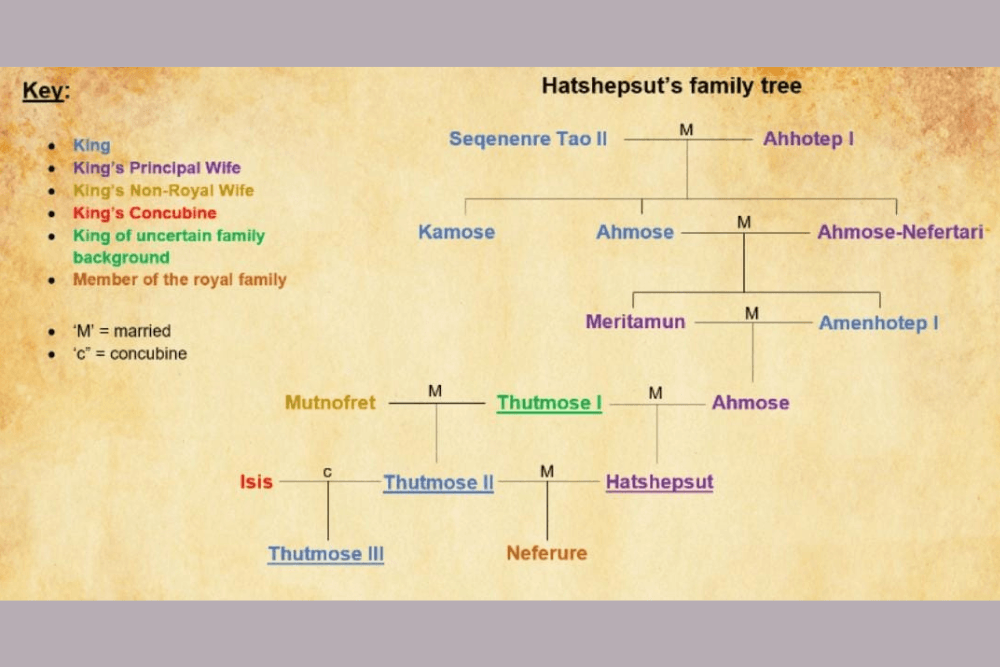
Hatshepsut’s family roots were firmly established within the esteemed Eighteenth Dynasty, a golden age of Egyptian power. Her parents, Pharaoh Thutmose I and Queen Ahmose, were highly prominent figures.
Exploring Queen Hatshepsut’s Ancestry
How did Queen Hatshepsut ascend the Throne?
Following the death of her influential father, Pharaoh Thutmose I, Hatshepsut harbored a powerful ambition to rule. She held a strong claim because she was the daughter of the Principal Queen and therefore possessed the purest royal blood. However, Egyptian tradition strictly mandated that the pharaoh must be a man.
To navigate this limitation, Hatshepsut initially married her half-brother, Thutmose II. This marriage was crucial to legitimizing his claim to the throne, as Thutmose II was born to a secondary wife named Mutnefer, rather than the Principal Queen.
Thutmose II, unfortunately, suffered from weak health and reigned for only about eight years. During their marriage, he and Hatshepsut had two daughters, Neferure and Merit-Ra-Hatshepsut. Crucially, Thutmose II also fathered a son, Thutmose III, with another secondary wife named Isis.
When Thutmose II died, his young son, Thutmose III, became the legal heir. To solidify his claim, Thutmose III married his half-sister, Neferure (Hatshepsut’s daughter). Since the new king was still a child, he was placed under the regency of his aunt, stepmother, and mother-in-law: Queen Hatshepsut.
Hatshepsut, a consummate strategist, seized this unprecedented opportunity to dominate the throne:
Co-Regency: She shared the throne with the young Thutmose III for approximately three years, carefully establishing her authority.
Sole Rule: She then decisively stepped out of his shadow, fully declaring herself the sole ruler and Pharaoh of Egypt, adopting all the male titles and regalia.
This daring political move secured her position as one of Egypt’s most successful female pharaohs.
Queen Hatshepsut with Thutmose III
Divine Birth of Queen Hatshepsut
To unequivocally legitimize her unprecedented claim to the pharaoh’s throne—a role traditionally restricted to men—Queen Hatshepsut put forth a powerful theological assertion: she was the divine daughter of Amun, the supreme and most dominant god of Egypt.
To support this claim, she commissioned a sophisticated narrative, meticulously carved onto the walls of her temple. This story asserted that the God Amun himself had temporarily assumed the physical form of her father, Thutmose I. In this guise, Amun visited her mother, Queen Ahmose, and prophesied the birth of a daughter named Hatshepsut, foretelling that she would eventually become the true and rightful ruler (Pharaoh) of Egypt. This divine narrative served as the ultimate political tool to justify her ascension and cement her authority over the land.
Illustrating the Divine Birth of Queen Hatshepsut
What were Hatshepsut’s greatest accomplishments?
The reign of Queen Hatshepsut was marked by remarkable peace and a strategic focus on economic and architectural prosperity, securing her place among Egypt’s greatest pharaohs. Her most significant achievements include:
Trade and Commerce: The Voyage to Punt Hatshepsut famously initiated a bold and prosperous trade expedition to the distant Land of Punt (widely believed to be modern-day Somalia). This successful venture resulted in the acquisition of highly prized exotic goods, including frankincense, myrrh, gold, ebony, and ivory. The influx of these resources dramatically enriched Egypt’s economy, demonstrating her visionary commercial leadership.
Monumental Building Projects: Deir el-Bahari As a prolific builder, Queen Hatshepsut commissioned numerous ambitious architectural projects. Her absolute masterpiece is her magnificent mortuary temple, Djeser-Djeseru (Holy of Holies), located at Deir el-Bahari on the West Bank of Thebes (Luxor). This grand, tiered structure, nestled against the sheer cliffs, showcased her innovative architectural style and stands as the physical embodiment of her powerful legacy.
Art and Culture: A Creative Flourish Hatshepsut’s rule witnessed a renaissance in art and culture. She actively sponsored and promoted artistic expression, leading to the creation of elaborate statues, intricate reliefs, and beautifully colored paintings that are considered stylistic masterpieces of the Eighteenth Dynasty.
Celebrating the Accomplishments of Queen Hatshepsut
What is the significance of Queen Hatshepsut’s temple?
Queen Hatshepsut’s temple, officially named Djeser-Djeseru (Holy of Holies) and famously known as Deir el-Bahari, is globally renowned as an unparalleled architectural masterpiece.
Its significance stems from its innovative design and its central function:
Architectural Features: The structure boasts a distinct series of colonnaded terraces, majestic statues, and remarkably vibrant reliefs that document her glorious reign and the journey to Punt.
Purpose: The temple served simultaneously as a monument to her reign, a major center for important religious ceremonies, and a powerful place of worship dedicated to the major Egyptian gods, especially Amun.
What sets Queen Hatshepsut apart from other pharaohs?
Hatshepsut’s unique place in history is cemented by her audacious decision to completely break the mold of gender expectations in ancient Egypt.
Her distinction from all other pharaohs lies in her calculated presentation of herself as a divine, male ruler:
Male Regalia: She boldly chose to wear the traditional regalia of a male pharaoh, including the ceremonial false beard and the kilt.
Artistic Depiction: In her official portrayals, she was consistently depicted with a male body and even commissioned powerful sphinx statues in her own likeness, discarding traditional female representations of power.
Divine Justification: To silence critics, she leveraged religion, asserting that the deity Amun was her direct father and insisting that her rule was established by divine will. Her bold declaration, “I acted under his command; he was my guiding force,” demonstrates how she used religious authority to cement her unprecedented claim to the throne.
Was there a Secret love relation between Queen Hatshepsut and Senmut?
The relationship between Queen Hatshepsut and her chief official, Senmut, remains a captivating mystery and a popular topic of historical speculation. Senmut was an incredibly smart and ambitious architect who began his career under Thutmose II. His roles were significant:
Royal Tutor: He was the private tutor to Princess Neferure, Hatshepsut’s daughter.
Steward of Amun: He held the powerful title of Steward of the Estates of Amun.
Following the death of Thutmose II, Senmut earned Hatshepsut’s unwavering trust, becoming one of the most essential figures who supported her domination of the throne.
The Basis for the Scandal
Senmut’s extraordinary talent led him to erect Hatshepsut’s masterpiece, the marvelous mortuary temple at Deir el-Bahari, as well as her famed obelisks at Karnak Temple and other ambitious constructions.
The speculation regarding a secret love relationship arose primarily from two factors:
Unique Tomb Placement: One of Senmut’s two tombs is uniquely located directly underneath Queen Hatshepsut’s mortuary temple at Deir el-Bahari.
Paternity Theories: Some scholars also theorized that Senmut might be the physical father of Princess Neferure.
However, these romantic theories lack definitive proof. Official documentation, such as the statue depicting Senmut together with Neferure, merely describes him officially as “the tutor of Neferure,” offering no validation of a clandestine affair.
Uncovering the Secret Love of Queen Hatshepsut and Senmut
When and how did The Egyptian Queen Hatshepsut die?
Queen Hatshepsut’s death is generally placed around 1458 BCE, marking the conclusion of her highly prosperous reign. The precise cause of her death remains one of the great debates among historians and Egyptologists.
Several theories propose different scenarios:
Natural Causes: Some evidence suggests she suffered from a long-term illness or complications related to her later life, possibly obesity or diabetes.
Assassination/Coup: Other theories speculate that her stepson and co-regent, Thutmose III, may have hastened her demise, perhaps staging a coup to seize full, unchallenged power.
Intriguingly, the motivation for assassination is complicated by the fact that an alternative theory suggests Thutmose III did not immediately demolish her monuments, but may have instead contributed to the construction and completion of some of her architectural projects after her death. The later systematic erasure of her image remains a separate, enduring mystery.
Queen Hatshepsut’s Death
What happened to Hatshepsut’s body after her death?
In accordance with ancient Egyptian funerary traditions,Hatshepsut’s body underwent the intricate process of mummification after her death. For centuries, however, her final resting place remained elusive. A major breakthrough occurred in 1903 when her mummy was finally discovered in the Valley of the Kings, where it had been secretly hidden by priests to protect it from grave robbers and intentional damage.
Mummified Body of Queen Hatshepsut
Pictures of Queen Hatshepsut:
Numerous statues, vibrant reliefs, and other artistic depictions of Queen Hatshepsut have been found throughout the ancient world. These visual representations were a form of calculated political propaganda, portraying her with the full, traditional symbols of pharaonic power:
The double crown of Upper and Lower Egypt.
The ceremonial false beard.
The full regal attire of a male king.
These artworks deliberately showcase her as a powerful, authoritative, and divinely sanctioned ruler, successfully bridging the gender gap to project absolute authority.
Elegant Queen Hatshepsut Pictures
What is Queen Hatshepsut’s legacy?
Queen Hatshepsut’s reign left a profound and indelible mark on ancient Egypt. Her accomplishments propelled the kingdom to a height of prosperity and cultural achievement:
Economic Strength: Pioneering expeditions, such as the famous trade mission to Punt.
Architecture: Her monumental mortuary temple, Deir el-Bahari, remains one of ancient Egypt’s most iconic architectural wonders, standing as the central exemplar of her enduring legacy.
Artistic Patronage: Her active support of the arts led to a period of exquisite artistic development.
How was Hatshepsut remembered after her death?
Following her death, Queen Hatshepsut’s legacy entered a complicated phase of historical revisionism. Many of her monuments and statues were systematically defaced or destroyed—an act carried out potentially by her successors (Thutmose III or later pharaohs) in an effort to erase her memory and prevent future women from claiming the pharaoh’s title.
However, modern Egyptology has successfully rediscovered and recognized her immense accomplishments, definitively restoring her rightful place in history as one of Egypt’s most influential and successful pharaohs.
Queen Hatshepsut’s Expansion of Trade and Diplomacy:
Queen Hatshepsut is celebrated not just for her authority, but for her significant efforts in successfully expanding Egypt’s trade and diplomatic relations. Her most important economic achievement was the monumental commercial expedition to the Land of Punt (located in East Africa, possibly modern-day Somalia) during the ninth year of her reign.
This highly prosperous expedition resulted in the acquisition of highly sought-after products that greatly enriched the Egyptian economy:
Valuable Goods: Large quantities of gold, aromatic resins, ebony, black wood, and ivory.
Exotic Animals: Various wild animals, including living specimens like monkeys and baboons.
The Route of the Expedition
The voyage to Punt was a major logistical achievement. The route involved a three-part journey:
Nile River: The expedition initially sailed south along the Nile River from the capital, Thebes, to the city of Coptos.
Eastern Desert: From Coptos, the goods and personnel traveled overland through the Eastern Desert to a coastal port.
Red Sea: They then sailed from this port, known today as Al-Kusir, across the Red Sea until they reached Punt.
The fact that the expedition traversed the Red Sea is confirmed by detailed temple reliefs that depict two specific species of saltwater fish—proof that the fleet navigated waters with a high salinity level, a characteristic unique to the Red Sea, not the Mediterranean.
Trade and Diplomacy: Queen Hatshepsut’s Legacy
Queen Hatshepsut’s Architectural Marvels
The Hatshepsut Temple, officially known as Deir el-Bahari, stands as a magnificent and globally recognized ancient Egyptian temple. Built during the 15th century BCE, it is a profound testament to the architectural and artistic excellence of the New Kingdom period.
The temple is strategically located on the west bank of the Nile River in Luxor City. It was constructed to honor the unparalleled legacy of Hatshepsut, one of ancient Egypt’s most notable female pharaohs, and served as a major center for the worship of the Egypt gods.
Design and Dedication
Carved directly into the formidable cliffs of the Theban Mountains, the temple’s innovative design consists of three terraced levels connected by sweeping ramps and stately colonnades.
Design Characteristics: The temple’s aesthetic is characterized by impressive colonnaded terraces, majestic statues, and incredibly detailed reliefs.
Lower Level: Features a large courtyard with rows of columns and various figures of the queen.
Middle Level: Showcases a colonnaded entrance leading to the central sanctuary dedicated to the supreme god Amun.
Upper Level: Houses sacred chapels and shrines dedicated to deities, notably the goddess Hathor, the goddess of love and beauty.
Historical Inscriptions and Legacy
The temple walls are adorned with intricate reliefs that serve as invaluable historical documents, vividly depicting significant events from Hatshepsut’s life, including her divine birth, successful military campaigns, and religious rituals. These detailed carvings provide essential insights into the queen’s prosperous reign and accomplishments.
Beyond her grand mortuary temple, Queen Hatshepsut restored and constructed several other significant religious structures throughout Egypt, enhancing existing temples and shrines to emphasize the importance of religious rituals and honoring the Egypt gods.
Today, the Hatshepsut Temple is celebrated as a UNESCO World Heritage Site and is unquestionably one of the best sights in Luxor, drawing visitors worldwide who marvel at its splendor and historical significance.
Hatshepsut Temple, also known as Deir el-Bahari, is a magnificent ancient Egyptian temple located on the west bank of the Nile River in Luxor City. Built during the 15th century BCE, the temple is a testament to the architectural and artistic excellence of the New Kingdom period.
The Temple of Queen Hatshepsut was constructed to honor the legacy of Hatshepsut, one of ancient Egypt’s most notable female pharaohs. The temple is carved into the cliffs of the Theban Mountains and consists of three terraced levels connected by ramps and colonnades. The temple’s impressive colonnaded terraces, statues, and reliefs characterize the temple’s design. The lower level features a courtyard with rows of columns and various figures of the queen. The middle level showcases a colonnaded entrance to the central sanctuary dedicated to the god Amun. The upper level houses chapels and shrines dedicated to goddess Hathor, the goddess of love and beauty.
The temple walls are adorned with intricate reliefs depicting significant events from Hatshepsut’s life, including her divine birth, military campaigns, and religious rituals. These reliefs provide valuable insights into the queen’s reign and accomplishments. Today, the Temple of Hatshepsut stands as a UNESCO World Heritage Site and one of the best sights in Luxor, attracting visitors from around the world who marvel at its splendor and the historical significance it represents.
In addition to her grand temple, Queen Hatshepsut restored and constructed several other significant religious structures throughout Egypt. She restored and enhanced existing temples and shrines, emphasizing the importance of religious rituals and honoring Egypt gods. Hatshepsut’s architectural endeavors showcased her devotion to the spiritual practices of ancient Egypt and left a lasting impact on the country’s architectural landscape.
Political Stability and Economic Prosperity
Hatshepsut’s reign was characterized by political stability and economic prosperity. Her strong leadership and efficient governance enabled Egypt to thrive economically, increasing trade, agricultural productivity, and wealth accumulation. The kingdom experienced a period of relative peace and prosperity during her reign, fostering cultural and artistic development.
Conclusions:
Queen Hatshepsut’s reign was pivotal in ancient Egyptian history, marked by her bold rise to power, visionary leadership, and remarkable achievements. Despite attempts to erase her legacy, her memory lives on through the enduring structures she commissioned and the artworks that depict her majestic presence. As a groundbreaking female pharaoh, Queen Hatshepsut defied societal norms and left an inspiring legacy that continues to captivate and intrigue us today.