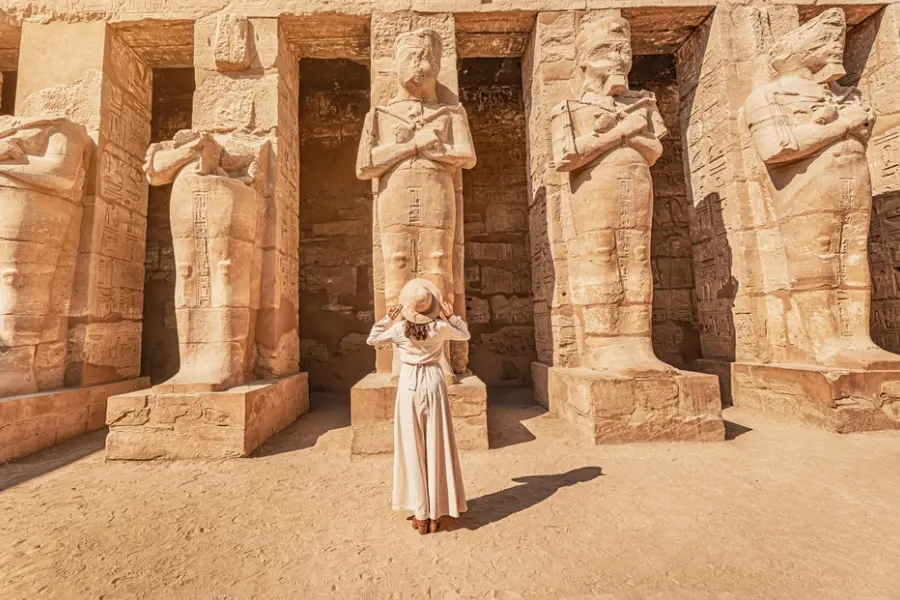
Unleash the adventure with Egypt Tours Group! Explore amazing tour packages, cruise the Nile River, and embark on captivating shore excursions. Your unforgettable experience starts here!
Step back in time and journey to the heart of ancient Egypt, where history and grandeur converge at the Temple of Edfu. Nestled majestically on the west bank of the Nile River, this magnificent sanctuary is a perfectly preserved testament to the enduring legacy of the pharaohs and their divine architects. Join us on a virtual expedition to unravel the secrets of Edfu, where every stone whispers tales of profound religious devotion and unparalleled architectural marvels.
The Temple of Edfu is a monumental sanctuary dedicated to the Great God Horus, the falcon-headed deity. It holds the distinction of being the best-preserved temple in all of Egypt and is considered the most significant religious structure after the colossal temple of Karnak.
This magnificent Ptolemaic structure represents the classical design of Egyptian temples, beginning with an imposing pylon. Its immense scale rivals its historical importance, measuring approximately 137 meters long by 79 meters wide and 36 meters high. Edfu’s exceptional state of preservation—with its roof, walls, and inner chambers nearly intact—offers the modern visitor an unmatched opportunity to experience the atmosphere of an ancient place of worship exactly as it once looked.
Experience the grandeur of Edfu Temple with Egypt Tours Group
Who was God Horus? & Dedication of the Temple
Horus was son of Isis and Osiris. He was a representation of justice, as he took revenge on God Set, who killed his father, God Osiris, so he was well-known as “His Father’s Guardian”.
God Horus, characterized by a human body with a falcon’s head, was one of the most important Gods in ancient Egypt, not only for of his mythology or his lineage but also because each Egyptian king, when he assumed authority, was conceived as the carnal image of Horus on earth. As a result not, it is surprising that the Temple of Horus at Edfu, one of the largest in Egypt, was founded in his honor.
Witness the divine presence of God Horus at Edfu Temple with Egypt Tours Group
Edfu Temple Location
The temple of Edfu, located in the city of the same name (Edfu), is situated on the west bank of the Nile, 115 km south of Luxor City and 105 km north of Aswan City.
Map indicating the strategic location of Edfu Temple.
Who constructed the Temple of Edfu?
Ptolemy III – Eurergetes I started the construction of the temple mostly in 237 BC, but the temple wasn’t completed until about 57 BC.
Learn about the visionary behind the Temple of Edfu’s construction with Egypt Tours Group.
Who discovered Edfu Temple?
The Temple was buried in the sand, secured in the heart of the desert for several centuries until it was excavated in the year 1860 by the French Egyptologist Auguste Mariette.
Archaeologists unveiling the temple’s hidden history.
What makes Edfu’s Temple of Horus significant?
The Temple of Edfu is very significant because it reflects the mixture of the Pharaonic culture of ancient Egypt and the Ptolemaic culture. Inscriptions on its walls provided valuable knowledge about religion, mythology and language during the Hellenistic period in Egypt.
Unravel the historical importance of Edfu’s Temple of Horus with Egypt Tours Group.
History of the Temple of Edfu
The construction of the Temple of Edfu began in 237 BC under Ptolemy III Euergetes and was finally completed around 57 BC, meaning this monumental project spanned approximately 180 years. This temple is dedicated entirely to Horus, the revered falcon-headed Egyptian god, and was deliberately erected atop an earlier, more ancient temple site.
The Temple of Edfu is a key testament to the architectural output of the Ptolemaic Dynasty—the Greek rulers who governed Egypt after Alexander the Great’s conquest in 331 BC until 30 BC. Like other Ptolemaic temple complexes, such as Dendera, Edfu uniquely showcases a harmonious blend of traditional Egyptian and Greek styles.
The temple’s preservation story is remarkable: with the ascent of Christianity and the prohibition of paganism in 391 AD, the site was deliberately left alone. Crucially, it became covered and protected by sand for several centuries, allowing its structure and reliefs to survive the elements and time nearly intact. It was sensationally rediscovered and excavated once again in 1860 AD by the great French Egyptologist Auguste Mariette, restoring Edfu to its rightful place as a central monument of ancient history.
Embark on a historical journey through the Temple of Edfu with Egypt Tours Group.
Description of the Temple of Edfu
Intricate Architecture
The Temple of Horus at Edfu is recognized as one of the most complete and best-preserved ancient temple structures in Egypt. Its exceptional state allows visitors to trace the precise, classical layout of an Egyptian sanctuary, from the massive entrance pylon to the secluded Naos (Sanctuary).
Key Architectural Elements of Edfu Temple
The Pylon (Monumental Gateway): The entrance is defined by an impressive pylon, a monumental gateway consisting of two immense, tapering towers that measure 36 meters tall and 80 meters wide. The façade is richly decorated with reliefs, notably mirror images of Ptolemy XII symbolically defeating his enemies.
The Entrance Statues: Guarding the entrance gate are two magnificent black granite statues of the falcon god Horus, welcoming devotees into the complex. (Practical Note: Modern facilities including parking and a cafeteria are situated at the visitor entrance).
The Great Courtyard (Court of Offerings): Following the entrance, the massive courtyard is designed for public worship. It is ringed on three sides by a covered colonnade featuring thirty-two columns. Reliefs here depict a feast of the gods. The courtyard once housed two statues of the falcon god, one of which is well-preserved.
The Great Outer Hall (Pronaos): Beyond the courtyard lies the massive Outer Hall, supported by twelve columns arranged in two rows. The capitals and the ceiling are beautifully adorned with detailed astronomical pictures.
The Inner Hall: This hall features twelve columns in three rows and is notable for its columns, which are often illuminated in various colors. It is surrounded by three smaller rooms decorated with reliefs.
The Hall of Offerings: Adjacent to the Inner Hall is a narrow room used for the ceremonial burning of offerings, including food and oil, vital for sustaining the god’s spirit.
The Naos (Sanctuary): The heart of the temple is the Naos. Built by Nectanebo II, this section is considered the oldest part of the structure. It houses a replica of the sacred boat that was thought to have been present originally.
Ancillary Chambers: Other surrounding rooms include the Antechamber (at the entrance of the Naos) and numerous chambers used as storage and dedicated places for mixing sacred temple oils and scents. Some chambers even preserve the ancient recipes for preparing these ritual materials.
Edfu Temple: Reliefs and Points of Interest
The Temple of Edfu has a Nilometer. The Nilometer was accessed from the Inner passage that surrounded the sanctuary.
On the northern wall of the court, there is a relief that represents the divine marriage of Goddess Hathor and God Horus of Behdet. The marriage was celebrated twice a year, the first one at the Temple of Edfu and the second one at the Dendera Temple.
The northern wall of the court contains the Journey of Goddess Hathor from the city of Dendera to Edfu and vice versa.
The Temple of Horus contains several battle scenes together with the famous scene of the Ceremonious of the Temple foundation.
Inside the western outer corridor, there is a relief that represents the legend of the conflict between God Horus and God Seth, the subsequent victory of God Horus and his ultimate coronation to rule the whole world.
Inside the sun court, there are descriptions of the voyage of Goddess Nut on her solar boat throughout the twelve hours of daylight.
Conclusion:
The Temple of Edfu, dedicated to the Great God Horus, stands as an extraordinary and unique relic of ancient Egypt. This magnificent structure is not only the best-preserved temple in the country but also a crucial architectural artifact, seamlessly blending traditional Pharaonic design with Greek Ptolemaic influences. It offers invaluable insights into the distinct culture, language, and religious beliefs of the Hellenistic period in Egypt.
Constructed over nearly 180 years, the temple’s enduring architecture showcases a flawless fusion of Egyptian and Greek styles, visually narrating Egypt’s rich historical transition. Its miraculous preservation—having been buried by sand for centuries—led to its sensational rediscovery in 1860 by the renowned French Egyptologist Auguste Mariette.
As you explore its towering halls, meticulously detailed reliefs, and secluded sanctuaries, Edfu Temple immerses you in a vibrant world of divine unions, cosmic journeys, and mythological epic battles. It remains a powerful symbol of Egypt’s enduring architectural and spiritual grandeur, leaving every visitor in awe of its completeness and scale.