Unleash the adventure with Egypt Tours Group! Explore amazing tour packages, cruise the Nile River, and embark on captivating shore excursions. Your unforgettable experience starts here!
Situated on the banks of the Nile River, the Kom Ombo Temple stands as a magnificent testament to the grandeur of ancient Egypt. This extraordinary temple is uniquely dedicated to two of the most powerful deities, Sobek, the crocodile god, and Horus, the falcon-headed god, blending their mythologies, history, and architectural brilliance in a way unlike any other temple in the country.
What sets the Kom Ombo Temple apart from other temples in Egypt is its dual dedication. On one side, it honors Sobek, representing strength, fertility, and protection, while the other side celebrates Horus, symbolizing kingship and divine power. This duality is reflected in the temple’s remarkable layout, intricate carvings, and fascinating myths, making it a must-visit site for history enthusiasts and travelers alike.
The Kom Ombo Temple was constructed during the Greek-Roman period, between 332 and 395 AD. However, it was built on the foundation of an older structure dating back to the 18th Dynasty of the New Kingdom. Some remnants of this ancient temple can still be seen today, providing a fascinating glimpse into the long history of the site.
Who is the god Sobek, the crocodile god?
To truly appreciate the Kom Ombo Temple, it’s essential to understand the deities it honors. One of them is Sobek, the crocodile god, revered as a symbol of power and strength in ancient Egypt. Worship of Sobek dates back as far as the Old Kingdom, and legends describe him as the god who created the cosmos. According to ancient Egyptian beliefs, Sobek rose from the primordial waters of Nun to shape the universe. Beyond creating the cosmos, he was also celebrated as the god of the Nile, whose sweat brought fertility to the lands and gave life to the river that sustained all of Egypt—earning him the title “Lord of the Waters.”
Explore God Sobek
Who was the god Horus, the falcon-headed god?
Horus was the sun god and the son of god Osiris and the goddess Isis. He symbolized justice, famously reclaiming the throne from his uncle, god Set, to avenge the murder of his father, god Osiris. Known as “his father’s guardian,” Horus played a central role in the iconic Egyptian myth that illustrates the eternal struggle between order and chaos.
Unravel God Horus
The Name of Kom Ombo Temple
The name “Kom Ombo” has fascinating origins. The Arabic word “kom” means “small hill,” while “Ombo” in ancient Egyptian hieroglyphics means “gold.” Together, the name can be interpreted as “the hill of the god” or, according to another view, “the golden city.” Linguistically, the word Ombo evolved from the ancient Egyptian term “Nbty,” meaning “old,” later transforming to “enbo” in the Coptic period, and finally becoming “Ombo” when Arabic became the dominant language in Egypt.
Decoding Kom Ombo
The Location of Kom Ombo Temple
The Kom Ombo Temple is situated approximately 48 kilometers north of the city of Aswan and about 800 km south of Cairo City. It sits on the right bank of the Nile River, between Edfu and Aswan, making it a must-visit stop for nearly every Nile cruise traveling through this historic stretch of Egypt.
Location of Kom Ombo Temple
The Origin of Kom Ombo Temple
Kom Ombo Temple was strategically constructed along the Nubian caravan routes and near the gold mines of the eastern desert, highlighting its importance in ancient trade and economy. During the reign of King Ptolemy VII, the temple also served as a preparation ground for war animals used in battles against the Seleucid Empire.
Although the construction began under Ptolemy VII, many historians believe that most of the temple’s elaborate decorations were completed later during the rule of Ptolemy XII Neos Dionysos. One of the most fascinating aspects of the temple is its dedication to the crocodile god, Sobek. The devotion stems from the crocodiles that once basked in the temple under the sun’s rays, symbolizing power, fertility, and protection—an enduring testament to the ancient Egyptians’ reverence for nature and divine forces.
The Construction of Kom Ombo Temple
As said earlier, the temple of Kom Ombo was constructed on the ruins of a much older temple; the older temple was called ‘pr Sobek,’ Which means the house of the god Sobek; the older temple was founded in the 18th dynasty in the new kingdom under the rule of Queen Hatshepsut and king Thutmose the third whose stunning temple is still standing in the West Bank of Luxor City. The temple of Kom Ombo was constructed between 205 and 180 BC during the reign of Ptolemy V. Still. It ended there because the process of building the temple continued from 180-169 BC, which allowed every king to rule Egypt to add his ‘touch’ to the beautiful structure.
A large portion of the Kom Ombo Temple, including the hypostyle hall, was erected during the reign of Tiberius from 81 to 96 BC. Work on the temple went on subsequently for about 400 years throughout the ruling period of Caracalla and Macrinus till the middle of the 3rd century AD.
Ancient Craftsmanship
The Design of the Kom Ombo Temple
The Ptolemies erected the Kom Ombo Temple to worship two Egyptian gods, God Sobek, the crocodile god, and God Horus, the falcon god. This is why the complex chiefly consists of two similar temples that include all the customary components of such ancient Egyptian religious constructions are present in the two temples.
The Temple of Kom Ombo was built mainly with limestone in a rectangular shape, with a plan and a design that is quite similar to many temples built in the Greco-Roman period. Such examples are the Temples of Dandara and Philae, considered among the most important monuments in Upper Egypt, which are visited annually by numerous tourists.
Intricate Architecture
The Description of Kom Ombo Temple
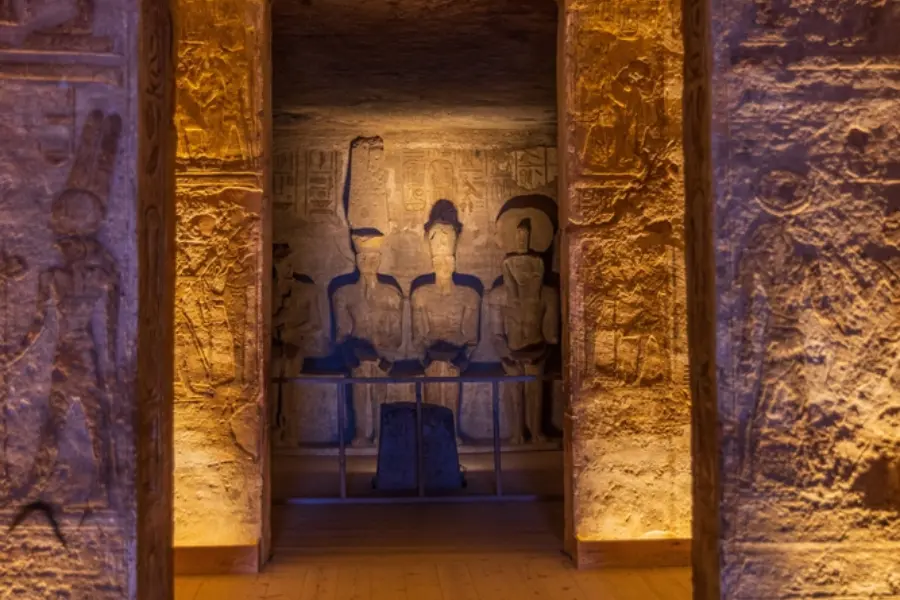
The Kom Ombo Temple stands out not only for its remarkable architectural design but also for the stunning reliefs that adorn its walls. A set of stone steps leads visitors from the ground up to the temple’s grand entrance, constructed with massive blocks of stone that have withstood the test of time.
The temple’s facade is beautifully decorated with intricate carvings depicting Ptolemaic kings triumphing over their enemies and offering tributes to the gods, highlighting the religious and political significance of the era. Beyond the entrance lies the hypostyle hall, built during the Roman period, which, although partially damaged over centuries, still reflects the grandeur and spiritual aura of this dual temple dedicated to Horus and Sobek.
Temple’s Historical Significance
The Kom Ombo Temple is ingeniously designed, beginning with a spacious front courtyard that leads into a majestic hypostyle hall. Beyond the hall, visitors will find three inner chambers followed by two sanctuaries, one dedicated to Sobek and the other to Horus. Flanking the inner halls are seven side chambers—three on the eastern side and four on the western side—each serving unique religious or ceremonial purposes. The temple also includes multiple antechambers and smaller rooms, which were historically used for various sacred rituals.
The temple courtyard features a rectangular open space surrounded on three sides by sixteen columns. Today, only the bases of these columns remain, but traces of the capitals still reveal the artistic detail that once crowned them. Proceeding from the courtyard, the first inner hall, largely attributed to the reign of Ptolemy XII, showcases exquisite reliefs. On the eastern walls, there are remarkable depictions of the Ptolemies receiving purification from the gods Sobek and Horus, emphasizing the divine authority and protection granted to Egypt’s rulers.
Magnificent Temple Columns
The inner hall of the Kom Ombo Temple mirrors the design of the outer hall but features shorter columns, each crowned with stone capitals shaped like the lotus flower—a symbol of purity and sacredness in ancient Egypt.
The temple is renowned for its two sanctuaries, dedicated separately to Sobek and Horus. These sanctuaries consist of two symmetrical rectangular halls, considered among the oldest parts of the temple, constructed during the reign of Ptolemy VI. The southeastern section of the complex marks the birthplace of the temple, built under Ptolemy VII. This area includes an outer courtyard leading into a front hypostyle hall, which further opens into two chambers where sacred rituals honoring the birth of the gods’ offspring were performed.
The Chapel of Hathor:
Located in the northeastern section of the Kom Ombo Temple, the Chapel of Hathor is a rectangular structure elevated above the ground and accessible via a series of steps. Measuring approximately 5 meters in length and 3 meters in width, the chapel houses three glass galleries displaying mummified crocodiles, symbolizing the god Sobek. The facade of the chapel features a captivating relief of Hathor seated at the entrance, welcoming visitors to this sacred space.
The Nilometer at Kom Ombo Temple
In the northwestern section of the Kom Ombo Temple complex, visitors can find a circular well known as a Nilometer, similar to those used on Rhoda Island in Cairo City. Constructed during the Roman period, this Nilometer is linked to a smaller water well and played a crucial role in measuring the Nile River’s water levels. Its measurements were especially important during the annual flooding season, which determined agricultural planning and the prosperity of ancient Egyptian lands.
Ancient Nilometer
The Chapel of Sobek at Kom Ombo Temple
Located in the northeastern section of the temple, the Chapel of Sobek showcases Roman architectural influence and was built in the 3rd century AD. This chapel is dedicated to Sobek, the revered crocodile god, who was widely worshiped during the Ptolemaic and Roman periods. Near the entrance, two columns feature depictions of Emperor Caracalla alongside Sobek, highlighting the fusion of political power and religious devotion in ancient Egypt.
Chapel of Sobek Revealed
Conclusion
Kom Ombo temple is a unique spot dedicated to two gods. It has all the different touches of different kings from the Ptolemaic dynasty, and it has the story behind its original ruins; it contains two unified system parts that share the first pylon, the courtyard, the thin corridor, and the portico.
Only from the columned hall does the appearance of two regular halves start to form up to the main sanctuary. The complex was constructed under the rule of the Ptolemies kings in the 2nd century BC. Principally worth seeing: In the Chapel of goddess Hathor, embalmed 2,000-year-old, sacred crocodiles are on display.
Near Aswan stands one of the most beautiful structures ever; we thank anyone who was able to contribute to building this masterpiece, which was the majesty of the temple of Kom Ombo.