

Saqqara Step Pyramid of Djoser – Egypt’s First Pyramid
Key Takeaways – Saqqara Step Pyramid
- The Saqqara Step Pyramid is Egypt’s first pyramid and the tomb of King Djoser (Third Dynasty).
- Designed by Imhotep, it introduced stacked mastabas forming six steps, about 62.5 m high.
- Built of fine limestone; its complex includes courtyards, temples, and underground corridors.
- It marks the transition from mud-brick tombs to monumental stone architecture in ancient Egypt.
- Located in the Saqqara Necropolis (UNESCO World Heritage as part of Memphis and its Necropolis).
- Visitors can explore the enclosure, courts, and restored areas with ticketed entry.
What Is the Saqqara Step Pyramid?
Simply put, it’s the first pyramid ever built in Egypt, an experimental leap from a single mastaba to a six-tiered stone monument that became the blueprint for Giza and beyond.
The monument, widely called the Step Pyramid of Djoser or the Pyramid of Djoser, crowns the northern part of the Saqqara Necropolis. Its stepped profile comes from stacking progressively smaller mastabas, creating a towering structure that announced royal power and belief in the afterlife.
Over time, the site evolved into a full funerary complex with temples, courtyards, dummy chapels, and a vast underground system. This was the moment Egypt shifted from mud-brick tombs to precision-cut limestone, a revolution in design that paved the way for the true pyramids.
What Is a Step Pyramid?
A step pyramid is a monumental structure built from several smaller levels stacked one above another. What is a step pyramid? It is essentially a pyramid that rises in distinct terraces rather than smooth, continuous sides. The word mastaba comes from Arabic for a bench or raised seat, and the stepped form developed by placing six mastabas of decreasing size on top of one another. This step pyramid definition distinguishes it from a true pyramid, whose sides rise continuously to a single apex.
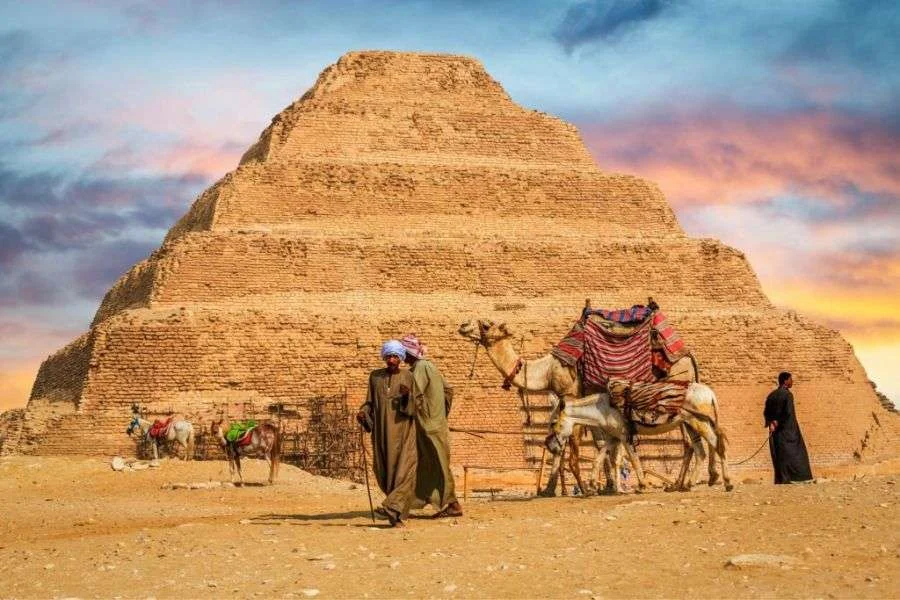
People exploring the Step Pyramid of Djoser
Where Is the Saqqara Pyramid Located?
The Saqqara Step Pyramid is located in the village of Badrasheen, Giza Governorate, within the Saqqara Necropolis, part of the UNESCO World Heritage Site of Memphis and its Necropolis. This ancient burial ground stretches across the desert plateau and preserves monuments from the earliest dynasties through the Greco-Roman era.
Commissioned by King Djoser, the pyramid was built by his architect Imhotep during Egypt’s Third Dynasty. Construction began around 2667 BCE, during the reign of King Netjerykhet, better known today as Djoser.
Saqqara is unique as it contains tombs, pyramids, and temples spanning nearly the entire span of Egyptian civilization. It remains one of the most important archaeological landscapes in Egypt, attracting scholars and travelers eager to explore its layered history.
The answer to where is the step pyramid located is about 30 km south of central Cairo and around 12 km south of the Giza Plateau. A Saqqara pyramid map shows its position within the Memphis Necropolis, a UNESCO World Heritage Site. By car, the journey usually takes about 45 to 60 minutes, depending on traffic.
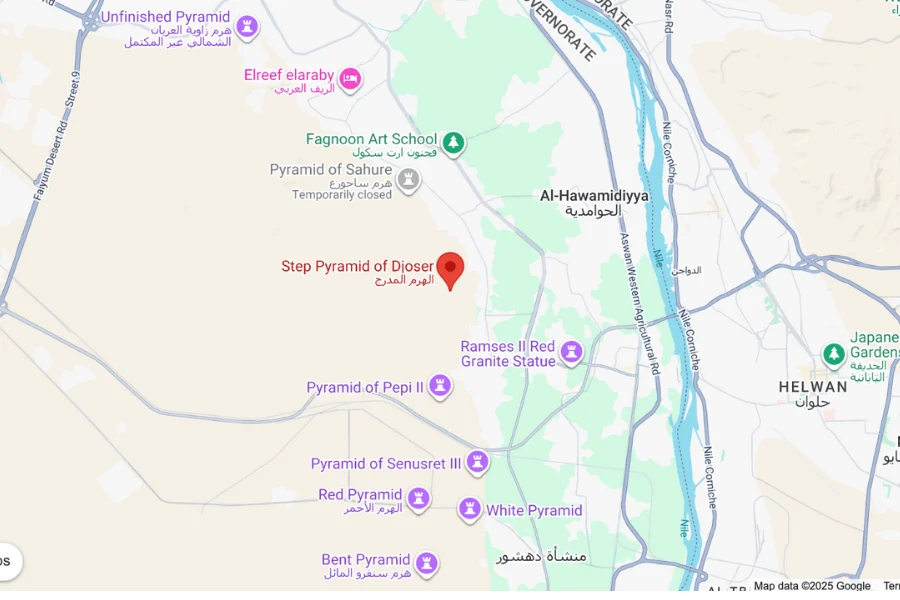
Saqqara Step Pyramid of Djoser
The Impressive History of the Saqqara Pyramid
Built more than 4,700 years ago, the Pyramid of Djoser marks the dawn of Egypt’s pyramid age, a turning point from simple mud-brick tombs to grand stone monuments.
From Mastaba to Pyramid
Pharaoh Djoser of the Third Dynasty originally planned a traditional mastaba tomb, a flat rectangular structure with sloping sides. Under the guidance of his architect Imhotep, the design was expanded step by step into six stacked tiers, creating a new form: the world’s first pyramid.
Who Built the Step Pyramid — Djoser and Imhotep
Who built the step pyramid? King Djoser commissioned the monument, while Imhotep, his vizier and chief architect, is credited with directing its innovative design and construction. Djoser was known by his Horus name, Netjerykhet, while the name Djoser became associated with him only in a later period. Imhotep supervised the transition to monumental stone architecture and helped transform a traditional royal tomb into a six-level pyramid complex. The Imhotep step pyramid project became a landmark in Egyptian architecture. Imhotep was later deified and associated with healing and medicine.
Construction Scale and Materials
The pyramid eventually rose to about 62.5 meters (205 ft) in height. It was built with an estimated 11.6 million cubic feet (330,400 cubic meters) of stone and mud, introducing limestone as the primary material instead of mudbrick. This innovation set a precedent for later pyramids at Giza.
Beneath the pyramid lies a vast maze of tunnels extending about 5.7 kilometers (3.5 miles), designed to protect the king’s burial chamber from robbers.
Religious Meaning and Protection
Earlier pharaohs were buried in mastabas that could be easily looted. By building a stepped structure, Djoser and Imhotep created a tomb that was harder to penetrate, while also symbolizing a stairway to the heavens, reinforcing the king’s divine journey into the afterlife.
The pyramid’s enduring form reflects both practical concerns of security and the spiritual vision of eternal life, making it one of the most influential monuments of ancient Egypt.
When Was the Step Pyramid Built and How Old Is It?
The Step Pyramid was built about 4,700 years ago, during the reign of King Netjerykhet, with construction dated to c. 2667–2648 BC. When was the Step Pyramid built? Construction began around 2667 BC and continued during the early Third Dynasty. It is widely regarded as the oldest pyramid in Egypt, marking the beginning of a new form of royal architecture. Where was the first pyramid built? It was built at Saqqara, in the ancient Memphis area, where its stone construction represented a major architectural breakthrough. The monument is also considered the oldest known large-scale stone building and the first pyramid in Egypt. It predates the Great Pyramid of Khufu at Giza by roughly a century.
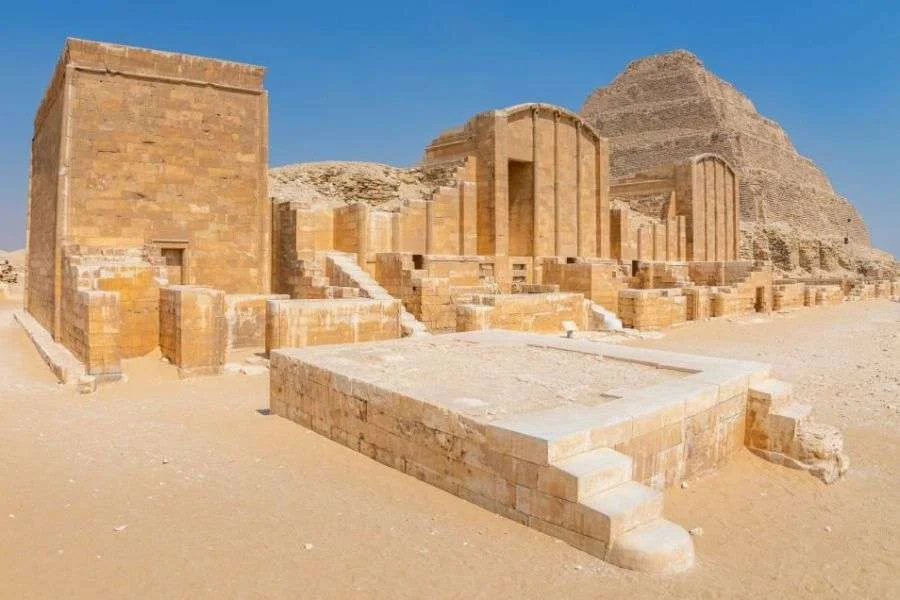
Saqqara Pyramid Complex – Giza Governorate
The Astonishing Exterior Design of the Saqqara Pyramid
Unlike earlier mudbrick tombs, the Step Pyramid was the first royal monument built entirely of stone, clad in gleaming white limestone that once reflected the desert sun.
The pyramid consists of six terraces rising to a height of about 62.5 meters (205 ft). Its rectangular base measures approximately 121 × 109 meters, oriented precisely to the cardinal points. Each layer was carefully stacked to form the distinctive stepped silhouette that gives the pyramid its name. The Saqqara pyramid height is one of its most distinctive features.
Archaeological studies show that the structure was originally covered with fine polished limestone casing stones. Over time, much of this covering was stripped away, leaving the core steps exposed, yet the monument’s grandeur is still unmistakable.
The innovation of building in stone instead of mudbrick not only ensured durability but also marked the beginning of Egypt’s golden age of pyramid construction, later perfected at Giza.
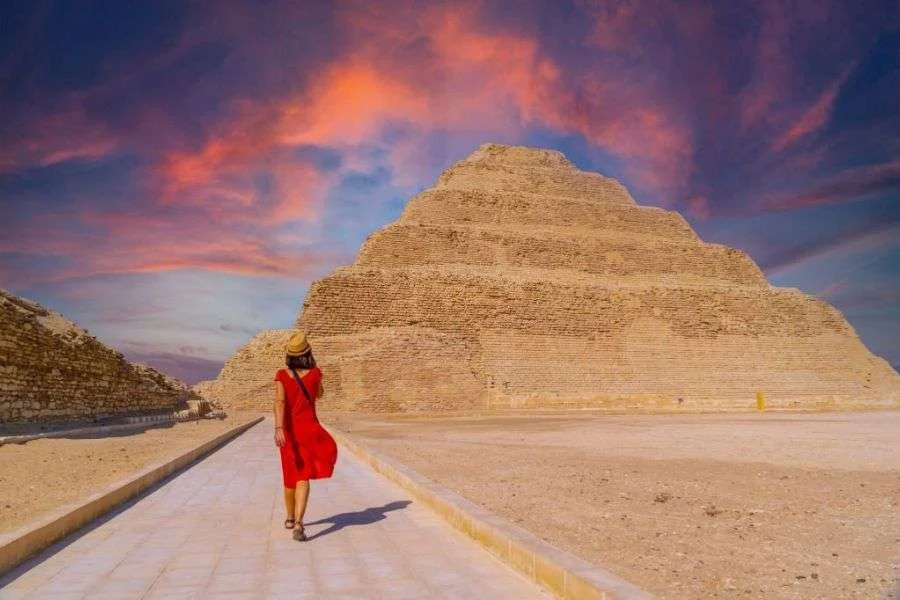
The Step Pyramid of Djoser in Saqqara
The Spectacular Infrastructure of the Step Pyramid
Beneath the Saqqara Step Pyramid lies a labyrinth of chambers, corridors, and shafts that reflect both practical engineering and deep religious symbolism.
The Burial Chamber
A vertical shaft measuring about 7 × 7 meters descends nearly 28 meters beneath the pyramid. At its base sits the granite burial vault of King Djoser, sealed with a massive granite plug.
Corridors and Side Rooms
Surrounding the burial chamber are a series of corridors and galleries extending over about 5.7 kilometers (3.5 miles). Several side rooms were decorated with stone panels and inlaid with symbolic motifs. In one eastern vestibule, four chambers were adorned with tiles of blue faience, symbolizing water and rebirth in the afterlife.
Religious Symbolism
The blue faience tiles, niches, and symbolic designs emphasized the Egyptians’ belief in resurrection and eternal life. These decorations, combined with the intricate underground network, created a sacred landscape guiding the king into the afterlife.
Inside the Step Pyramid of Djoser: What Lies Beneath
The inside pyramid of Djoser contains an extensive network of passages, shafts, galleries, and chambers beneath the monument. Beyond the king’s burial vault, the underground complex includes additional burial spaces associated with members of the royal family, as well as rooms decorated with blue faience tiles and stone panels. Together, these spaces formed an elaborate funerary environment designed to support the king and his household in the afterlife.
One notable feature is the Serdab, a sealed chamber on the east side of the Step Pyramid. It once contained a seated statue of King Djoser, which was discovered during excavations in 1924–25. The original statue is now in Gallery 46 on the ground floor of the Egyptian Museum in Cairo, while a plaster replica has replaced it in the Serdab at Saqqara.
Landmarks Associated with the Step Pyramid
The Step Pyramid was not an isolated monument. It formed the heart of a vast funerary complex filled with symbolic structures that reflected both earthly power and the pharaoh’s journey to the afterlife.
- Massive Moat: A huge trench about 40 m wide that enclosed the complex on all sides, possibly serving as a protective boundary around the sacred precinct.
- Enclosure Wall: Stretching about 1,645 m long and 10.5 m high, this fine Tura limestone wall surrounded the pyramid complex. Its panelled palace-façade design featured numerous recessed sections and a single entrance.
- Southern Tomb: A mysterious structure whose exact function remains debated; some believe it symbolized Djoser’s eternal presence in both Upper and Lower Egypt.
- Funerary Temple: Located to the north of the pyramid, this temple housed about 40,000 stone vessels made of materials including alabaster, granite, and diorite, many of which were reused from earlier dynasties.
- Corridors and Galleries: Beneath the complex lie additional passages dating back to the First and Second Dynasties, linking Djoser’s reign with earlier traditions.
- Gisr el-Mudir: This massive stone enclosure lies west of Djoser’s complex and is generally considered one of the earliest large stone structures at Saqqara.
- The Four Symbolic Structures: The Pavilion of the North, Pavilion of the South, South Tomb, and Heb-Sed Courtyard were symbolic structures associated with sustaining the king’s ka and his continued existence in the afterlife.
Together, these landmarks created one of the most complete and symbolic mortuary landscapes in ancient Egypt, setting the stage for the grand pyramid complexes that followed.
What the Step Pyramid Symbolized
What did Djoser’s Step Pyramid symbolize? It represented the king’s renewal, eternal rule, and ascent to the afterlife. The complex was closely connected with the Sed Festival (Heb-Sed), a royal ritual traditionally held after thirty years of a king’s reign to renew his strength and legitimacy.
The two courtyards in front of the pyramid recreated the ceremonial setting of this royal festival. Along the eastern side, several stone structures appear to reproduce temporary shrines used during the ritual, transforming them into permanent forms so that the king’s renewal could continue symbolically for eternity.
The South Tomb may also have served as a symbolic second burial place, reflecting Djoser’s role as ruler of both Upper and Lower Egypt. Meanwhile, the pyramid’s six stepped levels created a visual form that could be understood as a symbolic stairway carrying the king upward toward the heavens.
This combination of ritual spaces, symbolic structures, and the stepped form transformed the complex into more than a tomb: it was a permanent setting for the king’s eternal renewal and divine journey.
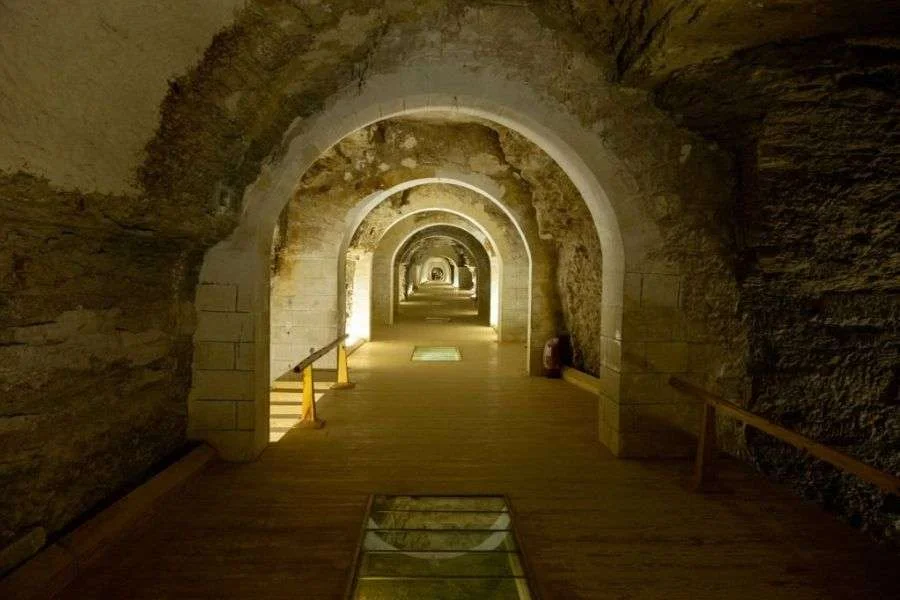
Subterranean passages at Saqqara Necropolis
Tour of the Step Pyramid of Djoser
Visiting the Saqqara Step Pyramid is more than just a sightseeing trip, it’s a journey back to the dawn of Egypt’s pyramid age. With the right planning, you can enjoy both the history and the unique atmosphere of this ancient necropolis.
Best Time to Visit
The Saqqara region is known for its extreme summer heat. The best time to visit is during the cooler months, from October to April, when the weather is mild and pleasant. If you must visit in summer, plan for early mornings or late afternoons.
What to Wear
Wear breathable cotton clothes and comfortable shoes, especially if you plan to enter the pyramid’s narrow corridors. In summer, bring sunglasses, a hat, and sunscreen. In winter, wear light layers that allow easy movement while exploring.
The Visitor Experience
When you arrive, you’ll see the Step Pyramid rising at the heart of a vast architectural complex. Parts of the enclosure wall, once decorated with massive cobra friezes, still stand, adding to the grandeur of the site. Walking through Saqqara, you’ll encounter not only Djoser’s pyramid but also a panorama of ancient chapels, tombs, and ceremonial spaces.
A guided tour with an Egyptologist is highly recommended to fully appreciate the religious symbolism, architectural genius, and historical significance of the pyramid complex.
Staying in Hurghada? Our Giza, Saqqara and Memphis day tour by plane includes a visit to the Step Pyramid, round-trip flights and private transfers.
Can You Go Inside the Step Pyramid?
Yes, you can go inside the Pyramid of Djoser and explore parts of its restored underground passages. The pyramid’s interior was reopened to visitors after a major restoration project that lasted from 2006 to 2020, making its corridors and chambers accessible again as part of the visitor experience.
Entry into the pyramid itself requires a separate ticket from the general ticket for the Saqqara archaeological site. Before entering, keep in mind that the route descends through narrow, sloping passages and underground spaces. These conditions may be uncomfortable for visitors with claustrophobia or difficult for people with limited mobility.
The restoration helped preserve the monument while allowing visitors to experience its underground architecture more closely. If you plan to go inside, comfortable footwear and a steady pace can make the experience easier.
As access policies can change depending on conservation work or site regulations, it is best to confirm the current entry arrangements before your visit.
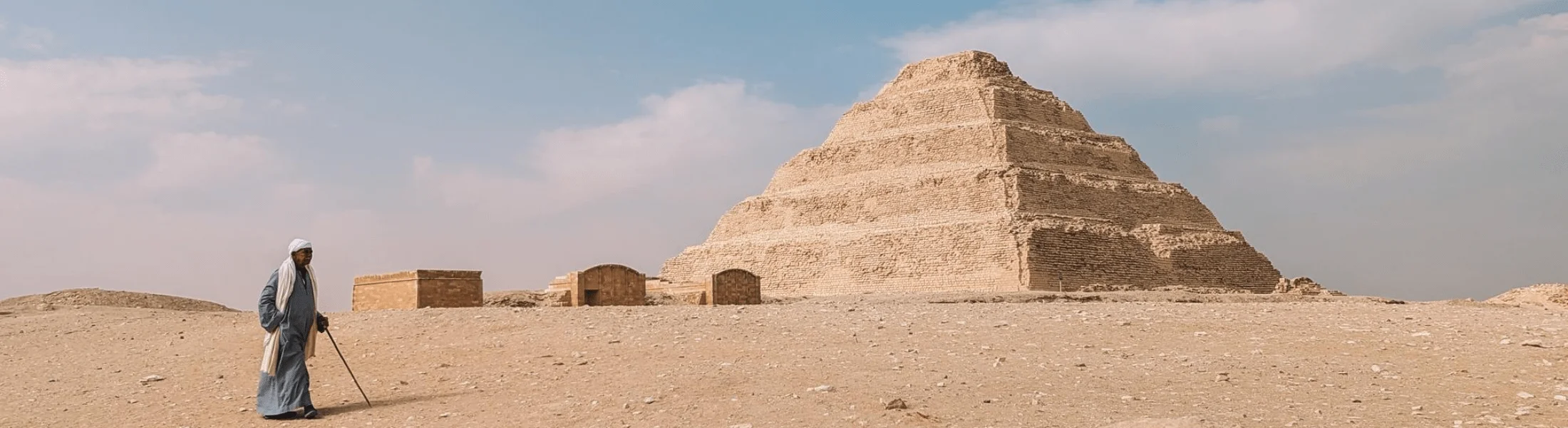
Exploring the grandeur of the Saqqara Step Pyramid, a marvel of ancient Egyptian craftsmanship.
Saqqara Step Pyramid Tickets, Hours
Before planning your visit, it is important to understand that entry to the Saqqara archaeological area may involve more than one ticket, depending on which monuments and spaces you want to explore. A general site ticket provides access to the main archaeological area, while entering the Step Pyramid from inside requires a separate ticket. Other attractions within the wider Saqqara area, including the Serapeum and the Tomb of Mereruka, may also require separate tickets.
| Ticket | Price |
|---|---|
General Saqqara Site (Adult) | EGP 1400 |
General Saqqara Site (Student) | EGP 700 |
Step Pyramid Interior | Included in the general site ticket |
Children under 6 | Free |
Opening Hours
All Days
Summer: From 08:00 am – Last Entry 04:00 pm; site closes at 05:00 pm.
Winter: From 08:00 am – Last Entry 04:00 pm; site closes at 05:00 pm.
Ramadan: From 08:00 am – Last Entry 03:30 pm
⚠️ Please adhere to the opening and closing hours for every site. To ensure a pleasant experience, make sure you arrive at least one hour prior to closing time.
Prices shown reflect current rates at the time of publishing and may change. Check the latest official prices before your visit.
Interesting Facts about the Saqqara Step Pyramid
Here are some of the most interesting Step Pyramid of Saqqara facts and Pyramid of Djoser facts, from its groundbreaking architecture to the discoveries that continue to shape our understanding of ancient Saqqara.
- It is the first pyramid ever built in Egypt, dating back to the 27th century BCE.
- Designed by the architect Imhotep, who was later deified and associated with healing and medicine.
- The pyramid rises about 62.5 m (205 ft) with a rectangular base measuring approximately 121 × 109 m.
- Beneath it lies a network of tunnels stretching about 5.7 km (3.5 miles).
- The funerary complex covers more than 15 hectares, including temples, courtyards, and shrines.
- It was declared a UNESCO World Heritage Site in 1979 as part of Memphis and its Necropolis.
- The king’s Horus name was Netjerykhet, while the name Djoser became associated with him at a later period.
- Restoration work on the pyramid lasted for 14 years, from 2006 to 2020, before the monument reopened to visitors.
- Saqqara remains one of Egypt’s most active archaeological sites, with ongoing excavations continuing to reveal new tombs and other discoveries.
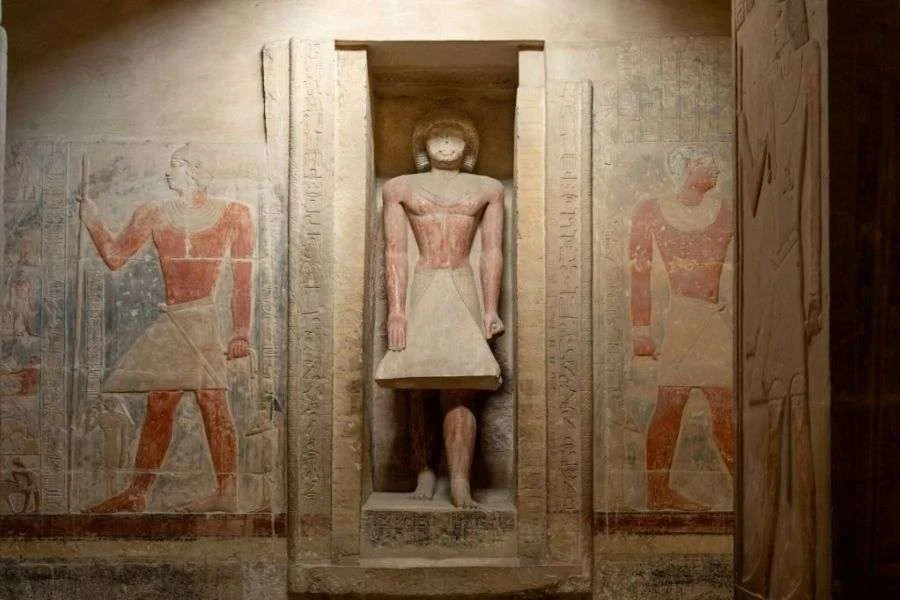
Tomb of Mereruka near the Step Pyramid
Step Pyramid vs. Other Famous Egyptian Pyramids
To better understand the uniqueness of the Saqqara Step Pyramid, it helps to compare it with other iconic pyramids such as the Great Pyramid of Khufu at Giza and the Black Pyramid at Dahshur.
A step pyramid Giza comparison highlights how the earlier stepped design differs from the smooth-sided pyramids that followed.
| Pyramid | Dynasty | Height | Significance |
|---|---|---|---|
Step Pyramid of Djoser (Saqqara) | 3rd dynasty | 62.5 m | First pyramid in Egypt, designed by Imhotep |
Great Pyramid of Khufu (Giza) | 4th Dynasty | 146.6 m (original) | Largest pyramid in Egypt, one of the Seven Wonders |
Bent Pyramid (Dahshur) | 4th Dynasty | 101 m | Transitional design; angle changes mid-build |
Red Pyramid (Dahshur) | 4th Dynasty | 105 m | First successful true pyramid |
Black Pyramid of Amenemhat III (Dahshur) | 12th Dynasty | 75 m (ruined) | Known for collapse; rare Middle Kingdom pyramid |
The evolution from a pyramid with steps to smooth-sided monuments can be seen clearly when these structures are viewed together. Djoser’s stepped design came first, followed by experiments such as the Bent Pyramid and Red Pyramid before the architectural tradition reached its monumental scale at Giza.
This comparison shows how Djoser’s Step Pyramid paved the way for later achievements like Khufu’s masterpiece, while the Black Pyramid illustrates the experimentation and challenges of the Middle Kingdom.
Recent Discoveries at Saqqara
Saqqara remains one of Egypt’s most active archaeological sites, with excavations continuing to reveal important evidence from different periods of ancient Egyptian history. Among the documented discoveries is the tomb of Prince Userefre, son of King Userkaf, founder of Egypt’s Fifth Dynasty. The tomb contained statues, inscriptions, and other archaeological remains that add to our understanding of the royal necropolis and its long history.
These discoveries show that archaeological work at Saqqara is far from finished. As excavations continue across the necropolis, the site still holds many clues about ancient Egypt that have yet to be uncovered.
Conclusion
The Step Pyramid of Djoser stands as one of ancient Egypt’s most important architectural achievements, transforming the royal tomb into a monumental stone structure and establishing a design tradition that shaped the pyramids that followed.
Saqqara is worth at least half a day because it lets you see the origins of Egypt’s pyramid form before following its development at other sites. A natural chronological route is Saqqara, then Dahshur, then Giza, allowing you to trace how Egyptian pyramid design evolved from the stepped form to the true pyramids.
For more than 20 years, Egypt Tours Group has arranged Cairo day tours that include Saqqara alongside Giza and Memphis, with licensed Egyptologist guides.
FAQs – Saqqara Step Pyramid
Who built the Saqqara Step Pyramid?
The pyramid was commissioned by King Djoser of the Third Dynasty and designed by his vizier and architect Imhotep.
When was the Pyramid of Djoser constructed?
It was constructed around 2667–2648 BC, during the reign of King Netjerykhet, later known as Djoser. This makes the monument approximately 4,700 years old and places it at the beginning of Egypt’s pyramid-building tradition.
How old is the Step Pyramid at Saqqara?
The Step Pyramid is about 4,700 years old, dating to approximately 2667–2648 BC during Egypt’s Third Dynasty. It is recognized as the first pyramid built in Egypt and the earliest known large-scale stone monument of its kind.
Is the Saqqara Pyramid older than the Pyramids of Giza?
Yes. It predates the Giza Pyramids by roughly a century. Its construction dates to approximately 2667–2648 BC, while the Great Pyramid of Khufu belongs to the following Fourth Dynasty.
Can visitors go inside the Step Pyramid?
Yes. Visitors can access the restored internal corridors and chambers, although entering the pyramid requires a separate ticket from general site admission.
Why is the Saqqara Pyramid important?
It represents the first pyramid built in Egypt and one of the earliest large-scale monuments constructed primarily from stone. Its design marked a major development in royal funerary architecture and influenced the pyramid complexes that followed.
Who is buried in the Step Pyramid?
The monument was built as the tomb of King Djoser, also known as Netjerykhet. His burial chamber was robbed in antiquity, and the king’s body has not been conclusively identified there today. Human remains were discovered in the underground complex, but their connection to Djoser remains disputed. The lower chambers also contained burials associated with members of the royal family.
Is Saqqara the oldest pyramid in the world?
The Step Pyramid is the oldest pyramid known in Egypt and the earliest known large-scale stone building of its kind. That is different from calling it the oldest pyramid-shaped structure in the world, since other pyramid-like monuments from different cultures have disputed or closely comparable dates. Its distinction is therefore specifically as Egypt’s first pyramid and an early monumental stone structure.
Is the Step Pyramid the same as the Pyramid of Djoser?
Yes. Step Pyramid, Pyramid of Djoser, Step Pyramid of Zoser, and Sakkara Step Pyramid all refer to the same monument. Djoser and Zoser are different forms of the king’s name, while Saqqara and Sakkara are alternative spellings of the site’s name.