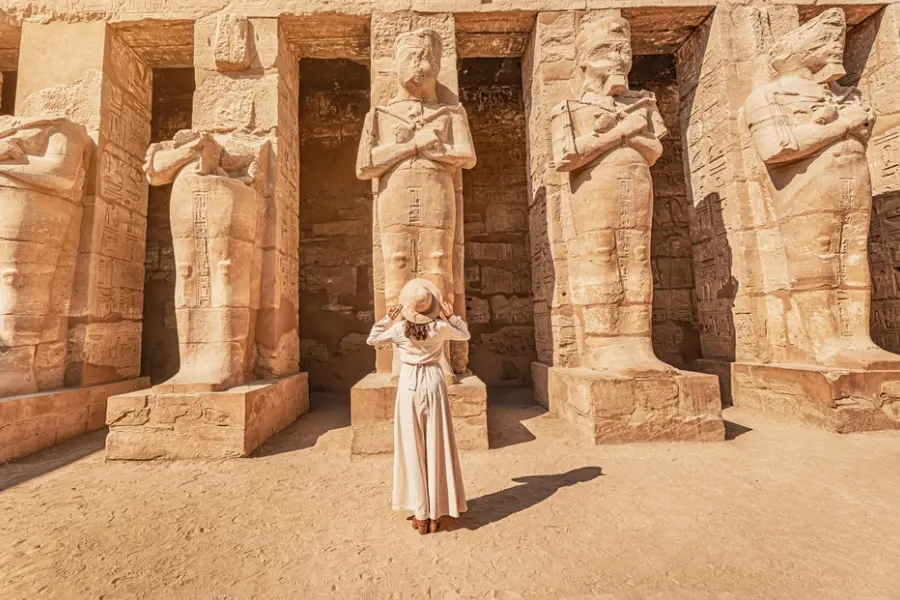
Valley of the Queens – Tombs of Royal Legacy
The Valley of the Queens can be found on Luxor’s West Bank (ancient Thebes). There are between 75-80 tombs located here which belong to Queens from 18th, 19th, and 20th Dynasties.
Map and Location of the Valley of the Queens
The magnificent Valley of the Queens lies directly across the Nile River from Luxor, situated prominently on the west bank. This iconic site, easily accessible via luxury Nile cruises, is the final resting place for many members of the Egyptian royal family from the 19th and 20th Dynasties. The undeniable star attraction is the spectacular tomb of Nefertari, the Great Royal Wife of Pharaoh Ramesses II, famous for its vivid, perfectly preserved wall paintings. Visitors can also explore the tombs of other royal figures, including Princes Khaemwese, Titi, and Amonhirkhopsef, making it an essential historical destination near Luxor.

Map of Valley of the Queens
Fascinating Facts About the Valley of the Queens
Tombs Reflect New Kingdom Burial Changes
While the modern name suggests the tombs are exclusively for royal consorts, the ancient Egyptians knew the site as Ta-Set-Neferu. The traditional meaning, “The Place of Beauty,” is often cited, but modern Egyptologists agree that a more accurate translation is the “Place of the Pharaohs’ Children.” This revised meaning better reflects the true nature of the tombs, which were dedicated to royal princes, princesses, and loyal high-ranking nobles who served the royal family—not just the queens alone. This unique mix of burials provides unparalleled insight into New Kingdom royal family structures.

Nefertari tomb.
Priests and Police Guarded the Valley
The selection of this precise location for the Valley of the Queens during the New Kingdom remains a subject of debate among researchers. Its strategic significance is manifold: it lies directly west of the Nile River, opposite ancient Thebes (modern-day Luxor, Upper Egypt), and is situated close to both the Valley of the Kings and the artisan village of Deir el-Medina.
Crucially, researchers believe the site was chosen for its potent religious symbolism: the entrance to the valley was guarded by a chapel or temple dedicated to the powerful Goddess Hathor, the divine protector of the dead. Ancient Egyptians considered this sacred valley the precise spot where the deceased could emerge and return to life after passing through the afterlife. This spiritual importance necessitated strict security, with the site being secured and protected by specialized Mortuary Priests and the Valley Police Force.

a balloon over the valley of the queens.
Challenges of Tomb Construction in the Valley
Building royal tombs in the Valley of the Queens presented intensive, site-specific challenges for the ancient Egyptian laborers. While the limestone hills were initially seen as ideal for carving due to their soft nature, allowing for precise decoration, this geological weakness was compounded by frequent local flooding and seismic activity (earthquakes). The result was a constant threat to the stability of the tombs, leading to frequent cave-ins that endangered both the workers and the integrity of this vital historical burial ground.
Deir el-Medina: The Tomb Builders’ City
The unparalleled construction efforts required a dedicated, highly skilled workforce. Deir el-Medina—the famous ancient Egyptian workers’ village—became the specialized home for the artisans and laborers involved in creating these royal tombs. This unique town was strategically positioned between the Valley of Kings and the Valley of the Queens. Although the village reached its peak during the 19th Dynasty, archaeological evidence confirms that its occupation spanned centuries, dating back to the reign of Thutmose I (c. 15th Century BCE) until the end of the 20th Dynasty, housing both skilled craftsmen and unskilled labor.
Queen Nefertari Consort and Diplomat
The most celebrated individual interred here is Queen Nefertari, the Great Royal Wife of Pharaoh Ramesses II. Her influence extended far beyond the royal court: she played a vital diplomatic role, corresponding and exchanging opulent gifts with Queen Pudukhepa of the Hittite kingdom—a major Near Eastern power with which Egypt frequently engaged in warfare. Nefertari’s role as a diplomatic conduit during Ramesses II’s 66-year rule (c. 1279–1213 BC) was essential to securing stability. She died around 1255 BCE, and her tomb remains one of the Valley of the Queens’ most stunning and best-preserved monuments.

Nefertari tomb.
Ramses II Buried His Wives in Valley of the queens
The practice of burying royal wives and children in the Valley of the Queens highlights the complex and strictly controlled lives of royal women in ancient Egyptian politics. Pharaohs, including Ramesses II, exercised tight control over the marriages of their daughters and sisters, viewing them not just as family members but as critical assets for maintaining dynastic security.
The strict rules governing royal unions were fundamentally a geopolitical strategy:
-
Preventing Usurpation: Royal princesses were legally prohibited from marrying foreign kings whose alliance might later be exploited to claim or usurp the Egyptian throne. Marriages were generally limited to Egyptian princes or high-ranking officials to prevent any external claimant from gaining legitimacy.
-
Maintaining Purity and Power: Many royal daughters were either never married or, when they did marry, they were often required to enter into unions with their father (the Pharaoh) or a brother. This highly controversial practice of close-kin marriage was intended to keep the sacred royal bloodline pure, consolidating power and wealth strictly within the immediate ruling family.
Thus, the final, secure placement of these royal women and children in the Valley of the Queens reflects not just familial devotion, but the ultimate control the Pharaoh exercised over their lives—from their political constraints in marriage to their eternal resting place.

Ramses II.
FAQ
Were Egyptian Queens Buried with the Pharaohs?
Abydos was among the oldest kingdoms on Earth; at first, people and ministers believed their Pharaoh was God and therefore tried to be buried as close as possible to his tomb so he would take care of them in their next lives.
Unfortunately, this practice eventually changed over time due to people and ministers believing this King to be deified – people thought their King took good care in looking after his subjects even after death!
Which Egyptian Queen Is Buried in the Valley of the Kings?
One of the best-known examples in the Valley of the Queens is Queen Nefertari (1290-1224 BCE), who rests peacefully beneath a tomb hewn out of rock in her tomb’s polychrome reliefs which still stands today. Other members of her royal family continued being interred within this Valley of Kings burial ground.
Is the Valley of the Queens Worth Visiting?
Even though many tombs have been vandalized over time, many still feature vibrant paintings on the walls and beautiful decor inside them.
While past travelers advised avoiding this attraction if time was tight, many noted how stunning its decor could be an attraction worth experiencing first-hand.

Valley of the Queens
Who Was Egypt’s Most Beautiful Queen?
Nefertari was widely revered among ancient Egyptians. Reigning during the 19th Dynasty (1290-1255 BC), she held significant political and cultural sway over Egypt at that time and beyond.
As the Great Royal Wife of Pharaoh Ramesses II known as Ramesses the Great (known today), Nefertari played an invaluable role in Egyptian history and culture.