

Pyramid of Menkaure: History, Secrets & Visitor Guide
In the heart of ancient Egypt, where mighty pharaohs ruled and timeless wonders rose from the desert sands, stands the smallest of the three main Pyramids of Giza — the Pyramid of Menkaure. Although it is often overshadowed by the larger pyramids of Khufu and Khafre, this remarkable monument has its own story to tell through its elegant design, distinctive red granite casing, fascinating interior, and rich historical legacy.
The pyramid is also known as the Mykerinos Pyramid, and is sometimes referred to as Mankaure or Menakure. While these names differ in spelling, they all refer to the same royal monument built for Pharaoh Menkaure during Egypt’s Fourth Dynasty.
This guide explores the Menkaure Pyramid, covering its history, construction, architectural features, recent scanning research, archaeological finds, and practical visitor information. By the end, you’ll understand why the smallest pyramid at Giza remains one of the most fascinating monuments on the plateau and an essential part of Egypt’s ancient heritage.
What is the Pyramid of Menkaure?
The Pyramid of Menkaure, also called the Menkaure Pyramid, is the third and smallest of the three Giza pyramids. Built during Egypt’s Fourth Dynasty as King Menkaure’s final resting place, it is renowned for its elegant granite casing and balanced proportions, making it a distinctive part of the Giza Plateau.
Although smaller than Khufu’s and Khafre’s pyramids, the Menkaure Pyramid completes the iconic Giza trio. Its unique design, durable red granite casing, and sophisticated interior reflect the remarkable craftsmanship of ancient Egyptian builders and secure its place among the world’s greatest archaeological monuments.
Names and Spellings of the Third Pyramid
If you’re researching the third pyramid at Giza, you may come across several different names. They all refer to the same monument, but the spelling varies depending on language, historical tradition, or modern transliteration.
The most common names include:
- Pyramid of Menkaure
- Menkaure Pyramid
- Mykerinos Pyramid
- Mankaure Pyramid
- Menakure Pyramid
The name Mykerinos Pyramid comes from the Greek version of King Menkaure’s name, which was widely used by ancient Greek historians. Meanwhile, Mankaure and Menakure are simply alternative spellings that appear in travel guides, academic publications, and online searches. Regardless of the name used, they all refer to the same royal pyramid, the smallest of the three main pyramids on the Giza Plateau.
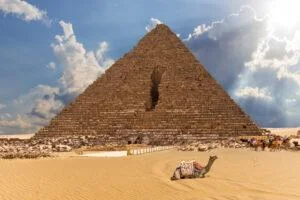
Menkaure Pyramid: A Timeless Wonder
Who Was Pharaoh Menkaure?
Pharaoh Menkaure was a king of Egypt’s Fourth Dynasty whose reign is generally dated to approximately 2532–2503 BCE. He was most likely the son of Khafre and the grandson of Khufu, connecting the builders of Giza’s three main pyramids across three generations. He is best known for constructing the Pyramid of Menkaure and its surrounding funerary complex.
- Although his pyramid is the smallest at Giza, it stands as a lasting symbol of his legacy.
- The famous Menkaure triad statues depict the king alongside the goddess Hathor and personifications of different Egyptian nomes, reflecting his royal and religious role.
What are the three small pyramids?
South of the Pyramid of Menkaure stand three small subsidiary pyramids that formed part of his funerary complex. Today, archaeologists identify them as G3-a, G3-b, and G3-c.
These smaller pyramids were used for royal burials and are generally associated with Menkaure’s queens. However, the largest, G3-a, may originally have been planned as a satellite pyramid before being adapted for a royal burial.
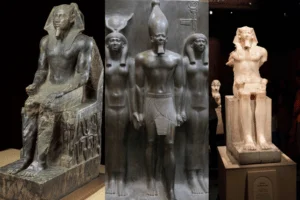
Pharaoh Menkaure: The Pyramid’s Creator
How Was the Pyramid of Menkaure Constructed?
The Pyramid of Menkaure was built using locally quarried limestone with a distinctive lower casing of red granite from Aswan, showcasing the advanced engineering skills of ancient Egyptian builders.
Researchers believe the stone blocks were shaped with copper tools before being transported on wooden sledges. Ancient waterways connected to the Nile, including the Khufu Branch, likely helped move heavy building materials closer to the Giza Plateau, where ramps were used to position the stones with remarkable precision.
Some of the largest local limestone blocks used in Menkaure’s mortuary temple may have weighed as much as 220 tons, while the heaviest granite blocks transported from Aswan weighed more than 30 tons. These estimates relate mainly to the temple complex rather than the pyramid’s outer casing.
What is the most beautiful pyramid in Egypt?
There is no official answer to this question, as beauty is largely a matter of personal preference. While many admire the Great Pyramid of Khufu for its scale or Khafre’s Pyramid for its preserved casing, the Pyramid of Menkaure is often praised for its elegant proportions and distinctive red granite casing along its lower levels.
Although it is the smallest of the three main Giza pyramids, its refined design and unique appearance make it one of the most visually striking monuments on the plateau.
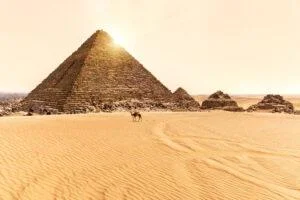
The Story of Menkaure Pyramid’s Construction
What’s Inside the Pyramid of Menkaure?
Inside the Pyramid of Menkaure is far more than a simple passage leading to a burial chamber. Although the pyramid is smaller than Khufu’s and Khafre’s, its internal layout is considered more complex than that of Khafre’s Pyramid, reflecting the advanced planning and craftsmanship of Old Kingdom architects.
A descending passage leads visitors deep into the pyramid, where a series of chambers were designed for both practical and symbolic purposes related to the king’s journey into the afterlife.
Why is the inside of the Menkaure Pyramid unusual?
Beyond the descending passage lies an antechamber decorated with recessed palace-façade panels, an architectural motif associated with royal buildings. Deeper inside are a granite burial chamber and a separate room containing six large niches whose exact purpose remains uncertain.
Together, these features give Menkaure’s pyramid a more elaborate internal plan than its relatively modest exterior might suggest.
Modern Discoveries: The ScanPyramids Project
In 2025, researchers from Cairo University and the Technical University of Munich used ground-penetrating radar, ultrasound, and electrical resistivity testing to examine an area of unusually smooth granite blocks on the pyramid’s eastern face.
The investigation identified two air-filled voids located approximately 1.4 meters and 1.13 meters behind the outer facade. Their location has renewed interest in the theory that an additional entrance may once have existed on the eastern side of the pyramid.
However, the findings do not prove the existence of a hidden entrance, chamber, or passage. Further investigation is needed to determine the purpose and full extent of the detected spaces.
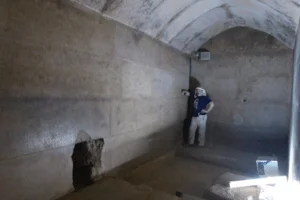
Inside Menkaure Pyramid
What Was Found Inside the Pyramid and Its Complex?
Archaeologists have discovered important artifacts both inside the Pyramid of Menkaure and throughout its surrounding funerary complex. Objects found inside the pyramid include remains of burial equipment, while some of the most famous statues associated with Menkaure were uncovered in the temples connected to the monument.
Among the most important discoveries inside the pyramid were a basalt sarcophagus associated with Menkaure and fragments of a wooden anthropoid coffin bearing his name. However, the wooden coffin dates to Egypt’s Twenty-Sixth Dynasty and was part of a much later restoration of the burial rather than Menkaure’s original Fourth Dynasty funerary equipment.
One of the finest sculptures from the complex is the famous Menkaure and Queen statue, now displayed in the Museum of Fine Arts, Boston. The lifelike carving is considered one of the greatest masterpieces of ancient Egyptian sculpture.
Excavations in Menkaure’s Valley Temple also uncovered several remarkable triad statues depicting the king alongside the goddess Hathor and personifications of different Egyptian nomes. These sculptures provide valuable insight into royal ideology, religious beliefs, and artistic achievement during Egypt’s Fourth Dynasty. Surviving examples are held by the Egyptian Museum in Cairo and the Museum of Fine Arts, Boston.
What happened to King Menkaure’s lost sarcophagus?
The basalt sarcophagus of King Menkaure was discovered inside the burial chamber in 1837 by Colonel Richard William Howard Vyse during his exploration of the pyramid. The following year, the sarcophagus was shipped from Alexandria aboard the merchant schooner Beatrice on its way to Britain.
The Beatrice disappeared during the journey, and neither the ship nor the basalt sarcophagus was ever recovered. Its exact location remains unknown.
What Was the Pyramid’s Role in Menkaure’s Funerary Complex?
The Pyramid of Menkaure was the centerpiece of a large funerary complex designed to support the king’s journey into the afterlife. The complex included a mortuary temple beside the pyramid, a causeway connecting it to the Valley Temple, and a group of subsidiary pyramids built as part of the royal burial complex.
Together, these structures played an important role in religious ceremonies, offerings, and rituals that honored the pharaoh long after his death.
How many small pyramids are there at Giza?
Within the Giza Pyramid Complex, several smaller pyramids were built alongside the main royal monuments. The best-known examples include the three Queen’s Pyramids beside the Great Pyramid of Khufu and the three subsidiary pyramids south of the Pyramid of Menkaure, known as G3-a, G3-b, and G3-c.
These smaller pyramids were likely built for royal women, including queens and other members of the royal family, and formed an important part of the funerary complexes on the Giza Plateau.
Tips for Visiting the Pyramid of Menkaure
Visiting the Pyramid of Menkaure is a unique opportunity to explore one of the most fascinating monuments on the Giza Plateau. To make the most of your visit, keep these practical tips in mind:
- Location: The pyramid is located on the Giza Plateau beside the pyramids of Khufu and Khafre.
- Entry Tickets: A Giza Plateau ticket is required, while entry inside the pyramid usually requires a separate ticket.
- Visit Early: Morning visits offer cooler temperatures and fewer crowds.
- Hire a Guide: An Egyptologist can explain the pyramid’s history, architecture, and hidden details that are easy to miss.
- Dress Comfortably: Wear lightweight clothing, comfortable walking shoes, and bring water, sunscreen, and a hat, especially in summer.
- Respect the Site: Climbing the pyramid is prohibited, and visitors should always follow site regulations.
Can you go inside the Menkaure Pyramid?
Yes, visitors can usually enter the Pyramid of Menkaure with a separate interior-access ticket when it is open to the public. Availability, ticket prices, and access rules may change, so it’s always best to check at the ticket office or the official booking platform before your visit.
Keep in mind that the interior is reached through narrow, low passages that can become warm and require bending while walking. For this reason, the experience may not be suitable for visitors with claustrophobia, mobility difficulties, or anyone uncomfortable in confined spaces.
Essential Tips for Exploring Menkaure Pyramid
Stories and Secrets of King Menkaure’s Pyramid
Although the Pyramid of Menkaure is the smallest of the three main pyramids at Giza, it has inspired centuries of curiosity and debate. Historians, archaeologists, and travelers have long been fascinated by its elegant design, unfinished granite casing, mysterious interior, and the famous story of the king’s lost sarcophagus.
Unlike the larger pyramids built by Khufu and Khafre, Menkaure’s monument reflects a different architectural approach. Its refined proportions, extensive use of red granite, and unusually complex internal layout suggest that the builders placed as much emphasis on craftsmanship as they did on scale.
Many questions about the pyramid remain unanswered today. Why was part of its granite casing left unfinished? Were some sections of the funerary complex completed after the king’s death? And could modern technology reveal hidden spaces that have remained untouched for more than 4,500 years? Ongoing archaeological research continues to explore these mysteries.
Why does the Pyramid of Menkaure have a large vertical scar?
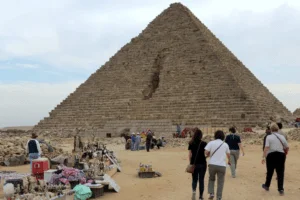
One of the pyramid’s most noticeable features is the large vertical scar on its northern face. This damage dates to 1196 CE, when Sultan Al-Aziz Uthman, the son of Saladin, attempted to dismantle the pyramid for building materials. Despite months of work, his laborers removed only a small section, leaving behind the dramatic scar that visitors can still see today. Rather than diminishing the pyramid’s appeal, the scar has become one of its most distinctive features, often catching the attention of visitors viewing the monument in person or in photographs.
Comparison with the Pyramids of Khufu and Khafre
The three pyramids on the Giza Plateau were built by successive rulers of Egypt’s Fourth Dynasty, yet each one has its own architectural identity and purpose. While the Pyramid of Menkaure is the smallest of the trio, its importance lies in its design, materials, and craftsmanship rather than its size alone.
| Pyramid | What Makes It Unique |
|---|---|
Khufu’s Pyramid | The largest and most famous pyramid in Egypt, representing the peak of Old Kingdom engineering and the immense power of Pharaoh Khufu. |
Khafre’s Pyramid | Although slightly smaller than Khufu’s, it appears taller because it stands on higher ground. It also retains part of its original limestone casing near the summit. |
Menkaure’s Pyramid | The smallest of the three, but distinguished by its red granite casing, elegant proportions, and a more complex internal layout than Khafre’s Pyramid. |
Rather than competing in size, the Pyramid of Menkaure stands out for its refined architecture and unique construction features. Its granite exterior, sophisticated interior design, and richly planned funerary complex make it one of the most fascinating monuments on the Giza Plateau, proving that its historical significance extends far beyond its smaller dimensions.
Quick Facts about the Pyramid of Menkaure
| Fact | Details |
|---|---|
Name | Pyramid of Menkaure |
Alternative Name | Mykerinos Pyramid |
Common Spellings | Mankaure, Menakure |
Location | Giza Plateau, near Cairo, Egypt |
Pyramid Group | Giza Pyramid Complex |
Builder | Pharaoh Menkaure, most likely the son of Khafre and grandson of Khufu |
Dynasty | Fourth Dynasty, Old Kingdom |
Construction Date | Circa 2530 BCE |
Original Height | 65.5 meters (215 feet) |
Current Height | Approximately 61 meters (200 feet) |
Base Length | Approximately 108.5 meters (356 feet) |
Materials | Limestone core with red granite casing on the lower courses |
Distinctive Feature | Red granite casing from Aswan |
Interior Feature | Complex passages and a chamber with six large niches |
Subsidiary Pyramids | G3-a, G3-b, and G3-c |
Purpose | Royal tomb and center of Menkaure’s funerary complex |
Lost Artifact | Menkaure’s basalt sarcophagus, lost at sea after the Beatrice sank in 1838 |
Recommended Tours Including the Pyramid of Menkaure
Although the Pyramid of Menkaure is the smallest of the three pyramids at Giza, it often becomes one of the most memorable stops for visitors who take the time to understand its unique history and architecture. A guided Giza Pyramids tour helps you discover details that are easy to miss, from the remains of its red granite casing to its unusually complex interior and the stories behind its funerary complex.
Whether you’re planning a short Cairo day tour or a longer Egypt tour Package, visiting the Menkaure Pyramid with an expert guide provides valuable context that transforms it from the “smallest pyramid” into one of the most fascinating monuments on the Giza Plateau.
Multi-Day Egypt Tours Including Giza Pyramids
5 Days Cairo and Bahariya Oasis Tour – History, Nature & Culture
Discover the Giza Pyramids, including the remarkable Menkaure Pyramid, before heading into Egypt’s beautiful Western Desert.
7 Days Cairo, Luxor and Hurghada Tour – History & Red Sea Fun
Combine the pyramids, ancient temples, and the Red Sea in one balanced itinerary.
9 Days Egypt Tour: Cairo, Alexandria & Nile Cruise Adventure
Explore Egypt’s iconic landmarks while learning the stories behind monuments like the Menkaure Pyramid.
10 Days Cairo, Luxor and Hurghada Holiday – Explore Egypt
A perfect mix of history, culture, and relaxation across Egypt’s most famous destinations.
13 Days Egypt Holiday: Cairo, Alexandria, Siwa, Abu Simbel and Luxor
A comprehensive journey covering Egypt’s greatest archaeological and natural attractions.
Short Cairo Tours
If you’re short on time, these tours include the Menkaure Pyramid alongside the other highlights of the Giza Plateau.
Shore Excursions
Cruise passengers can also visit the Menkaure Pyramid through private shore excursions designed to fit their ship schedule, with professional Egyptologist guides and comfortable transfers included.
Not sure which tour is right for you? Visit our Tailor-Made Tour page, share your travel dates, interests, and the experiences you have in mind, and our team will contact you to help plan every detail of your Egypt trip.
Frequently Asked Questions about the Pyramid of Menkaure
Who built the Pyramid of Menkaure?
The Pyramid of Menkaure was built for Pharaoh Menkaure, the sixth ruler of Egypt’s Fourth Dynasty. He was the son of Khafre and the grandson of Khufu, completing the famous trio of royal pyramids at Giza.
How tall is the Pyramid of Menkaure?
The Pyramid of Menkaure originally stood about 65.5 metres (215 feet) high. Over the centuries, the loss of its outer casing stones and natural erosion reduced its height.
Today, the pyramid stands at approximately 61 metres (200 feet), yet it remains one of the most impressive monuments on the Giza Plateau despite being the smallest of the three main pyramids.
Why is the Pyramid of Menkaure smaller than Khufu and Khafre?
Historians have suggested several explanations, including changing royal priorities, economic considerations, or a greater emphasis on architectural refinement rather than size. Despite being the smallest, it is famous for its granite casing and sophisticated interior design.
What are the three small pyramids near Menkaure?
South of the main pyramid are three subsidiary pyramids known as G3-a, G3-b, and G3-c. They were likely built for royal women and formed part of Menkaure’s funerary complex.
Can you go inside the Menkaure Pyramid?
Yes. Visitors can usually enter the pyramid by purchasing a separate interior ticket when access is available. Since opening times and regulations may change, it’s best to confirm details at the ticket office before your visit.
What is inside the Pyramid of Menkaure?
The interior includes a descending passage, an antechamber, decorative palace-façade panels, a burial chamber, and a chamber with six large niches. Its layout is considered more complex than that of Khafre’s pyramid.
What happened to King Menkaure’s sarcophagus?
Menkaure’s basalt sarcophagus was discovered inside the burial chamber during the 19th century. Unfortunately, it was lost at sea in 1838 when the ship Beatrice sank off the coast of Spain while transporting it to Britain.
How many small pyramids are there at Giza?
The Giza Plateau contains several subsidiary pyramids. The best known are the three queens’ pyramids beside Khufu’s Pyramid and the three smaller pyramids (G3-a, G3-b, and G3-c) beside the Pyramid of Menkaure.
Why does the Pyramid of Menkaure have a large scar?
The large vertical scar visible on one side of the pyramid is generally linked to medieval attempts to dismantle or damage the monument. Although the effort was never completed, it left one of the pyramid’s most recognizable features.