
King Tutankhamun: Life, Tomb, Death & Golden Treasures
Tutankhamun, also known as King Tut, was an ancient Egyptian pharaoh of the 18th Dynasty. He became king at about nine and died at around 18–19. His fame today comes largely from the discovery of his relatively intact tomb, KV62, in 1922.
This guide explains his life, the evidence and uncertainty surrounding his death, and the discovery of his tomb. For a visit today, distinguish the two locations: his treasures are at the Grand Egyptian Museum near Giza, while his mummy remains in KV62 in Luxor’s Valley of the Kings.
Reign and Dynasty
- Tutankhamun was the 12th ruler of Egypt’s 18th Dynasty in the illustrious New Kingdom.
- He ascended the throne around age nine, beginning his rule circa 1332 BCE.
- He reigned for about nine years (c. 1332–1323 BCE), a crucial period following the religious reforms of the Amarna era.
When was Tutankhamun born?
Tutankhamun was born around 1341 BCE, a time of immense religious upheaval in Egypt. His birth occurred during the controversial reign of his father, the heretic Pharaoh Akhenaten.
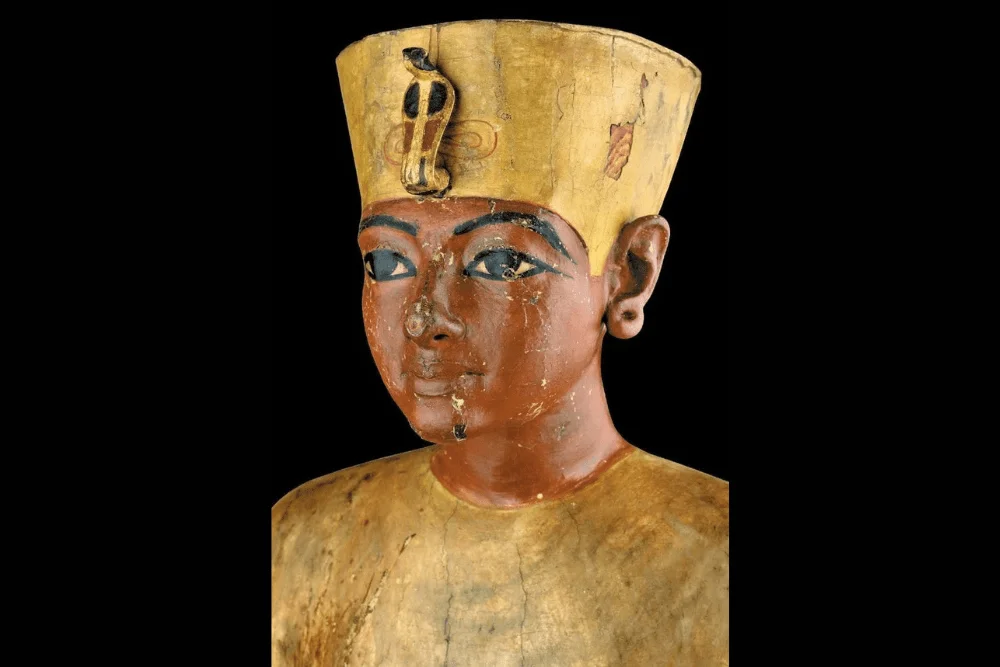
A glimpse into the life of Tutankhamun
How old was King Tut when he became pharaoh?
Historical evidence confirms that Tutankhamun—the famed boy king—ascended the throne at about nine years old. Given his youth, the early years of his reign were likely guided by a powerful regency, assisting him with the responsibilities of leading the 18th Dynasty.
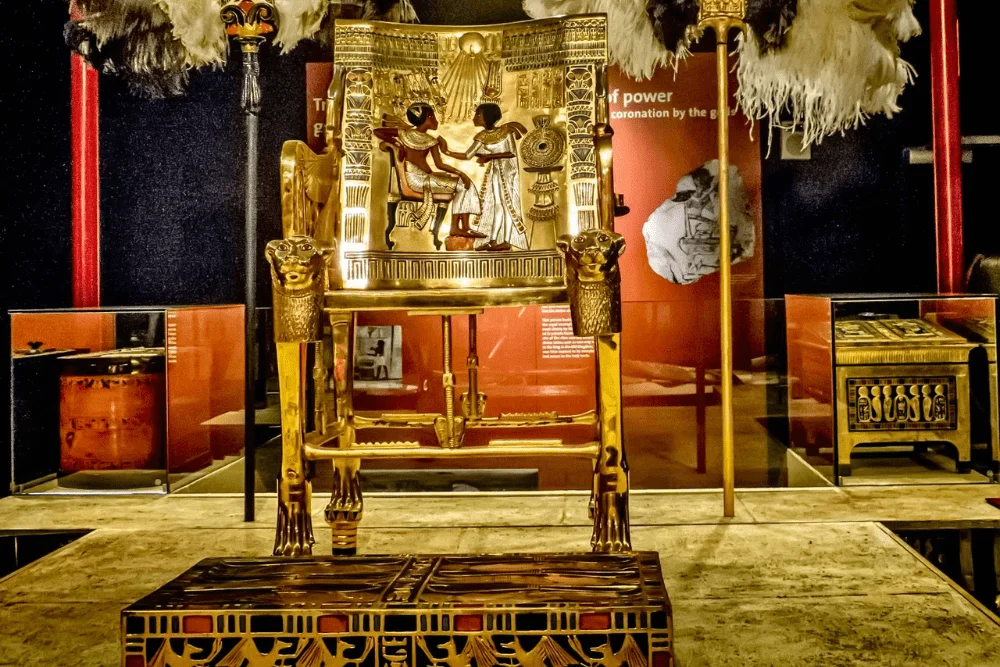
The ascent to the throne
How did King Tutankhamun die?
King Tutankhamun’s exact cause of death remains unproven. Malaria, bone disease and a leg injury have all been discussed, but finding an illness or injury in his remains does not establish that it killed him.
- What the study found: A 2010 CT and DNA study in JAMA reported malaria DNA, changes in the foot bones and a leg fracture.
- What its authors proposed: They suggested that bone disease combined with malaria was the most likely explanation for his death. This was an interpretation of the findings, not a confirmed diagnosis.
- Why uncertainty remains: A published scientific critique questioned that explanation. The surviving evidence does not establish one definitive cause.
The distinction matters: evidence that Tutankhamun had health problems is stronger than evidence identifying the particular condition that ended his life.
How old was Tutankhamun when he died?
Tutankhamun was about 18–19 years old when he died. The Metropolitan Museum of Art’s account places his accession at about nine and his death approximately nine years later; his age is an estimate, not an exact recorded birthday.
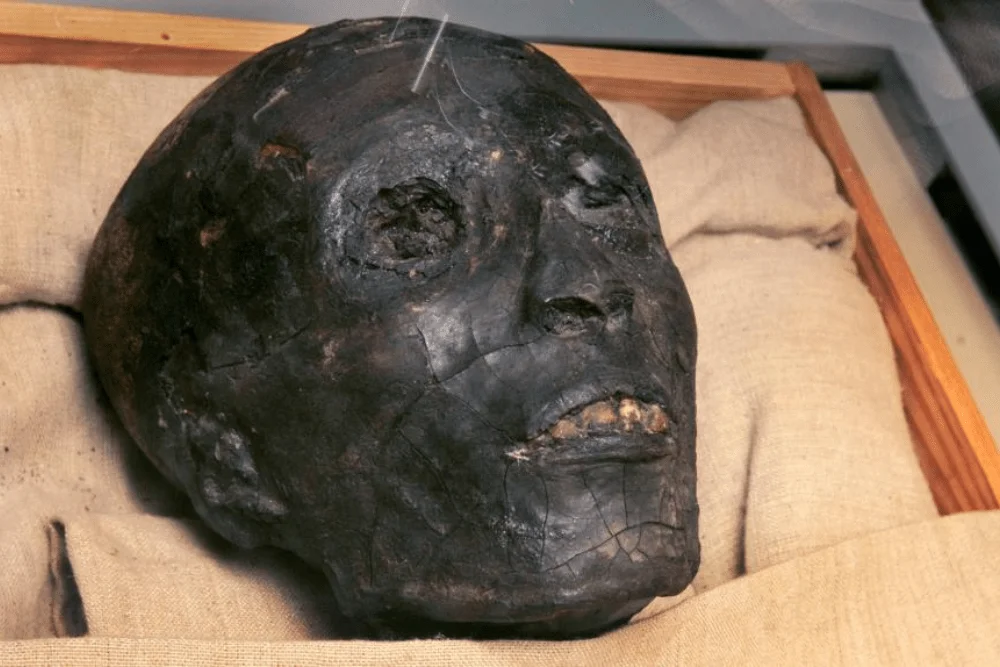
Tutankhamun
King Tutankhamun’s Tomb (KV62)
The tomb KV62 lies in the Valley of the Kings at Luxor. Discovered on 4 November 1922, it proved to be one of history’s most important archaeological finds, with thousands of objects—golden funerary equipment, jewelry, statues, chariots, and more remarkably preserved.
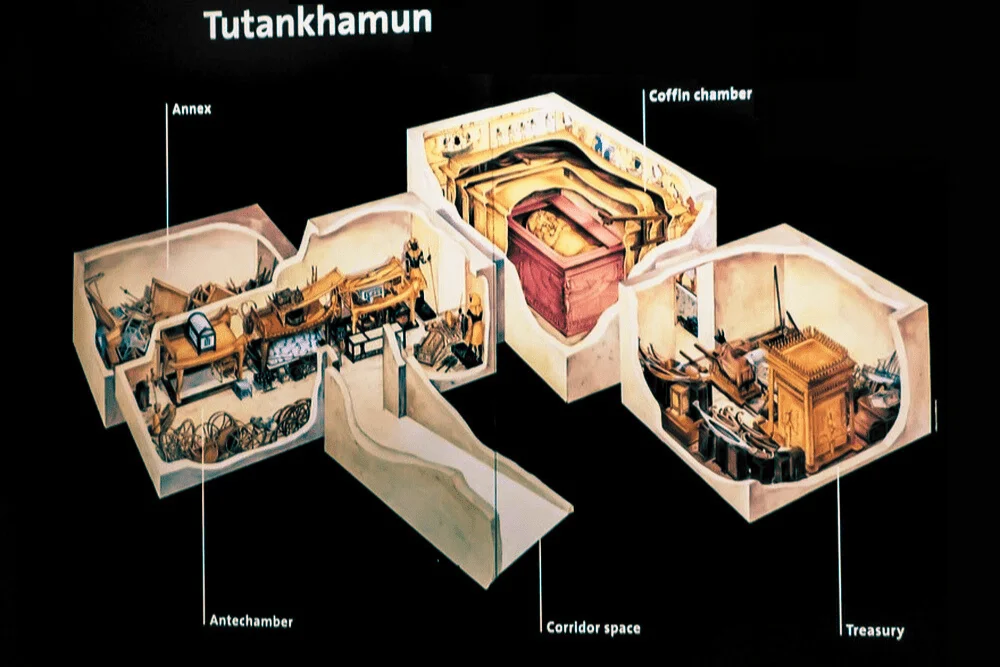
Inside the legendary tomb of King Tutankhamun
The Story of the Discovery — From Luxor to the Grand Egyptian Museum
Who discovered Tutankhamun’s tomb?
It was discovered by Howard Carter and funded by Lord Carnarvon.
The Discovery That Shook the World — Now Reborn at the GEM!
It all began with one small step in the golden sands of Luxor. In 1922, a young Egyptian boy named Hussein Abdel Rasul is said to have stumbled over a hidden stone, a step that led Howard Carter and his team straight to the sealed doorway of KV62 in the Valley of the Kings. Behind that sealed entrance lay a moment frozen in time.
When Carter peered through the opening and was asked, “Can you see anything?”, his answer became legend: “Yes, wonderful things.” More than 5,000 artifacts emerged, golden shrines and beds, chariots, statues, jewelry, and the iconic funerary equipment that turned King Tutankhamun into a global symbol of Ancient Egypt.
- 4 Nov 1922: A step cut in bedrock and a sealed doorway stamped with Tutankhamun’s name appear.
- 26 Nov 1922: First opening into the antechamber — “Yes, wonderful things.”
- 1922–1932: A decade of meticulous recording and conservation sets a benchmark for archaeology.
A century later, the story comes full circle. Today, Tutankhamun’s treasures shine anew at the Grand Egyptian Museum (GEM) beside Giza Pyramids—curated with cutting-edge conservation and storytelling so visitors can relive the discovery as if it just happened.
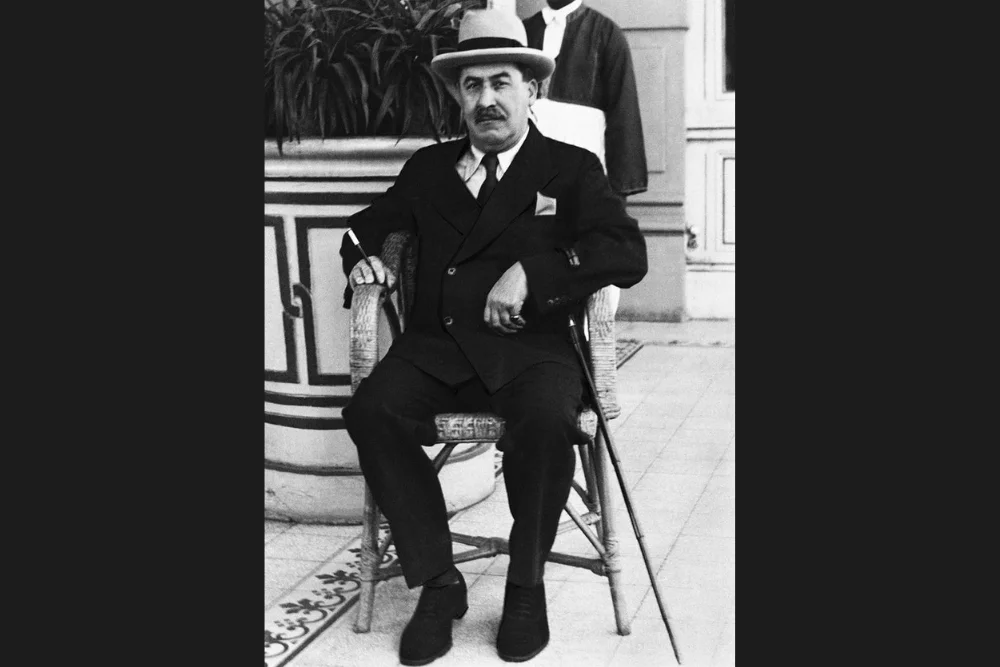
The archaeologist Howard Carter
Why is Tutankhamun famous despite his early death?
Tutankhamun’s fame comes from the remarkable preservation of his tomb (KV62) and the 5,000+ treasures found inside it. The discovery offered unmatched insight into ancient Egyptian funerary practices, religious symbolism, royal lifestyle, and New Kingdom craftsmanship, igniting a global fascination with Ancient Egypt.
- Intact burial chamber: A rare find that preserved context, layout, and ritual objects.
- Iconic artifacts: Golden shrines, chariots, statues, jewelry, and the boy king’s funerary equipment.
- Cultural impact: The discovery reshaped museum curation, conservation methods, and public interest worldwide.
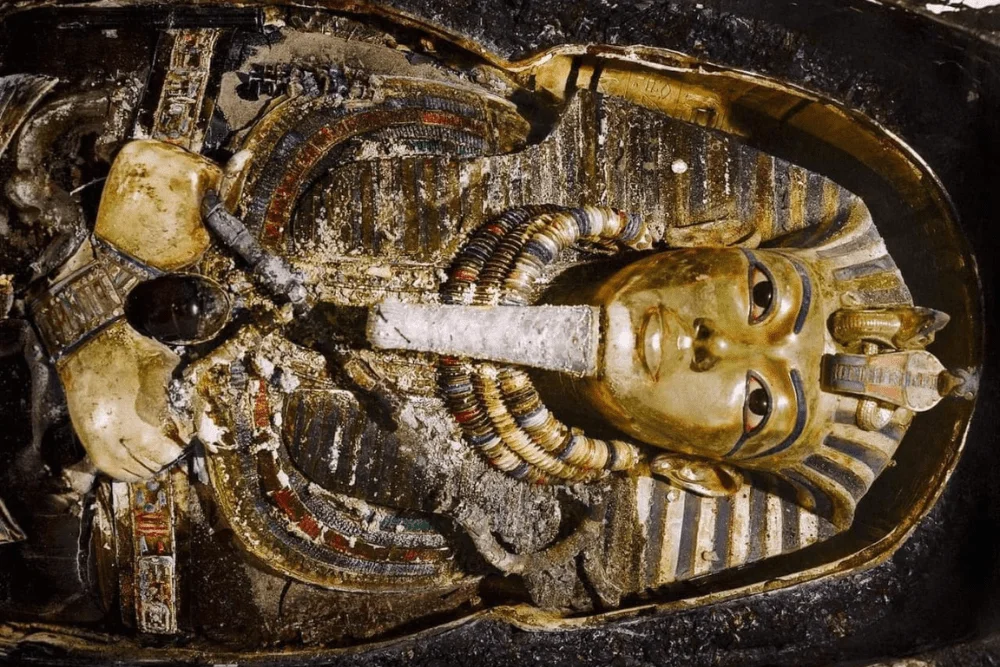
The enduring fame of King Tutankhamun
What were the names of King Tutankhamun?
Birth name: Tutankhaten — “Living Image of the god Aten,” reflecting the Amarna religious reforms under his father, Akhenaten.
Later name (after restoration): Tutankhamun Heqa-iunu-shema — “Living Image of Amun, Ruler of Southern Heliopolis (Thebes),” marking the return to traditional worship and the powerful priesthood of Amun.
The shift from Aten to Amun encapsulates the political and religious reset of the late 18th Dynasty and is central to Tutankhamun’s historical significance.
How to pronounce “Tutankhamun”
Standard English: too-tahn-KAH-moon. Minor variations exist across languages, but this is the most widely accepted pronunciation.
- Common spelling variants: Tutankhamun, Tutankhamen, Tutenkamen, Tuthankamon.
- Short form: “King Tut.”
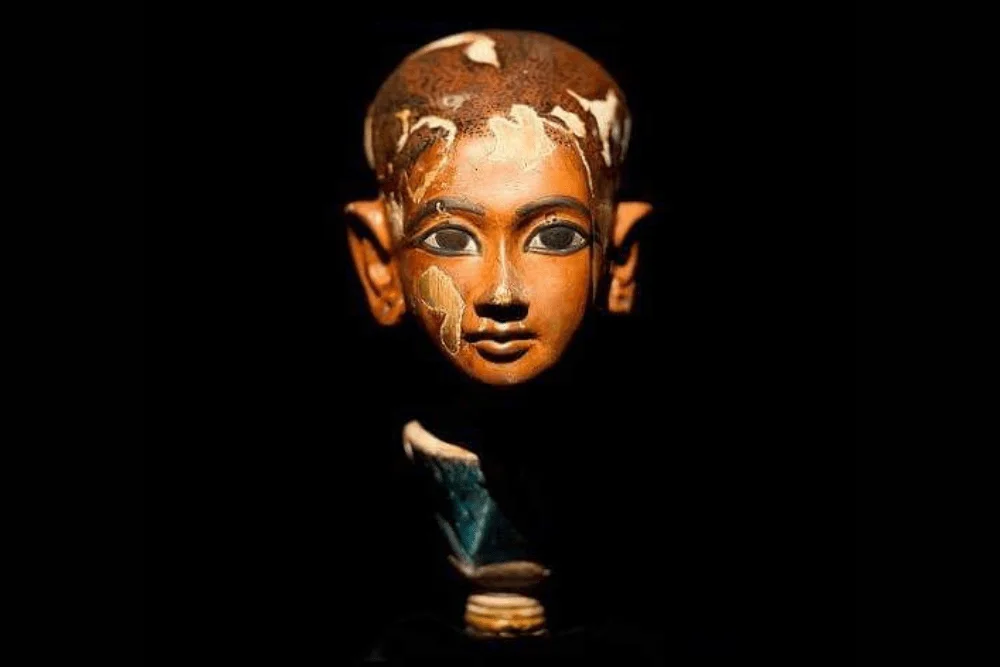
The titles and names of Tutankhamun
King Tutankhamun’s Background and Family Tree
Tutankhamun was a late-18th-Dynasty pharaoh whose family stood at the heart of Egypt’s Amarna period and its aftermath. His father is widely accepted as Akhenaten, the king who introduced the radical worship of the sun disk Aten. The identity of Tutankhamun’s mother is debated; evidence points to a close royal relative often called the “Younger Lady,” not definitively Queen Kiya.
- Father: Akhenaten (Amenhotep IV), architect of the Amarna religious revolution.
- Mother: A royal woman sometimes identified as the “Younger Lady” (exact identity uncertain in scholarship).
- Wife: Ankhesenpaaten/Ankhesenamun, daughter of Akhenaten; they married when Tutankhamun was a child king.
- Children: Two stillborn daughters were buried in KV62 (Tutankhamun’s tomb), attesting to a short, fragile royal line.
Ascending the throne around age nine, Tutankhamun initially ruled under powerful court figures, most notably the vizier Ay and the general Horemheb. During his reign, the royal court reversed Amarna policies, restoring the traditional cult of Amun and the prestige of Thebes—changes reflected even in the king’s name shift from Tutankhaten to Tutankhamun.
Why this matters: Understanding Tutankhamun’s family explains the political currents of his time—religious restoration, powerful advisors, and a fragile succession, all of which frame the story behind his tomb and its extraordinary contents.
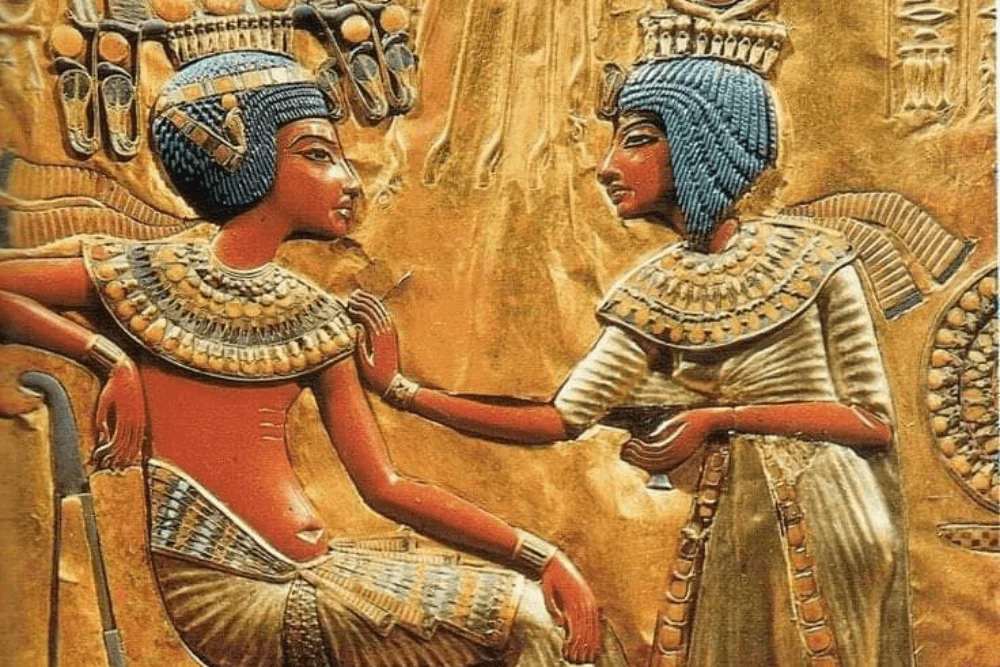
Tracing the lineage of King Tutankhamun
The Restoration of the Traditional Religion
During his brief reign, Tutankhamun reversed the Amarna religious revolution and restored Egypt’s traditional polytheism. He changed his name from Tutankhaten (“Living Image of Aten”) to Tutankhamun (“Living Image of Amun”), signaling a state-backed return to the cult of Amun and the great temples of Thebes.
- Policy shift: Reinstated priesthoods and endowments of major gods (Amun, Mut, Khonsu), reopening temples at Karnak and Luxor.
- Court & capital: Power gravitated back toward Thebes and Memphis after Akhetaten’s dominance under Akhenaten.
- Art & ritual: Artistic styles and royal titulary moved away from Aten exclusivity to classic New Kingdom forms.
This restoration defined the political and religious landscape of late 18th Dynasty Egypt and frames why King Tut became a pivotal figure despite his young age.
Tutankhamun’s Funerary Mask
The funerary mask of Tutankhamun is the most iconic artifact from KV62 and a symbol of Ancient Egypt. Crafted in solid gold and weighing about 11 kg (≈24 lb), it blends technical mastery with devotional symbolism.
- Materials & inlay: Sheets of gold with inlays of lapis lazuli, quartz, obsidian, and colored glass for the brows, eyes, and insets of the nemes headdress.
- Royal iconography: The cobra (uraeus) and vulture on the brow denote protection over Upper and Lower Egypt; the braided false beard marks divine kingship.
- Function: Served as both a likeness and a protective amulet, aligning the young king with the gods in the afterlife.
Today, Tutankhamun’s treasures are presented in a unified narrative at the Grand Egyptian Museum (GEM), allowing visitors to experience the mask and its burial assemblage in context with state-of-the-art curation and conservation.
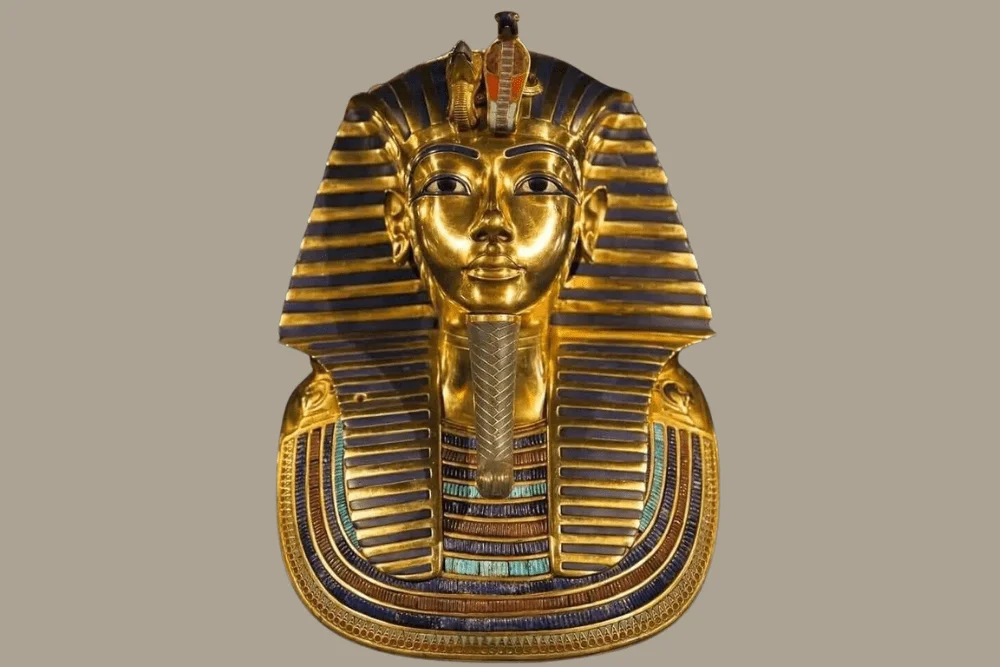
The iconic mask of Tutankhamun
The Curse of Tutankhamun
The dramatic discovery of King Tutankhamun’s tomb in 1922 quickly spawned tales of a supernatural “Mummy’s Curse.” A handful of deaths among people linked—directly or loosely—to the excavation were sensationalized by newspapers, giving rise to the legend. Modern researchers, however, widely agree there is no evidence of an actual curse; the cited deaths are explained by infection, illness, coincidence, and media exaggeration.
Stories Often Cited in the “Curse” Legend
- The canary & the cobra: On the night of the breakthrough, a cobra reportedly killed Carter’s canary, interpreted by some as an omen. Carter’s staff warned him not to disturb the tomb.
- Lord Carnarvon’s death: Months after the discovery, Carnarvon died following an infection believed to have started from an insect bite. Later commentary noted Tutankhamun’s mummy had a mark on the left cheek, fueling lore, but medical causes remain the accepted explanation.
- Other deaths mentioned: Carnarvon’s favorite dog allegedly died soon after; by 1929, press reports counted several early deaths among people tangentially connected to the find, such as Carter’s secretary Richard Bethell.
What Scholars Say
- No pattern of a “curse”: Many core members of the team lived long lives—Howard Carter himself died at 64 (not immediately after the opening), and several colleagues reached old age.
- Natural causes: The alleged “curse victims” had plausible medical explanations (infection, pre-existing conditions) rather than mysterious forces.
- Media amplification: Sensational headlines and public fascination with Egyptology in the 1920s amplified coincidences into a compelling myth.
In short, while the Curse of Tutankhamun makes for a memorable story, it remains a myth. The enduring legacy of the discovery lies not in superstition, but in the unparalleled insight it provides into New Kingdom art, religion, and royal life.
Tutankhamun’s DNA Analysis
CT scans examine the structure of Tutankhamun’s remains; DNA analysis investigates genetic relationships and traces of infection. These methods answer different questions, and their findings must be distinguished from explanations proposed for his death.
Key Takeaways
- Family relationships: The 2010 study identified genetic relationships among the tested royal mummies, while the historical identities of some individuals remain debated.
- Foot condition: The researchers diagnosed a left clubfoot, but orthopedic specialist James G. Gamble challenged that interpretation in a JAMA letter. It should not be presented as an undisputed finding.
- Malaria: Detecting parasite DNA supports infection during his lifetime; it does not, by itself, establish the cause of death.
For visitors and researchers alike, King Tutankhamun’s DNA results help paint a clearer picture of life, health, and mortality in ancient Egypt, enriching our understanding beyond the art and gold to the pharaoh’s human story.
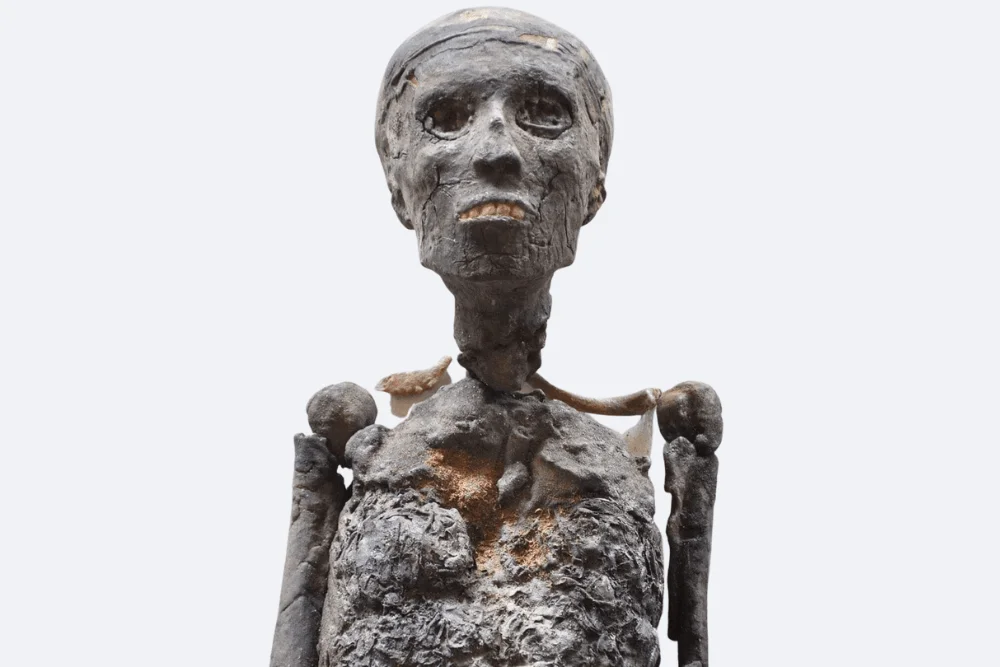
Unlocking the secrets through DNA analysis
King Tutankhamun’s Worldwide Exhibitions
For over a century, blockbuster Tutankhamun exhibitions have toured major cities, drawing millions and igniting global fascination with Ancient Egypt. Many shows presented original objects from KV62 (alongside carefully curated replicas in some displays) with immersive scenography that brought the boy king’s world to life.
What these tours achieved
- Public engagement: Introduced millions to New Kingdom art, religion, and funerary practice.
- Conservation awareness: Highlighted the need for climate control, documentation, and preventive care.
- Scholarship & access: Funded research while allowing audiences worldwide to encounter Tut’s story first-hand.
Today, that journey reaches a natural homecoming: the Grand Egyptian Museum (GEM) is designed to present the most comprehensive, conserved, and contextual display of King Tutankhamun’s treasures under one roof, reuniting objects that once toured the world.
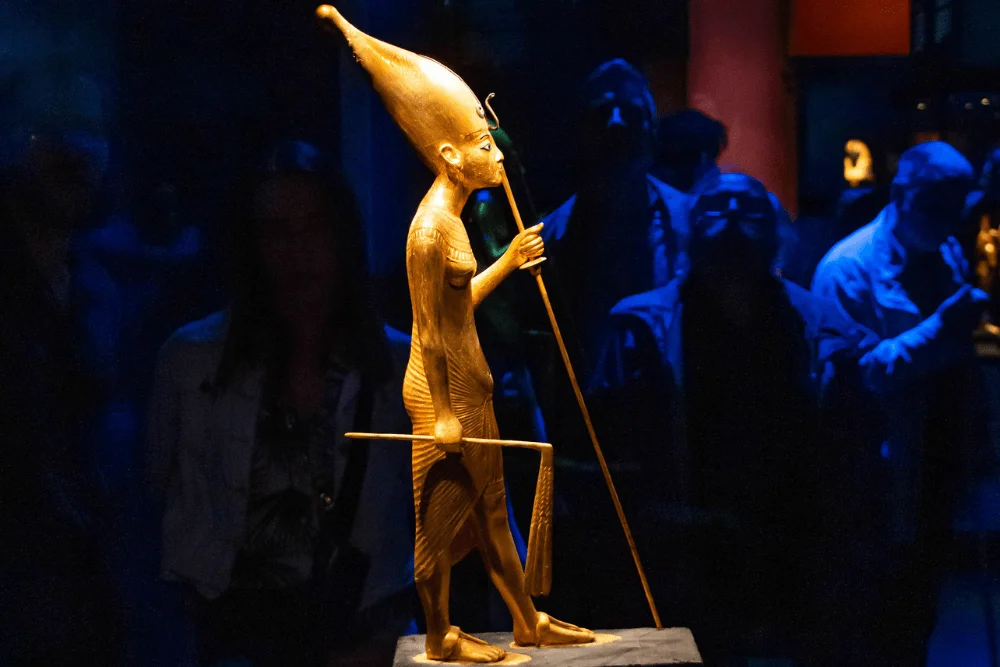
The global exhibitions of King Tutankhamun’s treasures
Tutankhamun Cartouche
A cartouche is an oval loop that encloses a pharaoh’s name in hieroglyphs, signifying royal, protected status. Tutankhamun’s names appear in cartouches across jewelry, shrines, canopic equipment, and seals, helping archaeologists authenticate objects and trace the king’s changing theology and titulary.
Names & meanings
- Birth name (nomen): Tutankhamun, “Living image of Amun.” Earlier, as Tutankhaten (“…of Aten”), reflecting the Amarna period before the religious restoration.
- Throne name (prenomen): Nebkheperure, “Lord of the manifestations of Re.” This appears widely on funerary furniture and seals.
The Tutankhamun cartouche is more than a label; it encodes ideology, kingship, and divine protection. Its presence across KV62 artifacts was crucial in confirming the tomb’s identity and the integrity of its assemblage. Today, the same ancient idea of enclosing and protecting a name continues to inspire modern cartouche necklace designs, where a personal name becomes a symbol of identity, heritage, and remembrance.
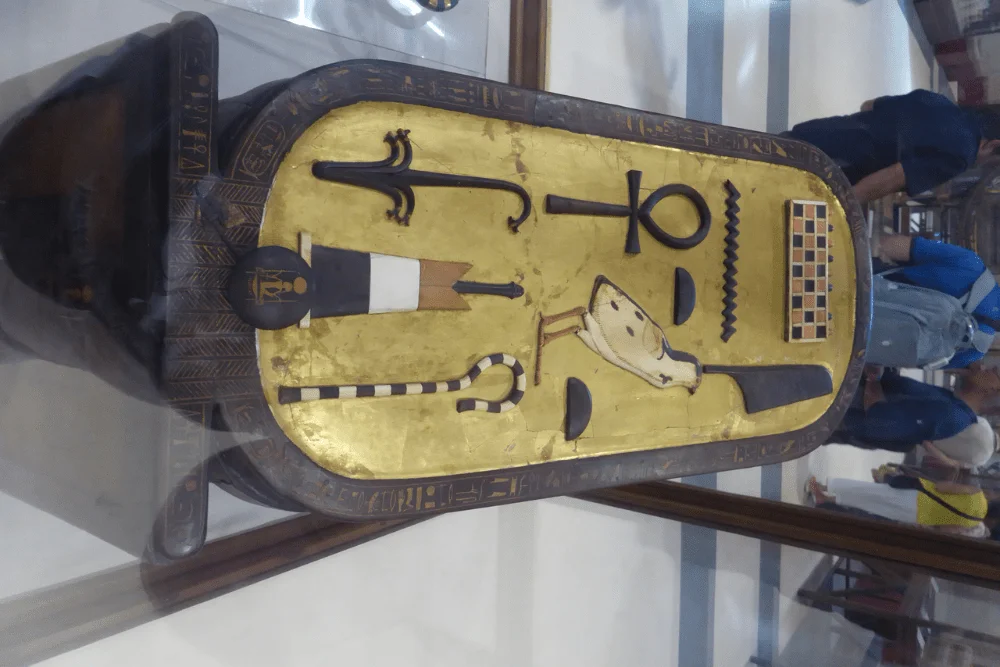
The royal cartouche of Tutankhamun
Tutankhamun’s Resting Place
Where is the mummy now? King Tutankhamun’s mummy remains in situ inside his tomb KV62 in the Valley of the Kings near Luxor City. Visitors to KV62 can see the pharaoh’s mummy in a protective display case inside the tomb and view the burial chamber from the visitor platform.
Where are the treasures? Tutankhamun’s golden mask and the major funerary assemblage—formerly displayed at the Egyptian Museum (Tahrir)—are now presented at the Grand Egyptian Museum (GEM) beside the Giza Pyramids.
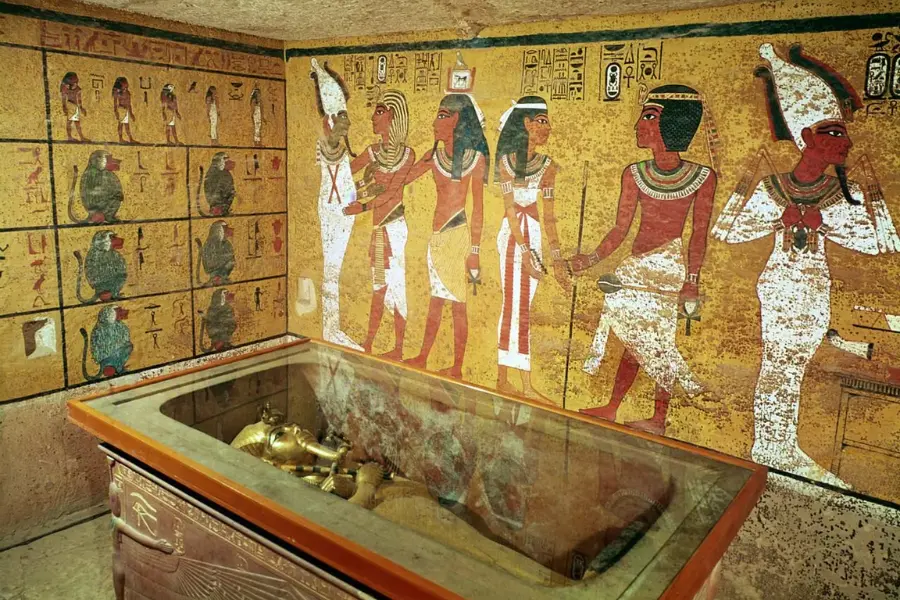
Burial chamber of Tutankhamun in the Valley of the Kings.
Tutankhamun’s Treasures Moved and the Grand Egyptian Museum Opening
After more than two decades of anticipation, the Grand Egyptian Museum (GEM) held its official inauguration on 1 November 2025 and opened fully to the public on 4 November 2025. For the first time since Howard Carter’s 1922 discovery, the complete collection of Tutankhamun’s treasures, more than 5,000 objects, is displayed together under one roof beside the Giza Pyramids. The opening marked a historic milestone for Egyptian archaeology, allowing visitors to experience the entire funerary collection as a single narrative rather than viewing objects across multiple museums and storage facilities.
What visitors experienced
- Immersive galleries: purpose-built halls that present Tutankhamun’s full burial assemblage as one continuous story, from life and courtly ritual to death, burial, and afterlife.
- Advanced display: precision lighting, custom mounts, and climate control to protect gold leaf, wood, textiles, pigments, and organic resins.
- Conservation in action: state-of-the-art labs supporting long-term research, stabilization, and restoration.
- Iconic setting: a new cultural landmark beside the Giza Pyramids, connecting the story of King Tut to Egypt’s most famous skyline.
Quick recap: Tutankhamun’s mummy remains in KV62 (Luxor), while his treasures now greet the world at the GEM (Giza).
Tutankhamun at the Grand Egyptian Museum (GEM)
The Grand Egyptian Museum (GEM) offers the most comprehensive, narrative display of King Tutankhamun’s treasures ever assembled—using state-of-the-art conservation, lighting, and interpretation. Here, visitors can understand the boy-king’s world from courtly life to burial and rebirth through a coherent, immersive route.
What you’ll see from Tutankhamun’s Collection
- Golden shrines & nested coffins: Monumental gilded shrines and the nested coffin set that safeguarded the royal body.
- Canopic shrine & coffins: The exquisite canopic ensemble protecting the king’s viscera for the afterlife.
- Ceremonial chariots & weaponry: Chariots, bows, and regalia demonstrating royal mobility and power.
- Furniture & ritual beds: Lion-leg thrones, ritual beds, and masterfully crafted pieces made “for eternity.”
- Jewelry & personal items: Pectorals, broad collars, amulets, cosmetics containers, and symbolic daily-life objects.
- Iconic masterpieces: The lotus (wishing) cup, superb inlays, and definitive New Kingdom craftsmanship.
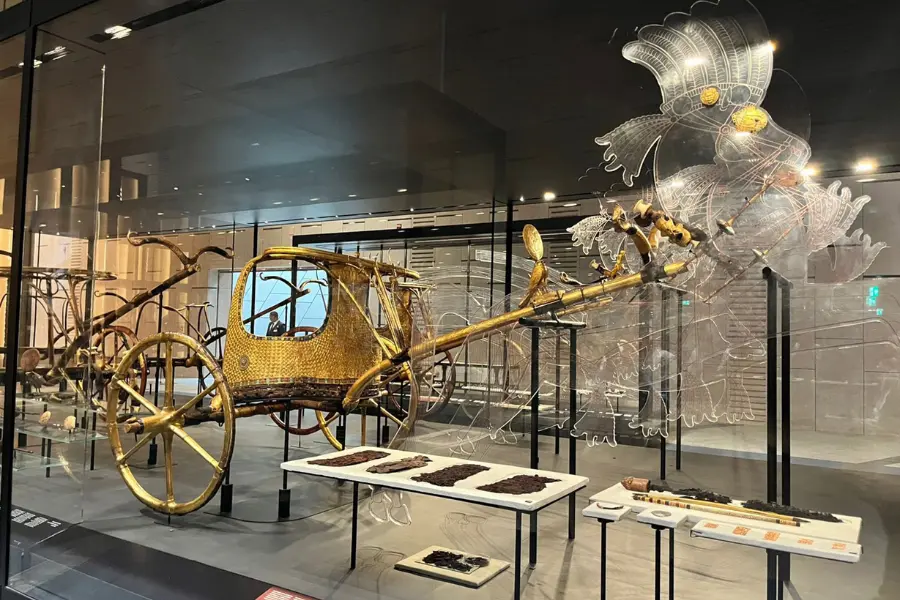
Tutankhamun’s ceremonial gilded chariot presented with an interpretive display at the Grand Egyptian Museum.
Where to find Tutankhamun inside the GEM
After entering via the Grand Atrium (home to the colossal Ramses II), follow the main circulation to the dedicated Tutankhamun galleries. The collection is arranged as an immersive storyline that reconstructs the burial and the “wonderful things” Carter described.
Planning your visit? For tickets, opening hours, maps & wayfinding, see our Grand Egyptian Museum – Visitor Guide.
Note: Tutankhamun’s mummy remains in Tomb KV62 at Luxor. The GEM showcases the funerary assemblage and the historical context.
Why the GEM display matters
With world-class labs and gallery design, the GEM delivers the largest, most coherent presentation of Tutankhamun’s world—connecting objects, rituals, and meaning so visitors grasp the scale and significance of this unparalleled discovery with 21st-century clarity.
Today, the Tutankhamun galleries are permanently open as part of the complete Grand Egyptian Museum experience. Visitors enter through the Grand Atrium, home to the colossal statue of Ramses II, before ascending the Grand Staircase toward the dedicated Tutankhamun exhibition halls.
To fully appreciate the collection, plan at least 3–4 hours inside the museum, or half a day if you wish to explore all major galleries at a comfortable pace. Many travelers choose guided Egypt tours that include the GEM to gain deeper insight into the artifacts and their historical significance.
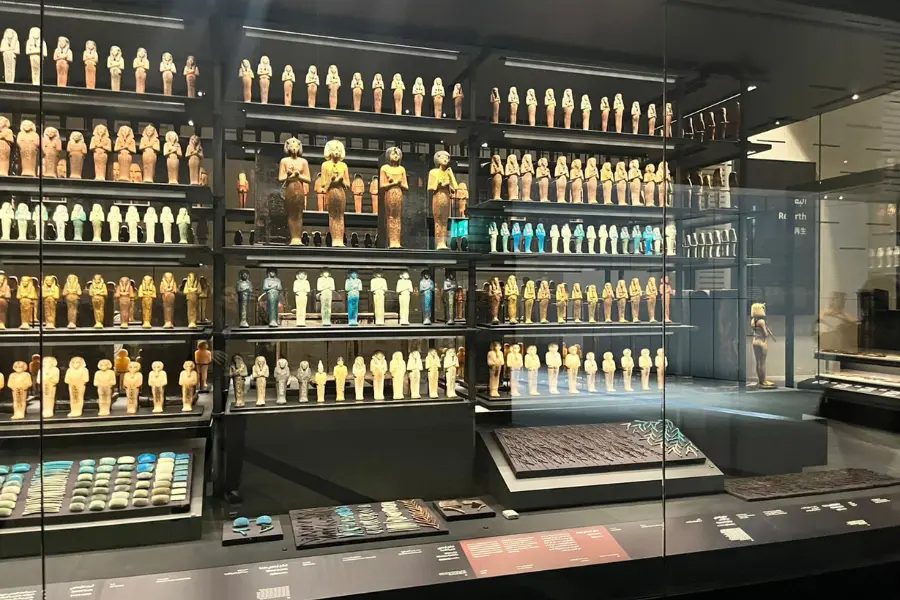
The ushabti “workforce” buried with Tutankhamun to serve him in the afterlife.
The Legacy of King Tutankhamun
King Tutankhamun’s legacy far outlived his brief reign. The discovery of the relatively intact KV62 transformed global understanding of New Kingdom culture, funerary art, and court life, and it ignited a century-long fascination with ancient Egypt that still shapes scholarship, museums, and popular culture today.
Beyond the treasures, Tutankhamun is remembered for restoring traditional religion and state institutions after the Amarna period, helping to re-center ritual life and royal ideology in Thebes. His name became a symbol of both the fragility of power and the timeless brilliance of Egyptian craftsmanship.
Monuments and works attributed to Tutankhamun include:
- At the Karnak Temple, restorations and reliefs on the Third and Sixth Pylons, plus stelae depicting offerings to Amun and Mut, a statue of Khonsu is also associated with his features.
- A mortuary temple for Tutankhamun is attested, but its exact location and whether it was completed remain uncertain.
- Evidence of royal building activity at Memphis and in Nubia (sites such as Kawa and Faras) indicates continued investment in key cult and administrative centers.
In essence, King Tut stands at the crossroads of upheaval and renewal: a young ruler whose death sealed a time capsule of “wonderful things,” and whose reign helped steer Egypt back toward the traditions that defined its enduring civilization.
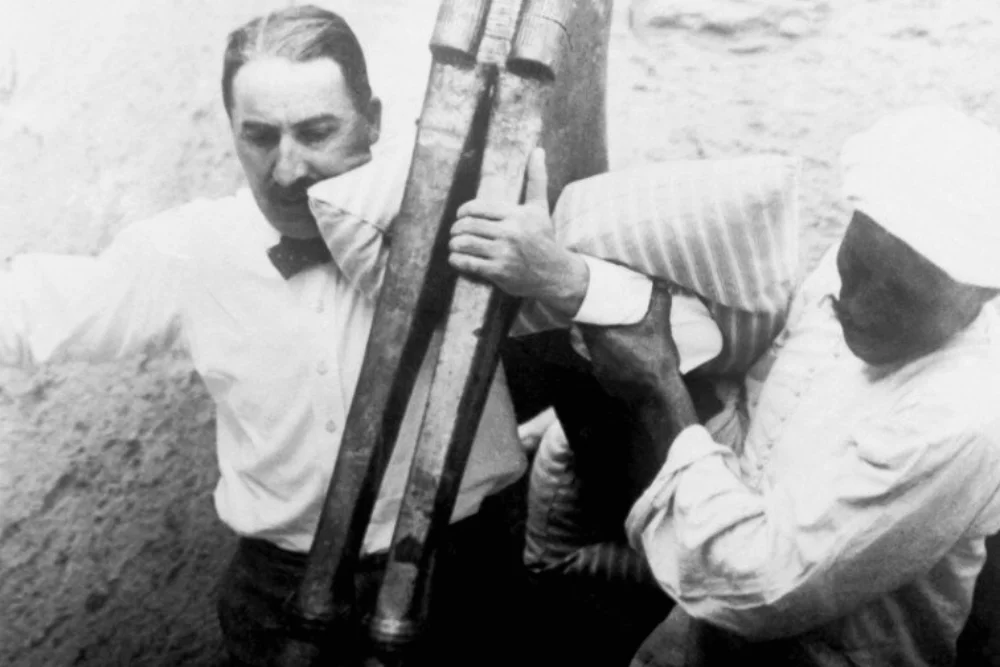
Reflecting on Tutankhamun’s enduring legacy
How to Visit Tutankhamun Today
Today, visitors can experience the story of Tutankhamun in two different locations. His treasures are displayed at the Grand Egyptian Museum (GEM) near the Giza Pyramids, while his mummy remains inside Tomb KV62 in the Valley of the Kings at Luxor. Seeing both sites offers the most complete understanding of the young pharaoh’s life, death, and legacy.
Tutankhamun’s Treasures at the Grand Egyptian Museum (GEM)
The Grand Egyptian Museum is now home to the complete collection of Tutankhamun’s treasures, with more than 5,000 objects displayed together for the first time since Howard Carter discovered the tomb in 1922. Highlights include the famous golden funerary mask, the nested coffins, ceremonial chariots, jewelry, furniture, and hundreds of personal belongings that accompanied the king into the afterlife.
Tickets and booking: Use the official Grand Egyptian Museum ticketing website to check the price for your visitor category and selected date. Choose the admission or guided-tour option that matches your visit; the booking flow shows the available entry times. Admission includes the Tutankhamun Galleries.
Opening hours: Check the museum’s official schedule before planning your day. Gallery hours differ on Wednesdays and Saturdays, and last entry is one hour before the galleries close. An entry slot is not a guarantee of a quieter visit.
How Long to Spend: Plan at least 3–4 hours for the museum. Since the GEM is located only about 2 km from the Giza Pyramids, many visitors combine both attractions on the same day.
Suggested Tour: Cairo Day Tour including the Grand Egyptian Museum
Tutankhamun’s Tomb (KV62) in Luxor
While the treasures have moved to Giza, Tutankhamun’s mummy remains in its original resting place inside Tomb KV62 in the Valley of the Kings on Luxor’s West Bank. Visitors can see the pharaoh’s mummy in a protective display case and view the burial chamber from the visitor platform.
Tickets: Entry to KV62 requires a separate special ticket in addition to the general Valley of the Kings admission ticket.
- Valley of the Kings General Ticket (foreign adults): 750 EGP
- Tutankhamun Tomb (KV62) Special Ticket (foreign adults): 700 EGP
Note: These are the current official ticket prices at the time of writing. Ticket prices may change without prior notice, so please contact us when booking to confirm the latest updated prices before your visit.
Best Time to Visit: Early morning is the most comfortable time to visit, helping travelers avoid both the heat and the busiest crowds.
Suggested Tour: 2-Day Tour to Luxor from Cairo by Flight. The standard itinerary does not include special-ticket tombs; ask about adding KV62 before booking.
To see both the tomb and the treasures, plan visits to KV62 in Luxor and the Grand Egyptian Museum in Giza. The four-day Cairo and Luxor itinerary below visits the Egyptian Museum in Tahrir, not the GEM; confirm any additional GEM visit and KV62 ticket before booking.
Suggested Tour: 4 Days Cairo and Luxor Tour Package
Tutankhamun’s Allies and Enemies
Key Allies
Ay (Vizier → King): Likely the closest political mentor to Tutankhamun and possibly a great-uncle. Ay helped stabilize the court during the boy-king’s early reign and, after Tutankhamun’s death, succeeded him as pharaoh. Many scholars believe he married the young widow Ankhesenamun to legitimize succession and protect the royal line.
Horemheb (General → King): A powerful military leader who served under Tutankhamun. Horemheb’s authority over the army and provinces helped reassert central control after the Amarna upheavals. He later became the last ruler of the 18th Dynasty and is credited with wider administrative and religious restorations.
Priesthood of Amun & Theban elites: As Tutankhamun reversed Amarna religious policy, the Amun priesthood and Theban nobility were natural allies who backed the return to traditional cults and rituals.
Likely Adversaries & Pressures
Amarna loyalists: Supporters of Akhenaten’s Aten-focused reforms would have resisted the restoration of Egypt’s traditional polytheism and the Amun cult, creating ideological and bureaucratic friction at court.
Foreign threats: Egypt faced strategic pressures on multiple fronts — notably from the Hittites in the north, and intermittent conflicts along southern (Nubian) and western (Libyan) borders. While direct campaigns under Tutankhamun are not well documented, these powers represented ongoing security concerns.
Note: Evidence for personal alliances and rivalries in Tutankhamun’s short reign is fragmentary. Modern reconstructions rely on inscriptions, later king lists, and administrative traces, so details remain open to scholarly interpretation.
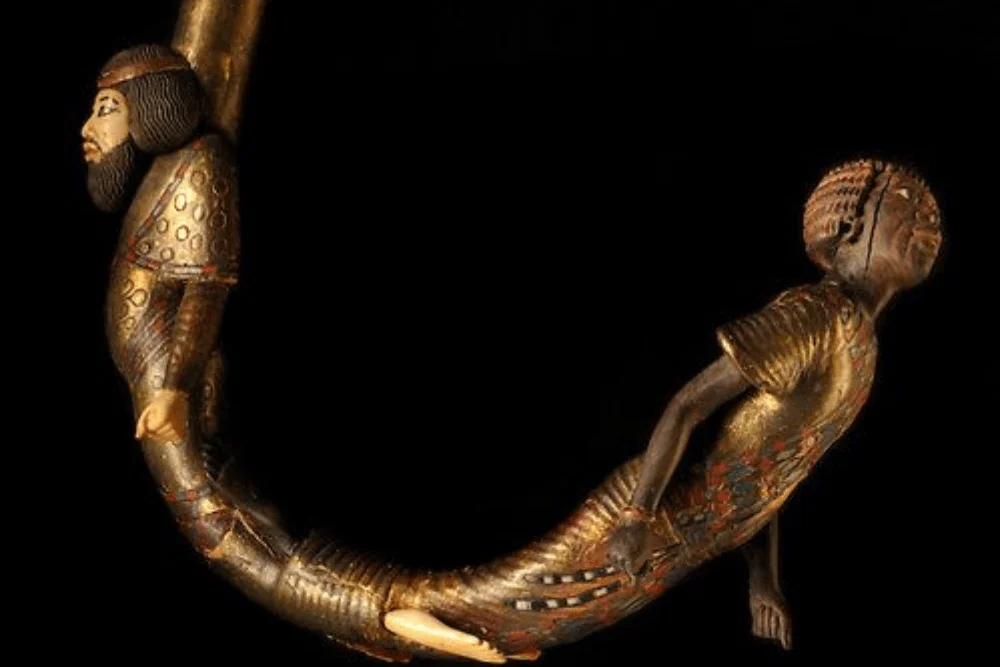
The pharaoh’s allies and adversaries
Conclusion — King Tutankhamun, From Valley Silence to Global Spotlight
From a boy-king with a brief reign to the world’s most iconic pharaoh, Tutankhamun bridges archaeology, art, and storytelling like no other figure in ancient Egypt. His relatively intact tomb (KV62) in the Valley of the Kings reshaped our understanding of royal life, belief, and craftsmanship—while the modern display of his treasures at the Grand Egyptian Museum (GEM) brings that wonder into a 21st-century experience.
Today, travelers can witness the original resting place in Luxor and explore the full Tutankhamun collection in Giza—a rare, complementary journey that connects context and conservation. Whether you’re drawn by golden shrines, intimate everyday objects, or the mystery of his life and death, King Tut’s story remains an unforgettable gateway to the soul of ancient Egypt.
If you’re planning your visit, pairing Luxor (KV62) with a deep-dive into Tut’s treasures at GEM is the definitive way to experience his legacy—seamlessly blending history, design, and immersive interpretation.
Plan Your Tutankhamun & Grand Egyptian Museum Experience
Compare the itineraries below for visits to the Grand Egyptian Museum and other highlights of Egypt. Routes vary: the eight-day Cairo, Alexandria and Siwa tour does not visit Luxor. For itineraries that visit the Valley of the Kings, confirm whether the separate KV62 ticket is included before booking.
16 Days Cairo, Nile Cruise & Siwa Tour
Iconic Cairo + cruise highlights, topped with Siwa’s desert magic—including a GEM visit for Tut’s full story.
14 Days Cairo, Luxor, Hurghada & Oases Tour
From Giza & GEM to Nile temples and desert oases—an immersive Egypt grand tour.
10 Days Cairo, Nile Cruise & Bahariya Oasis
Hit Cairo’s essentials (incl. GEM), sail the Nile, then venture to the White Desert via Bahariya.
8 Days Cairo, Alexandria & Siwa Oasis
A compact route pairing GEM & Giza with Mediterranean heritage and Siwa’s oasis charm.
Plan Your Egypt Tour with a Private Guide
Explore Egypt with a private guide and a smooth, well-planned itinerary. Browse our ready-made Egypt tour packages or let us tailor-make your trip based on your travel dates and interests.
Frequently Asked Questions about Tutankhamun
Who was Tutankhamun?
Tutankhamun, also known as King Tut, was an ancient Egyptian pharaoh of the 18th Dynasty during the New Kingdom. He became king at a very young age and ruled for a short period, but his tomb and treasures made him one of the most famous figures in ancient Egyptian history.
How old was Tutankhamun when he became pharaoh?
Tutankhamun is believed to have become pharaoh at around nine years old. Because of his young age, powerful court figures such as Ay and Horemheb likely helped guide the kingdom during his reign.
Why is Tutankhamun so famous?
Tutankhamun is famous mainly because his tomb, KV62, was discovered almost intact in the Valley of the Kings in 1922. The tomb contained more than 5,000 objects, including golden shrines, jewelry, chariots, furniture, and his iconic funerary mask.
How did Tutankhamun die?
The exact cause of Tutankhamun’s death is still debated. Modern studies suggest that several health factors may have contributed, including a severe leg injury, malaria infection, and underlying physical conditions. No single cause has been confirmed with complete certainty.
Where is Tutankhamun’s tomb?
Tutankhamun’s tomb, known as KV62, is located in the Valley of the Kings on the West Bank of Luxor. His mummy remains inside the tomb, where visitors can see it in a protective display case inside the tomb.
Where can visitors see Tutankhamun’s treasures today?
Tutankhamun’s treasures are displayed at the Grand Egyptian Museum near the Giza Pyramids. Visitors can see the famous golden mask, royal coffins, chariots, jewelry, furniture, and many other objects from his burial collection as part of the museum experience.