
Ancient Egyptian Names: Meanings, Gods, Pharaohs & Modern Influences
Ancient Egyptian personal names include Amenhotep (“Amun is satisfied”), Ramesses (“Re has given birth to him”) and Imhotep (“the one who comes in peace”). Women’s names include Hatshepsut (“foremost of noble women”), Nefertiti (“the beautiful one has come”) and Meritamun (“beloved of Amun”).
These names offer a starting point for exploring ancient Egypt. The sections below explain their meanings, the people who bore them, and the naming practices behind them. They also distinguish personal names from divine names, royal titles and modern names used in Egypt. English translations sometimes differ, and a famous name is not necessarily a common one.
How Did Ancient Egyptian Children Get Their Names?
Names could express religious associations, family connections or wishes for a child. The evidence comes from particular people, documents and periods; it does not reveal one naming formula followed by every Egyptian household.
Names connected with gods and religious devotion
A name containing a deity’s name is often called theophoric. Amenhotep includes Amun, while Ramesses invokes Ra, also written Re. Such names express a relationship with a deity rather than turning the bearer into that god. They are one way naming intersects with ancient Egyptian religion.
Family connections, good wishes and birth circumstances
Imhotep expresses peaceful arrival. A translation can reveal this kind of meaning without proving the exact words spoken when a particular child was born.
Egyptologist Günter Vittmann discusses names connected with birth circumstances and additional names acquired later in life in the UCLA Encyclopedia of Egyptology. That evidence supports varied practices, not the claim that every name came from an exclamation by a mother or midwife.
Why a name mattered
A name identified a person in society and helped preserve that identity after death. In Egyptian belief, recording or erasing a name could carry religious significance. Names therefore belong to the study of Egyptian culture as well as language.
When reading a naming story, separate the translation, the historical bearer and the explanation for choosing it. A source may establish one of those without proving the other two.
Further examples of religious names include Amenemhat, interpreted by The Met as perhaps meaning that Amun is in front; Hesi-Ra (Hesy-Ra), referring to praise received from Ra; and Hem-Ra, a servant of Ra. The latter two are documented in Vittmann’s study of personal names. Ptahhotep expresses Ptah’s satisfaction, according to The Met. These are personal names, not automatically nicknames.
Djed-Ptah-iuf-ankh expresses Ptah’s declaration that the child will live. Vittmann explains its oracular background while warning that an individual bearer need not have received the name through an oracle.
For non-royal examples, Nakht conveys strength in Vittmann’s study. Seneb is rendered “healthy” in an academic discussion of the named official. These documented forms replace the earlier spellings Nakhti and Sanab here; similarity alone is not proof that every variant denotes the same name.
Ancient Egyptian Nicknames and Multiple Names
Some people had more than one name. Vittmann documents Old Kingdom distinctions between a major name and a minor or “beautiful” name. These examples do not establish a universal arrangement of one name from the mother, one from the father and a third nickname.
Shortened names and everyday use
For a documented example, Egyptologist Maren Schentuleit’s research on Graeco-Roman Dime in the Fayum gives Peteosiris and its short form Pasis. The fuller name refers to a gift from Osiris. This is a useful example of an alternative form in a defined community and period.
It would be misleading to turn that example into a rule that all children were rarely addressed by their full names. A shortened form, an additional formal name and a royal title are also different things, even when a modern list places them together under “nicknames.”
Protective names and uncertain nickname lists
Some names could have protective significance. That does not establish a protective purpose for every humorous nickname. Lists of animal names, household objects or phrases such as “the fool” need evidence of their actual use before they can be presented as established Egyptian personal names.
Animal-based personal names are attested: Vittmann records Pnw (mouse), Pa-bik (falcon), Pa-miu (cat) and Pa-mesah (crocodile). They should not all be presented as humorous childhood nicknames or protection against envy. His study also records Ibi without translating it; it does not establish the earlier Ebi/Bibi list as rhyming children’s nicknames.
Naming Customs, Family Records and Male and Female Names
Names outside royalty are preserved in family and work records as well as monuments. The Met’s study of an artisan’s tomb at Deir el-Medina identifies a household whose members include:
- Sennedjem: a member of the royal tomb work crew.
- Iineferti: Sennedjem’s wife.
- Khonsu: their son, also connected with the work crew.
- Tameket: Khonsu’s wife.
These names show why a guide should include ordinary families alongside famous rulers. The source establishes the people and relationships; it does not supply a translation for every name or a popularity ranking for the whole country.
Can the meaning tell you whether a name is male or female?
The identity of a deity inside a name is not a reliable male/female rule. Women could have names referring to male gods: Ankhesenamun invokes Amun, and Sobekneferu invokes Sobek. Recorded use and historical context matter more than a modern assumption about whether a meaning sounds masculine or feminine.
The Dime research also shows why naming patterns need to be studied within their own setting. Avoid using one household, one dynasty or one English translation to make claims about every boy or girl in ancient Egypt.
Other documented names include Irynefer, listed with tomb TT290 in the IFAO archive, and Mutnofret, named as a king’s mother in Museo Egizio’s inscribed situla. These records establish bearers, but do not substantiate the translations previously attached to those names here.
Modern Egyptian Names and Ancient-Name Origins
A name used in Egypt today is not automatically ancient Egyptian in origin. Modern use, language of origin and documented ancient use are three different questions.
Ramesses/Ramses is an attested ancient royal name, with a divine element referring to Re. That does not, by itself, tell us how often it is given to children today. Nor does resemblance to an ancient name prove uninterrupted use over thousands of years.
The story of Narmer belongs to the history of kingship. It does not, on its own, establish the ancient origin sometimes claimed for the modern name Mina.
How to check a claimed ancient origin
- Find an attested bearer: a named person in an inscription, document or reliable museum record.
- Check the language: a name borne by a ruler of Egypt may be Egyptian, Greek or from another linguistic tradition.
- Separate meaning from popularity: a dictionary entry does not establish current baby-name rankings.
- Compare spellings carefully: transliteration and forms transmitted through Greek can look quite different.
This distinction matters when choosing a baby name or a fictional character’s name. A historically attested ancient name and a name used by Egyptian families today can both be valid choices, but they answer different requests. The examples here document ancient names; they are not a current list of Egyptian surnames or the most popular modern baby names.
Ancient Egyptian Pharaoh Names and Their Meanings
Royal names offer well-documented examples, but not every Egyptian male name belonged to a king. The following table includes royal names and Imhotep, an official associated with King Djoser. A historical bearer establishes the name’s existence, not its frequency among the wider population.
| Name | Meaning and historical context |
|---|---|
| Amenhotep | Amun is satisfied. Several Dynasty 18 kings bore this name. The Met’s Amenhotep I relief explains the translation. |
| Ramesses / Ramses | Re has given birth to him. The translation appears in the Allard Pierson Museum’s stela of Ramesses I. Ramesses II is another famous bearer. |
| Tutankhamun | Living image of Amun. His earlier name, Tutankhaten, referred to Aten. Harvard’s account of its museum exhibition explains the change. |
| Thutmose | Commonly rendered “born of Thoth.” Hunt Museum explains the divine element in the name Tuthmosis, another spelling of Thutmose. |
| Imhotep | The one who comes in peace. An official associated with King Djoser; Princeton’s museum record distinguishes the historical figure from his later reputation. |
| Merneptah | Traditionally “beloved of Ptah”; also interpreted as “he whom Ptah loves.” A linguistic discussion published by the University of Chicago notes the different grammatical interpretations. Both connect the name with Ptah. |
| Seti | A name referring to the god Seth. The Met’s Seti I record identifies the Seth element. Read more about Seti I. |
Why did a pharaoh have more than one name?
The established royal titulary included five names: the Horus name, Two Ladies name, Golden Horus name, throne name and birth name. This formal system should be distinguished from an ordinary person’s additional name or nickname.
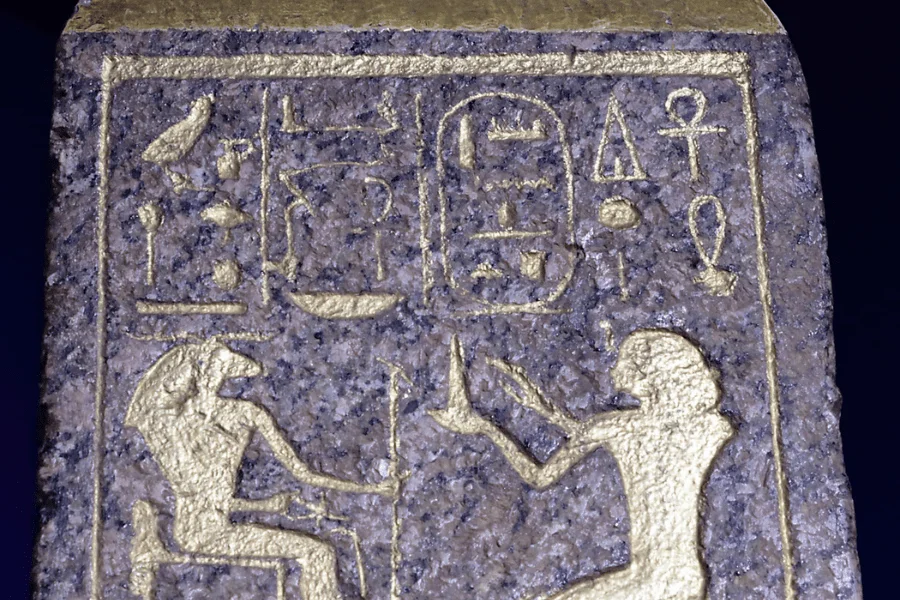
The throne and birth names were enclosed in cartouches, the oval outlines familiar from royal monuments. The Bibliotheca Alexandrina’s guide to royal names and titles explains these forms. Our introduction to hieroglyphic signs provides further reading about the writing system; a photograph of a cartouche alone is not a verified reading of the name inside it.
Khufu, Cheops and spelling variants
Khufu and Cheops can refer to the same king: Cheops is the Greek form, as the Egyptian Museum’s ruler guide notes. Ramesses and Ramses are likewise familiar alternative English spellings.
Conventional English forms do not record exactly how an ancient person pronounced a name. UCL’s discussion of Egyptian sounds explains the difficulties of recovering pronunciation. Use the bearer, period and context as well as the spelling when comparing sources.
Other attested names include Sobekhotep, Senusret / Senwosret and Userkaf. The Met’s inscribed linen record documents Sobekhotep and discusses the reign of Senwosret I. UCL documents Userkaf as a Fifth Dynasty king. An attested bearer establishes use of a name, not a literal English translation.
Khnum-Khufu is the fuller form of Khufu’s name. A fuller form does not, by itself, establish that Khufu was a rhyming childhood nickname.
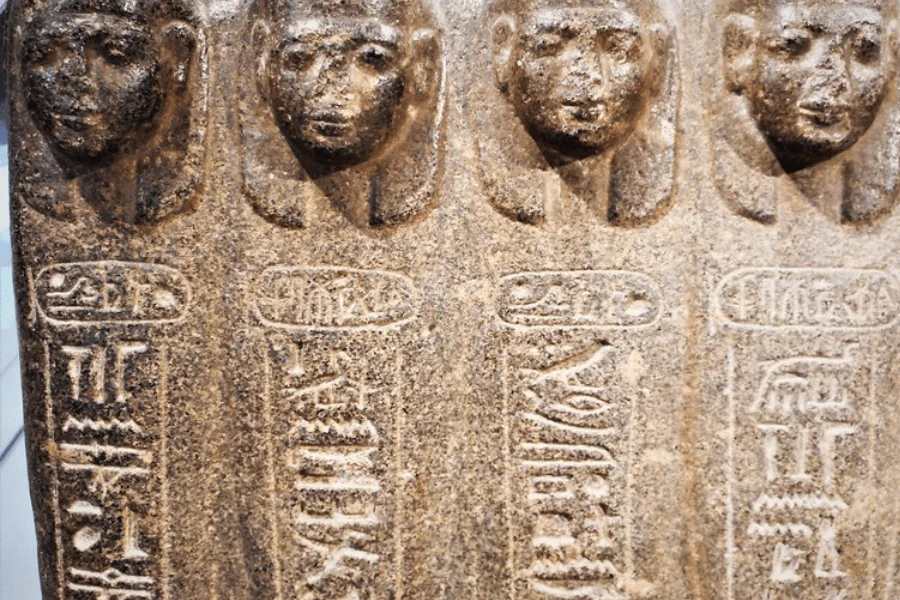
Names of Ancient Egyptian Gods and Goddesses
Divine names help explain many personal names, but people and deities should not be mixed in a single list without labels. Amun is a divine name; Amenhotep is a personal name containing it. The following associations provide context rather than literal translations:
- Amun and Ra/Re: major deities whose names appear in royal and personal names.
- Ptah: the Memphite creator deity, invoked in Merneptah.
- Osiris: associated with the afterlife; his name appears in Peteosiris.
- Horus: closely associated with kingship, including the royal Horus name.
- Anubis: associated with embalming and funerary care.
- Seth: a deity with complex associations, whose name is invoked in Seti.
The Met’s educational guide provides religious context. For more detail on individual deities, see our Egyptian gods and goddesses guide.
Earth, sky and the Ennead
Geb is associated with the earth, Nut with the sky, and Shu with the air between them. The Walters Art Museum’s Shu record explains his role separating Geb and Nut.
The Heliopolitan Ennead comprises Atum, Shu, Tefnut, Geb, Nut, Osiris, Isis, Seth and Nephthys. It includes gods and goddesses, so it should not be labelled a list of male gods. The British Museum’s account outlines their family relationships.
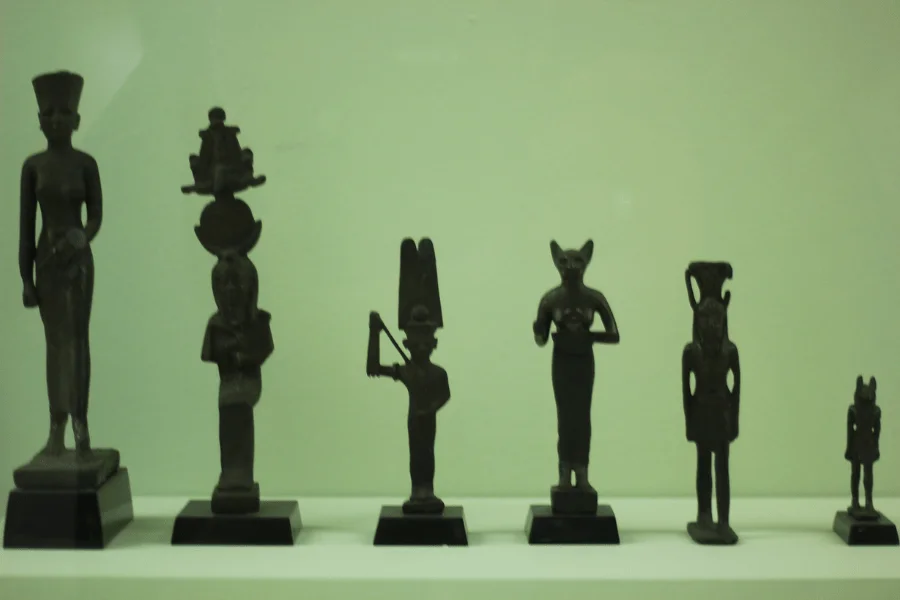
Ancient Egyptian Queen Names and Other Female Names
Women’s names deserve the same distinction between meaning and biography as men’s names. Some bearers were queens or ruling pharaohs; other names occur outside royalty. The table separates those contexts instead of treating every ancient female name as a queen’s name.
| Name | Meaning and historical context |
|---|---|
| Hatshepsut | Foremost of noble women. The Met’s statue record explains this name. Hatshepsut ruled as pharaoh. |
| Nefertiti | The beautiful one has come. A queen associated with Akhenaten. Berlin State Museums’ account of her bust supplies this translation. |
| Ankhesenamun | Rendered “living for Amun.” A queen associated with Tutankhamun. A University of Sadat City journal article uses this English rendering; English wording varies between references. |
| Meritites | An attested female personal name. Digital Giza documents a bearer of this name. The name alone does not establish a bearer’s title or status. |
| Sobekneferu | Usually translated “beauty of Sobek.” A female ruler at the end of Dynasty 12, discussed in an academic study held by White Rose eTheses. |
Nefertari, Nefertiti and different meanings
Nefertari, a queen associated with Ramesses II, should not be confused with Nefertiti, associated with Akhenaten. Both names contain the element nefer, connected with beauty. New Orleans Museum of Art explains the shared element.
English renderings of Nefertari’s full name differ; the shared element does not make her name identical in meaning to Nefertiti’s “the beautiful one has come.” It is more useful to keep the two people and their attestations distinct than to combine attractive translations from unrelated name lists.
Another attested queen is Mutnedjemet, also written Mutnedjmet. Museo Egizio’s group statue identifies her alongside Horemheb. Here she is included as a documented bearer, without assigning a literal translation that the catalogue does not establish.
Was Cleopatra an Egyptian name?
Cleopatra VII ruled Egypt, but Cleopatra is a Greek name. Historian E. R. Bevan renders it “having a glorious father” in The House of Ptolemy. A list of Egypt’s queens can therefore contain names from more than one language.
For the lives and reigns behind the names, our kings and queens guide is the next step. The name tables here focus on identification and meaning, not a ranking of the “greatest” rulers.
Meritamun means beloved of Amun. The official record of her statue identifies her as a daughter of Ramesses II and Nefertari who became a Great Royal Wife; it does not establish the origin of the modern name Meret. Mutemwia refers to Mut being in the barque, as explained by Cambridge’s VIEWS project. Merneith expresses being beloved of Neith in the ISAC catalogue.
Among descriptive names, Neferet corresponds to the feminine nfrt, conveying beauty or perfection, while Seshen refers to the lotus flower in Vittmann’s study. Tamit means “she-cat,” as the Toledo Museum’s coffin record explains; it names a woman, not just a pet or a childhood nickname.
Two further attested royal women are Neferu, identified by inscribed funerary objects at The Met, and Neithhotep, whose name appears on a jar sealing. These records support retaining their names without adding an unverified translation or a definite claim about Neithhotep’s regency.
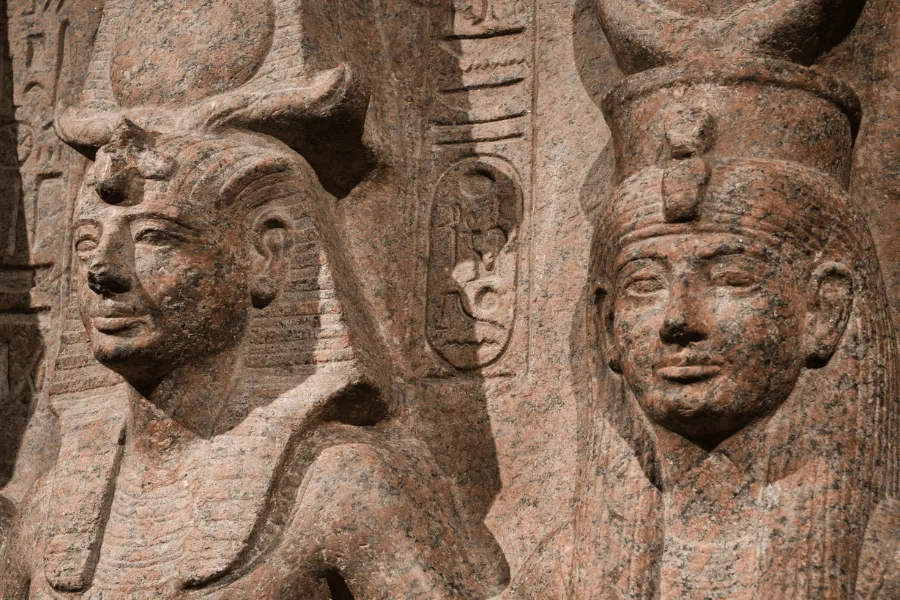
Ancient Egyptian Pyramid Names
A pyramid name is not another category of personal name, but the distinction can be confusing because monuments are often identified by the rulers associated with them. These familiar examples explain that connection:
| Monument | Name or association |
|---|---|
| Great Pyramid of Giza | The Pyramid of Khufu, also known by the Greek form Cheops. |
| Pyramid of Khafre | Identified with King Khafre; a different monument from Khufu’s pyramid. |
| Pyramid of Menkaure | The third principal pyramid at Giza, associated with Menkaure. |
| Step Pyramid | Associated with Djoser at Saqqara. |
| Bent Pyramid | A monument of Sneferu at Dahshur; its familiar descriptive name is not a personal name. |
These examples belong here to clarify names. A full inventory of pyramids, construction dates and dynastic succession is better handled in the monument guides.
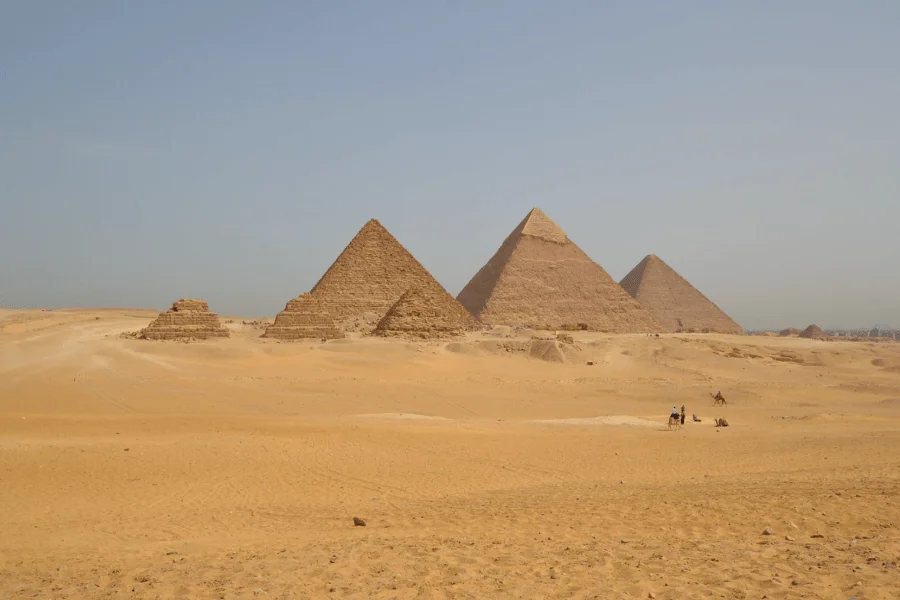
Meanings of Ancient Egyptian Deity Names
A god’s role and the literal meaning of the god’s name are different questions. Three examples illustrate the distinction:
- Sekhmet / Sakhmet: conventionally “the powerful one,” as Emory University’s Carlos Museum explains.
- Amun: rendered “the hidden one” in the Met’s educational guide.
- Nekhbet: “she who belongs to Nekheb,” according to UCL’s explanation of the Two Ladies.
Knowing that a deity is associated with the sky, earth or warfare does not establish that the name literally means “sky,” “earth” or “warrior.” Religious associations should be labelled as context, while uncertain etymologies should remain qualified.
Ancient Egyptian Mummy Names
Readers looking for “mummy names” are usually looking for the names of historical people whose remains or funerary objects are discussed in museums. “Mummy” describes preserved remains; it is not a separate naming system.
Tutankhamun, Thutmose III and Hatshepsut are royal names encountered in that context. Their names retain their personal or royal meanings. Identifying a particular body, however, is an archaeological question and should not be decided from the translation of a name or the appearance of the remains.
For people outside royalty, the named household of Sennedjem above shows how funerary evidence can preserve family identities. Our guide to the mummification process explains the separate subject of how bodies were prepared. A fictional mummy character’s name should not be presented as historically attested without a source.
Ahmose I also belongs among these historical examples: the National Museum of Egyptian Civilization’s account includes him among the royal mummies from the Deir el-Bahari cache. His name is retained here without restoring the separate pyramid-list digression.
Warrior Names and Egyptian War Deities
A name borne by a king or soldier does not automatically translate as “warrior.” Ramesses refers to Re, and Seti invokes Seth. Someone seeking an ancient Egyptian warrior name should first decide whether they want a documented human name or the name of a deity associated with power and protection.
Montu and Sekhmet
Montu is a martial deity, described as warlike in The Met’s Egyptian art bulletin. Sekhmet’s name expresses power, and her religious associations include destructive and protective aspects. Neither should be silently relabelled as a list of ordinary soldiers’ personal names.
Horus and Seth also appear in discussions of royal power, but a divine association is not an occupation or a literal translation. For a historical character, choose an attested name appropriate to the period and distinguish the person’s name from rank, title and divine patron.
If Ancient Egyptian names fascinate you, you’ll love diving deeper into Egypt’s mythology, temples, kings, and legendary queens. Explore the stories behind the gods, uncover the meanings of symbols, and learn how ancient Egyptians shaped one of the richest cultures on Earth.
Let Egypt Tours Group help you experience history where it truly belongs — in the temples, tombs, and sacred landscapes of Egypt.
FAQs – Ancient Egyptian Names Explained
What were the most common ancient Egyptian names?
Famous examples include Amenhotep, Ramesses, Imhotep, Hatshepsut and Nefertiti. Fame does not establish frequency: a reliable popularity claim needs records from a defined period and community.
Why were names so important in ancient Egypt?
A name helped identify a person and preserve that identity in society and religious belief. Its significance could extend beyond an everyday label.
Did ancient Egyptian names have magical meanings?
Some names had religious or protective significance. That does not make every name a spell or establish that every nickname was chosen to prevent bad luck.
How did families choose names for their children?
Names could express family relationships, religious associations, wishes or birth circumstances. Practices varied; there was no single formula for every household.
Are all names used in Egypt today ancient Egyptian in origin?
No. Modern use does not prove an ancient Egyptian origin. Check the language, an attested historical bearer and the proposed meaning separately; modern popularity requires modern evidence.
What should I check before using an ancient Egyptian name?
Check that the name is historically attested, distinguish the bearer from a deity or title, and use a reliable source for the meaning. Treat uncertain translations and pronunciation as uncertain.