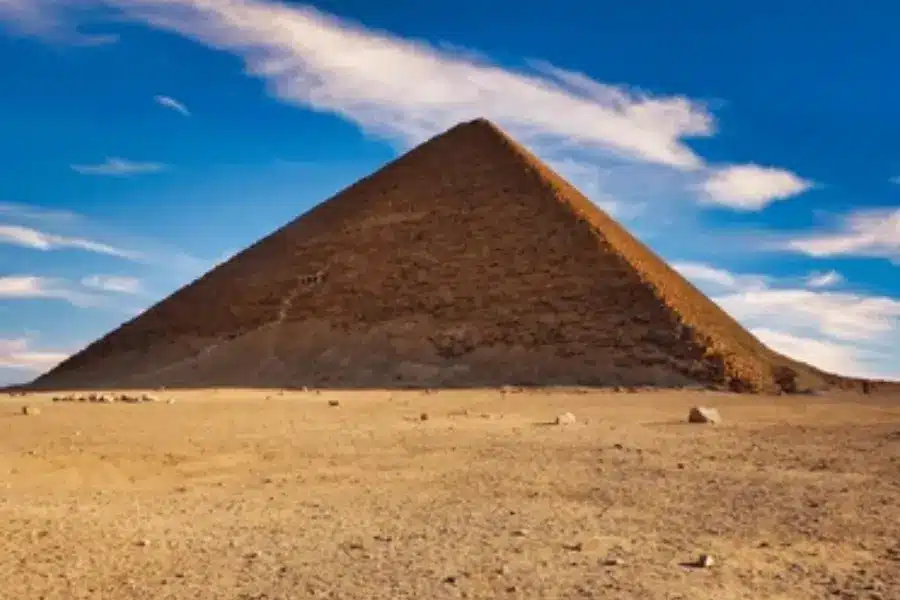
Egyptian Museum vs Grand Egyptian Museum: What’s the Difference?
When planning a visit to Egypt, many travelers ask the same question: Should I explore the historic Egyptian Museum in Cairo or the modern Grand Egyptian Museum? Both museums stand as guardians of ancient Egyptian civilization, yet each presents Egypt’s history in a very different way.
In this in-depth comparison by Egypt Tours Group, we highlight the key differences between the Egyptian Museum and the Grand Egyptian Museum — from architecture and artifact displays to the visitor experience — helping you decide which museum to visit first during your trip to Egypt.

A visual comparison between the Grand Egyptian Museum in Giza and the historic Egyptian Museum in Cairo, highlighting the contrast between modern and classical design.
Egyptian Museum vs Grand Egyptian Museum Overview
The Egyptian Museum in Cairo, inaugurated in 1902, is considered one of the most enduring cultural institutions in Egypt and the world. Dedicated to Egyptian antiquities, it reflects Egypt’s early determination to protect its heritage, prevent the smuggling of artifacts, and display them for admiration and study by both Egyptian and international audiences.
Located in Tahrir Square, the museum has represented Egypt’s cultural identity for more than a century, standing as a landmark at the heart of Cairo and a symbol of the country’s historical consciousness.
In contrast, the Grand Egyptian Museum (GEM) in Giza represents a modern gateway to ancient Egypt, standing near the Giza Pyramids and offering a new vision for presenting Egyptian artifacts. The museum highlights the connection between Egypt’s ancient past, its present identity, and its global cultural influence.
Through advanced technology, expansive exhibition halls, and innovative storytelling techniques, the Grand Egyptian Museum presents Egyptian civilization in a way that resonates strongly with modern visitors.
To make the comparison easier, here is a quick side-by-side overview of the main differences between the Egyptian Museum and the Grand Egyptian Museum.
| Compare | Architectural Style | Purpose | Visitors’ Experience | Location Significance |
|---|---|---|---|---|
|
Grand Egyptian Museum |
Monumental and symbolic of modern Egypt |
Reimagines how Egyptian heritage is presented |
Interactive, thematic, and immersive |
In Giza, with a direct visual and geographic connection to the Pyramids |
|
Egyptian Museum |
Neoclassical, with a strong colonial-era character |
Preserves and displays Egyptian antiquities |
Traditional, with denser object displays |
In Tahrir Square, at the historic heart of Cairo |
Architecture & Design – Classic vs Contemporary
From the outside, both buildings are museums dedicated to ancient Egyptian artifacts, but the differences become much clearer once you step inside. Their design approaches are very different, and each museum uses architecture to shape how visitors experience Egypt’s history.
Egyptian Museum Tahrir Design
✅ A classical museum designed by the French architect Marcel Dourgnon in the neoclassical style, giving the collections a sense of prestige while allowing the artifacts to remain the main focus.
✅ Elegant yet restrained decorative details, supported by the museum’s distinctive reddish-pink exterior.
✅ An atmosphere that feels traditional, scholarly, and closely tied to the early history of museum display in Egypt.
Grand Egyptian Museum Architecture
✅ A large-scale contemporary design inspired by Egyptian light, geometry, and the landscape of the Giza Plateau, blending modern architecture with references to ancient symbolism.
✅ The GEM building is visually linked to the Giza Pyramids and positioned as a major cultural gateway to the Giza area.
✅ Its vast interior spaces create a stronger sense of openness and movement, giving the visit a more modern and immersive character.
✅ Large glass facades bring natural light into the museum, helping shape a more dramatic and carefully staged viewing experience.
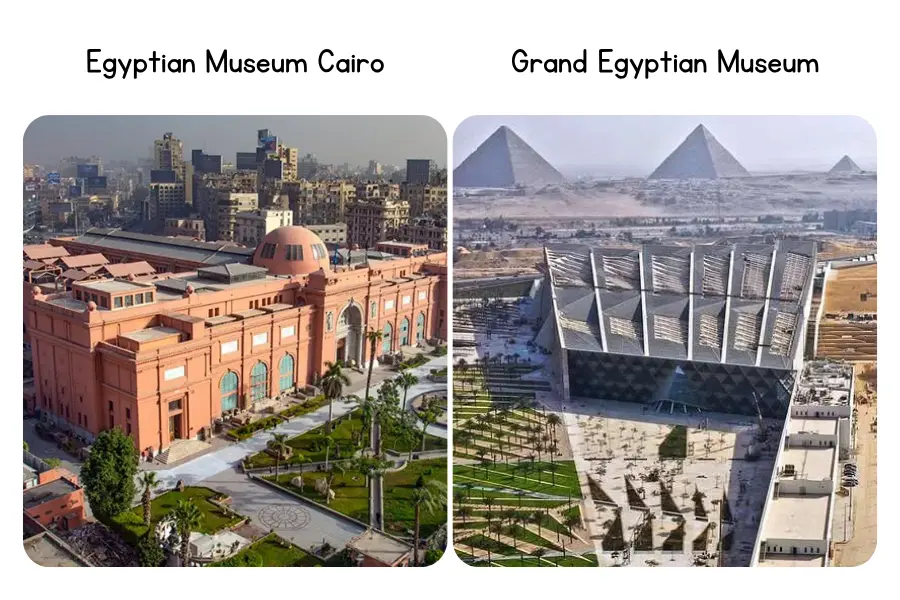
The Egyptian Museum in Cairo and the Grand Egyptian Museum highlight two very different architectural styles, from historic neoclassical design in Tahrir to the monumental modern structure of GEM near the Giza Pyramids.
| Compare | Design Philosophy | Style & Experience | Overall Impression |
|---|---|---|---|
|
Grand Egyptian Museum |
Contemporary architecture shaped by Egyptian symbolism, light, and landscape |
Contemporary design with a more immersive visitor experience |
Grand, modern, and immersive |
|
Egyptian Museum In Cairo |
A classical setting where the artifacts remain the main focus |
French neoclassical design with a traditional museum atmosphere |
Historic, dignified, and classic |
In simple terms, the Egyptian Museum feels closer to the traditional idea of a historic museum, while the Grand Egyptian Museum offers a more contemporary and immersive architectural experience.
Collections & Artifacts – What You’ll See Inside
Here’s a quick comparison of the collections inside the Egyptian Museum and the Grand Egyptian Museum, highlighting what stands out in each museum and how each one presents the story of ancient Egyptian civilization through its ancient artifacts.
🏛️ Museum of Egyptian Antiquities, Cairo
The Egyptian Museum in Cairo displays a vast range of artifacts, including statues such as King Akhenaten and the head of Queen Hatshepsut, royal jewelry, and famous mummies like Yuya and Tuya.
With more than 120,000 artifacts, the museum tells the story of ancient Egyptian civilization traditionally and straightforwardly. As you walk through its halls, you’ll encounter dense displays where statues and objects are presented simply, allowing the artifacts to remain the main focus.
Must-See Highlights in the Egyptian Museum:
- Narmer Palette – One of the most important symbols of the unification of ancient Egypt.
- Statues of Rahotep and Nofret – Admired for their realistic features and the remarkably preserved details that still stand out today.
- Statue of King Menkaure – A refined example of the beauty and balance of royal sculpture in ancient Egypt.
- Royal Jewelry – Delicate pieces that reflect the wealth, symbolism, and craftsmanship of ancient Egyptian elites.
- Mummies of Yuya and Tuya – Famous mummies that offer a closer look at elite burial traditions in ancient Egypt.
What makes the Egyptian Museum especially memorable is not only the importance of its collection, but also the atmosphere of the museum itself. Its traditional display style, filled with pharaonic and royal treasures, gives visitors a classic and immersive experience that feels very different from the layout of more modern museums.
🏺 Grand Egyptian Museum Exhibits
Inside the Grand Egyptian Museum, visitors experience remarkable displays such as the Tutankhamun collection, one of the solar boats discovered near the Great Pyramid, and many colossal statues of ancient Egyptian kings.
At the entrance, visitors are welcomed by the iconic Colossal Ramses II statue, standing as one of the museum’s most recognizable highlights. The museum features more than 100,000 artifacts presented using advanced exhibition technology and immersive storytelling.
Must-See Highlights in the Grand Egyptian Museum:
- Colossal Ramses II Statue – The monumental statue that welcomes visitors at the entrance and immediately gives a sense of the museum’s scale.
- Tutankhamun Collection – One of the museum’s biggest highlights, bringing together many treasures associated with the young king in a more unified display.
- Solar Boat – An extraordinary artifact that offers insight into ancient Egyptian funerary beliefs, royal symbolism, and ancient engineering skill.
- Colossal Royal Statues – Massive sculptures that highlight the scale, authority, and grandeur of ancient Egyptian kingship.
What makes the Grand Egyptian Museum especially impressive is not only the scale of its treasures, but also the way they are presented. Its spacious layout, modern design, and advanced display style create a smooth and visually striking experience that feels very different from the more traditional atmosphere of the old Egyptian Museum.
How the Collections Are Organized
The way the artifacts are displayed differs clearly between the Egyptian Museum in Cairo and the Grand Egyptian Museum.
In the Cairo museum, the artifacts are traditionally displayed and generally arranged chronologically, although some overlap between sections gives the experience a richer feel and requires more attention during the visit.
By contrast, the Grand Egyptian Museum follows a more modern and organized display style that combines chronological and narrative presentation, making it easier for visitors to follow the story of ancient Egyptian history gradually and clearly.
This difference makes the Grand Egyptian Museum easier to navigate for many travelers, while the older museum offers a classic atmosphere that feels rich in detail.
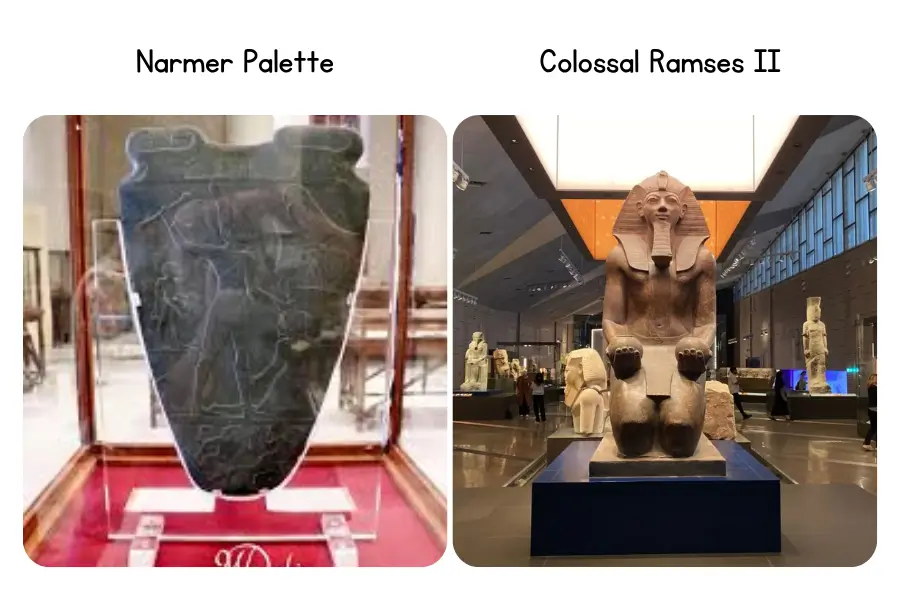
The Narmer Palette and the Colossal Ramses II statue represent two of the most memorable highlights visitors can see when comparing the collections of the Egyptian Museum in Cairo and the Grand Egyptian Museum.
What Moved from the Old Museum to the New GEM
The Grand Egyptian Museum (GEM) in Giza now houses many important artifacts that were previously displayed in other locations, including public spaces, older museums, and collections that were not shown together in this way before. As part of the museum’s development, several major pieces were carefully transferred to a new setting designed for large-scale display, conservation, and visitor experience.
Tutankhamun Collection
One of the most significant changes is the transfer of Tutankhamun’s treasures to the Grand Egyptian Museum. While famous pieces from the young king’s tomb were long associated with the Egyptian Museum in Tahrir, the GEM now presents Tutankhamun-related artifacts in dedicated galleries and on a much larger scale.
Among the best-known highlights are the golden burial mask, the coffin, and other royal treasures associated with Tutankhamun, all presented in a more unified and modern museum setting. This shift is one of the main reasons many visitors now see GEM as the leading place to explore the story of Tutankhamun in greater depth.
Colossal Statue of Ramses II
The monumental statue of Ramses II was transferred from Ramses Square in Cairo and now stands at the entrance of the Grand Egyptian Museum, where it has become one of the museum’s most iconic features. Its placement gives visitors a dramatic introduction to the scale and ambition of the museum itself.
Solar Boat
One of King Khufu’s solar boats, discovered near the Great Pyramid, was moved to the Grand Egyptian Museum in 2021. The transfer was a major conservation and engineering operation, and the boat is now displayed in a setting that better supports preservation and interpretation.
Most Important Transfers to Know
When people ask what moved from the Egyptian Museum to GEM, the answer usually begins with Tutankhamun’s treasures. Still, it also includes other major highlights such as the Ramses II statue and the solar boat. Together, these transfers help explain why the Grand Egyptian Museum has become such an important destination for visitors who want to see some of ancient Egypt’s most famous masterpieces in a more modern setting.
Why Were These Artifacts Moved?
- To display major artifacts in a more modern and secure environment
- To give important pieces more space and a smart presentation
- To support preservation through advanced conservation and display technology
- To create a more organized visitor experience around some of Egypt’s most famous treasures
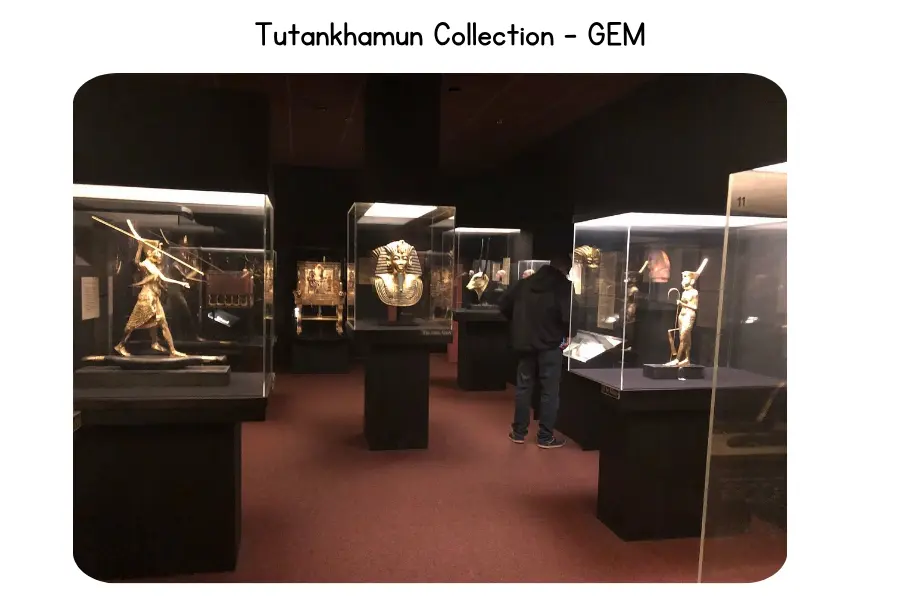
Part of the Tutankhamun collection displayed inside the Grand Egyptian Museum, one of the most important transfers associated with GEM.
| Where These Famous Artifacts Are Now | Previously | Now |
|---|---|---|
|
Tutankhamun Collection |
Selected pieces were long displayed in the Egyptian Museum in Tahrir |
Tutankhamun-related treasures are presented on a much larger scale at GEM |
|
Solar Boat |
Associated with the area of the Great Pyramid and preserved separately |
Displayed at the Grand Egyptian Museum |
|
Colossal Statue of Ramses II |
Located in Ramses Square in Cairo |
Stands at the entrance of the Grand Egyptian Museum |
The Grand Egyptian Museum Opening – A New Era Begins
The official opening of the Grand Egyptian Museum on November 1, 2025 marked a major new chapter in how ancient Egyptian civilization is presented to the world. Over the years, the museum’s opening timeline changed more than once, and access to the site developed in phases before the full museum experience reached its current form.
Today, the Grand Egyptian Museum welcomes visitors on a full daily schedule, with official opening hours and gallery access clearly listed through the museum itself. This makes the experience far more complete and easier to plan than during the earlier partial-opening stages.
From the moment visitors enter, they are welcomed by the Colossal Statue of King Ramses II, one of the museum’s most iconic features and one of the clearest symbols of its monumental scale. Opposite it stands the Grand Staircase, where statues of kings, queens, deities, and major architectural elements are arranged in a way that gives the visit a strong ceremonial and historical rhythm.
With its full opening, the Grand Egyptian Museum introduced a very different museum experience from the Egyptian Museum in Cairo. Its scale, design, and presentation style reflect a more contemporary approach to telling the story of ancient Egypt, while still remaining deeply rooted in the civilization it represents.
Visitor Experience – Tradition Meets Innovation
Each museum offers a very different visitor experience. Here is a quick comparison of what you can expect when visiting the Egyptian Museum in Cairo and the Grand Egyptian Museum.
| Compare | Grand Egyptian Museum (GEM) | Egyptian Museum in Cairo |
|---|---|---|
|
Overall Experience |
A technologically advanced and immersive museum experience, designed to feel more modern, spacious, and visually dramatic. |
A nostalgic and traditional museum experience, with a strong sense of history and a classic atmosphere. |
|
Accessibility |
Offers a more organized entry process, with online booking and timed entry helping create a smoother arrival experience. |
Easier to reach for many visitors because of its central location in Cairo. Tickets are also typically easy to buy on-site. |
|
Visitor Flow |
More carefully planned and structured, with a clearer visitor route that reflects a modern museum approach. |
More traditional and flexible, allowing visitors to wander more freely through the halls, though the layout can feel busier and less structured. |
Egyptian Museum Tickets vs Grand Egyptian Museum Tickets
Ticket prices are one of the clearest practical differences between the Egyptian Museum in Cairo and the Grand Egyptian Museum. In general, the Egyptian Museum in Tahrir remains the more budget-friendly option, while GEM follows a more structured ticketing system with timed entry slots and different price categories.
Egyptian Museum Tickets
- Foreign adult: 550 EGP
- Foreign student: 275 EGP
The Egyptian Museum is usually the easier option for walk-in visitors, and tickets can typically be purchased on-site.
Grand Egyptian Museum Tickets
Ticket prices at GEM vary depending on nationality and visitor category, and entry is linked to a selected time slot.
Based on the current booking page, the Expatriates category is listed as:
- Adult: 730 EGP
- Child: 370 EGP
- Student: 370 EGP
GEM also employs a more organized booking process, enabling visitors to select an entry time in advance, which makes the visit more structured than the traditional walk-in experience at the Egyptian Museum.
If ticket prices are especially important for your trip, it is always best to check the official booking page before your visit, since categories and rates may change over time.
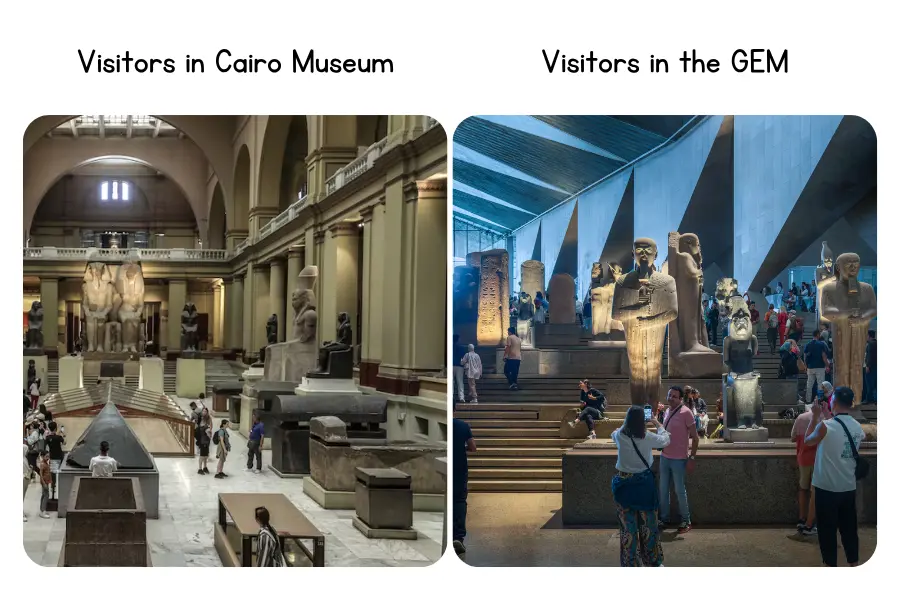
The Egyptian Museum in Cairo and the Grand Egyptian Museum offer two very different visitor experiences, from the classic traditional halls of Tahrir to the larger and more immersive interior spaces of GEM.
Location & Accessibility – Downtown Cairo vs Giza Plateau
Here’s a quick overview of how to reach both museums. Many visitors are surprised by how close the Grand Egyptian Museum is to the Giza Pyramids, and how manageable the distance is between the two museums when planning a day tour in Cairo.
Egyptian Museum, Cairo – Tahrir
Located in the heart of Cairo, in Tahrir Square, the Egyptian Museum is generally easy to reach whether you are traveling by private car or using public transportation.
Visitors can usually buy tickets at the entrance during opening hours, which makes the visit simple and convenient for many travelers.
Grand Egyptian Museum – Giza
The Grand Egyptian Museum is located near the Giza Pyramids, making it a natural stop for visitors who plan to explore the pyramid area on the same day.
GEM follows a more organized entry system, with online booking and timed entry helping create a smoother visitor experience and better crowd management.
Future of Both Museums – Complementary, Not Competing
The future of the Egyptian Museum in Tahrir and the Grand Egyptian Museum is best understood not as a competition, but as a continuation of Egypt’s museum story through two different experiences. Each museum plays a distinct role in preserving, presenting, and interpreting ancient Egyptian civilization.
Egyptian Museum in Tahrir – A Historic Legacy
For more than a century, the Egyptian Museum in Tahrir has played a central role in preserving and displaying priceless artifacts as one of Egypt’s most important archaeological institutions. Located in the heart of Cairo, it became closely associated with generations of archaeologists, researchers, and visitors who experienced ancient Egypt through its traditional galleries.
Known for its rich and varied collection, the museum offers a classic atmosphere that still holds deep historical and cultural value. For many visitors, it remains one of the most meaningful places to encounter the earlier museum tradition of Egypt and to experience ancient Egyptian history in a more direct and traditional setting.
The Grand Egyptian Museum – A Modern Global Vision
The vision behind the Grand Egyptian Museum was to create a large-scale modern museum experience dedicated to ancient Egyptian civilization. This ambition can be seen in its design, exhibition layout, storytelling approach, and the way major artifacts are presented in a more structured and expansive environment.
The transfer of important treasures, including many artifacts associated with Tutankhamun, shows that the role of GEM is not to erase the importance of the Egyptian Museum in Tahrir, but to expand how Egypt’s heritage is presented to the world. In this sense, the two museums complete each other, with each one representing a different chapter in the story of ancient Egypt.
Final Perspective
Rather than asking which museum replaces the other, it makes more sense to see them as two complementary institutions: one rooted in Egypt’s long museum tradition, and the other shaped by a more contemporary vision of display, preservation, and visitor experience.
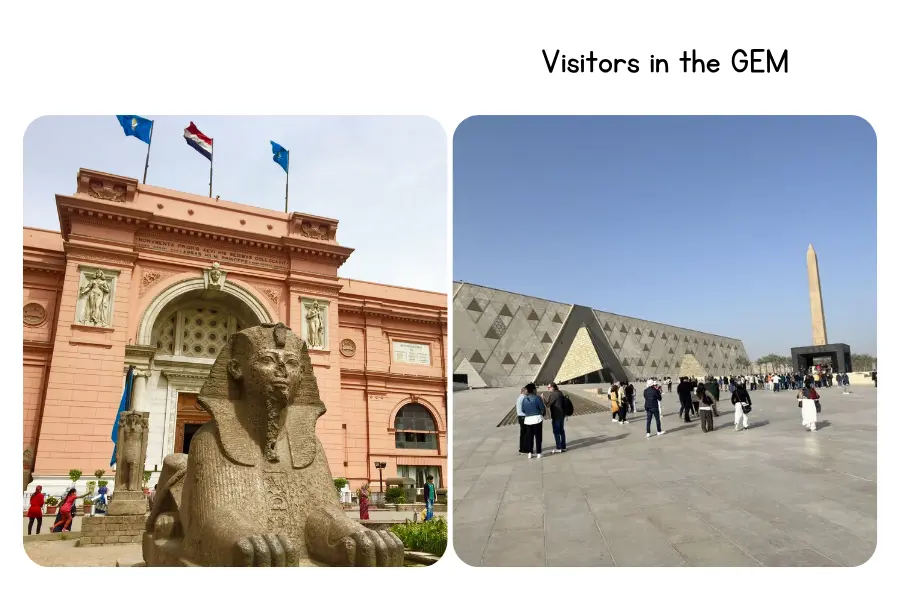
The Egyptian Museum in Tahrir and the Grand Egyptian Museum reflect two complementary sides of Egypt’s museum story, combining historic legacy with a modern vision.
Quick Comparison – Egyptian Museum vs Grand Egyptian Museum
Here is a quick side-by-side comparison to help you understand the main differences between the Egyptian Museum in Cairo and the Grand Egyptian Museum.
| Aspect | Grand Egyptian Museum (GEM) | Egyptian Museum in Cairo (Tahrir) |
|---|---|---|
|
Year Opened |
A modern museum project opened in stages and now functions as Egypt’s newest large-scale museum experience. |
Opened in 1902. |
|
Location |
Located in Giza, near the Pyramids. |
Located in Tahrir Square, in downtown Cairo. |
|
Architectural Style |
Contemporary and monumental, designed to deliver a more immersive and large-scale museum experience. |
Neoclassical and traditional, with a historic downtown setting. |
|
Collection Style |
More spacious and structured displays, with stronger use of modern exhibition design and storytelling. |
Dense and traditional displays, with artifacts presented in a more classic museum layout. |
|
Major Highlights |
Tutankhamun galleries, the Colossal Ramses II statue, the Solar Boat, and monumental royal sculptures. |
Narmer Palette, statues of Rahotep and Nofret, royal jewelry, and famous mummies such as Yuya and Tuya. |
|
Technology |
More technology-driven and interactive in its display approach. |
More conventional museum presentation. |
|
Visitor Experience |
More modern, immersive, and carefully organized. |
More traditional, flexible, and historic in atmosphere. |
|
Accessibility |
Better suited to visitors planning a Giza itinerary, with a more structured entry process and timed booking system. |
Easier for many visitors because of its central Cairo location, with on-site ticket purchase typically available. |
|
Best For |
Visitors who want a modern museum experience with large-scale presentation and a more structured flow. |
Visitors who want a classic museum atmosphere and a strong sense of historic Cairo. |
Many important treasures associated with Tutankhamun are now presented at GEM, while the Egyptian Museum in Tahrir still remains one of Cairo’s most historically significant museum experiences.
Which Museum Should You Visit First?
Both museums offer a unique experience, each with its own character and impressive collections. For many travelers, it makes sense to visit the Grand Egyptian Museum first, especially if the day already includes the Giza Pyramids, and then visit the Egyptian Museum in Tahrir as part of a separate or follow-up Cairo experience.
Now that the Grand Egyptian Museum is open to visitors, it has become a much easier and more practical stop to include in a Cairo or Giza itinerary.
1. Grand Egyptian Museum (Giza)
- Time needed: Around 3 to 4 hours for a shorter visit, but a full day is often better for travelers who want to explore the museum more comfortably and in greater depth.
- Tickets: Usually booked through a more organized system with timed entry
- Best photo spots: The Colossal Ramses II statue, panoramic views toward the Pyramids, and the museum’s monumental interior spaces
- Experience: Modern, spacious, and more immersive in presentation
2. Egyptian Museum (Cairo, Tahrir)
- Time needed: Around 2 hours
- Tickets: Usually easier for walk-in visitors to purchase on-site
- Best photo spots: The museum’s iconic pink façade, selected interior halls, and major statues such as Hatshepsut
- Experience: Traditional, historic, and full of classic museum atmosphere
Which Museum Fits Your Travel Style?
Many travelers ask which museum they should visit first in Cairo when comparing the Grand Egyptian Museum and the Egyptian Museum in Tahrir. The answer depends mainly on your travel style and on the kind of museum experience you want.
Choose the Grand Egyptian Museum if… You prefer modern museums with spacious galleries, a more organized visitor flow, and a stronger sense of large-scale presentation. It is also a strong choice for travelers who want a more contemporary museum setting near the Giza Pyramids.
Choose the Egyptian Museum if… You prefer a more traditional atmosphere or are staying in downtown Cairo. It is ideal for visitors who want to explore a dense and historic collection in one of Egypt’s most iconic museum settings.
Visit both if… You are deeply interested in ancient Egyptian civilization and want the fullest possible experience. Visiting both museums offers a broader understanding of how Egypt’s treasures are displayed, preserved, and interpreted through two very different museum styles.
If you have enough time in your itinerary, visiting the two museums on separate days usually offers a more comfortable and rewarding experience.
Choosing between the Egyptian Museum in Cairo and the Grand Egyptian Museum is not really about deciding which one is better. It is about understanding how each museum presents ancient Egypt in a different way. The Egyptian Museum reflects the country’s long archaeological legacy in a traditional and historic setting, while the Grand Egyptian Museum offers a larger, more modern, and more immersive display experience.
Together, the two museums complement each other and give visitors a broader understanding of how Egypt’s treasures are preserved, displayed, and interpreted today. If your itinerary allows, visiting them on separate days usually creates a more comfortable and rewarding experience.
If your schedule allows, you do not necessarily have to choose between the Egyptian Museum in Cairo and the Grand Egyptian Museum. A smart approach is to pair GEM with a visit to the Giza Pyramids, then leave the Egyptian Museum for a separate Cairo day so you can enjoy both experiences without rushing.
With Egypt Tours Group, you can include both museums in a well-planned itinerary or request a tailor-made tour built around your interests, whether you want to focus on Tutankhamun highlights, photography spots, family-friendly pacing, or a private guide for a deeper understanding of the exhibits.
Choose from Egypt Day tours, tour packages, or a tailor-made itinerary built around your interests.
What is the difference between the Egyptian Museum and the Grand Egyptian Museum?
The main difference is the overall museum experience. The Egyptian Museum in Tahrir offers a more traditional and historic atmosphere, with dense displays and a classic museum layout, while the Grand Egyptian Museum provides a more modern, spacious, and immersive presentation style. The two museums reflect different ways of exploring ancient Egyptian civilization.
Which museum has the Tutankhamun collection?
The Grand Egyptian Museum is now the main place to explore Tutankhamun-related galleries on a much larger scale. GEM officially features dedicated Tutankhamun Galleries, making it the more important destination for visitors especially interested in the young king’s treasures.
What moved from the Egyptian Museum to the Grand Egyptian Museum?
Some of the most important transfers associated with GEM include many treasures connected to Tutankhamun, the monumental Ramses II statue at the entrance, and King Khufu’s boat, which was transferred to the museum as part of a major conservation and display project.
Is the Egyptian Museum in Tahrir still worth visiting after GEM opened?
Yes, the Egyptian Museum in Tahrir is still worth visiting. It remains one of Egypt’s most important archaeological museums, opened in 1902, and continues to offer a distinctive historic setting and a classic museum experience in the heart of Cairo.
Is the Grand Egyptian Museum open to visitors?
Yes. The Grand Egyptian Museum is open daily to visitors, and its official FAQs currently describe standard guided visits that include the Tutankhamun Galleries, Grand Hall, Grand Stairs, and Main Galleries. Since visit arrangements can still evolve, checking the official museum site before your visit is still a smart idea.
Can you visit the Grand Egyptian Museum and the Egyptian Museum in one trip?
Yes, you can visit both in one trip to Cairo, but many travelers find it more comfortable to visit them on separate days. A common approach is to pair the Grand Egyptian Museum with the Giza Pyramids, then leave the Egyptian Museum in Tahrir for a separate Cairo day. This gives you more time to enjoy the very different atmosphere of each museum.
) Which museum should you visit first in Cairo?
That depends on your travel style. Many travelers choose the Grand Egyptian Museum first if they are already planning to visit the Giza Pyramids, while the Egyptian Museum is often easier to fit into a downtown Cairo day. If your schedule allows, visiting both gives you the most complete understanding of how ancient Egyptian artifacts are displayed in two very different museum settings.