

Pyramid of Khafre: History, Facts & Visiting Tips
Built stone by stone to endure eternity, the Pyramid of Khafre has dominated the Giza skyline for more than 4,500 years. It is the second-largest pyramid on the Giza Plateau and was built as the royal tomb of Pharaoh Khafre. The monument is instantly recognizable by the surviving band of smooth limestone casing near its summit. Although it is shorter than the Great Pyramid of Khufu, its position on higher ground makes it appear taller from certain viewpoints.
Rising near the Great Sphinx, the Pyramid of Khafre offers visitors the chance to step inside when interior access is available. Its simpler internal layout and often quieter atmosphere can make it an appealing alternative to the Great Pyramid, although the narrow, enclosed passages may not be suitable for every traveler.
In this guide, you’ll explore the history of the Pyramid of Khafre, discover what lies inside, compare it with Khufu’s pyramid, and find practical information to help you plan your visit.
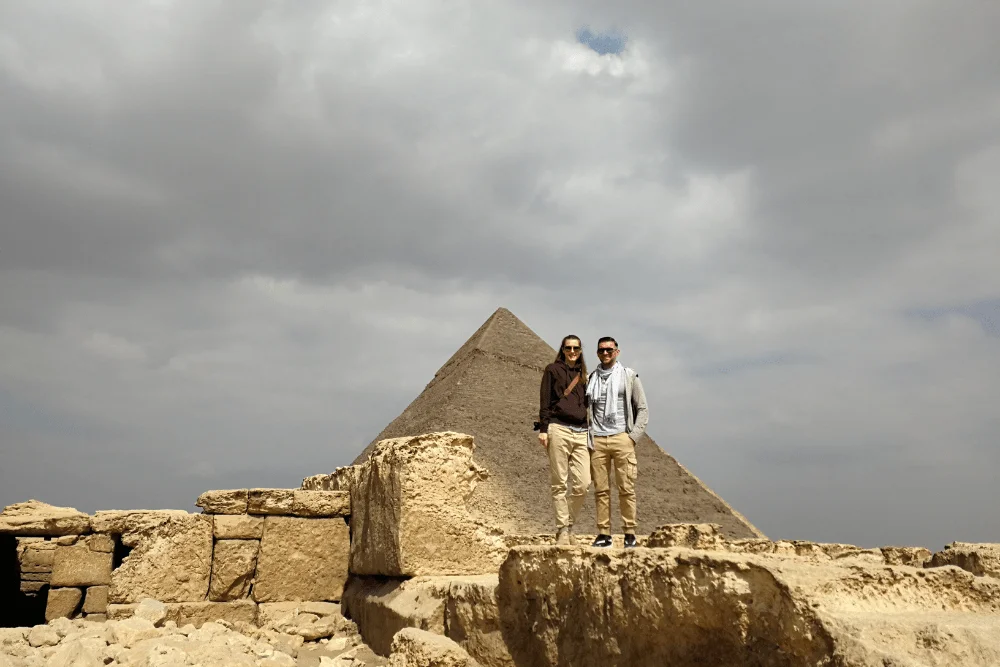
Khafre Pyramid
Key Takeaways
- The Pyramid of Khafre, also called Chephren’s Pyramid, is the second-largest on the Giza Plateau.
- Built around 2550 BCE during Pharaoh Khafre’s reign in Egypt’s Fourth Dynasty.
- Appears taller than Khufu’s pyramid due to higher bedrock foundation.
- Original height: approximately 143.5 meters
- Current height: approximately 136.4 meters
- Still preserves original limestone casing stones near its summit, a distinctive feature among the three main Giza pyramids.
Pyramid of Khafre at a Glance
The Pyramid of Khafre, also known as the Pyramid of Chephren, was built around 2550 BCE during Egypt’s Fourth Dynasty as the royal tomb of Pharaoh Khafre. It is the second-largest of the three main pyramids at Giza, after the Great Pyramid of Khufu.
The pyramid originally stood approximately 143.5 meters high and measured about 215.5 meters along each side of its base. Today, it reaches roughly 136.4 meters after losing part of its summit and outer casing over the centuries.
Although it is smaller than Khufu’s pyramid, Khafre’s monument stands on higher ground and has a slightly steeper profile. These features create the visual impression that it is the tallest pyramid on the Giza Plateau when viewed from certain angles.
Who Was Pharaoh Khafre? Facts About the Builder
Pharaoh Khafre, or Chephren, ruled Egypt during the Fourth Dynasty (c. 2558–2532 BCE). Son of Khufu and father of Menkaure, he continued Egypt’s golden age of pyramid building on the Giza Plateau.
His reign reflected prosperity and stability, leaving behind iconic monuments such as his seated statue, now displayed in the Egyptian Museum in Cairo. These works symbolize the artistry and power of the Old Kingdom.
Khafre succeeded Djedefre and became the fourth ruler of Egypt’s Fourth Dynasty. He was a son of Khufu and a grandson of Sneferu. His principal queens included Khamerernebty I and Meresankh III, and Khamerernebty I is generally considered the probable mother of Menkaure. These family connections placed Khafre at the heart of the royal line responsible for Giza’s great pyramid-building era.
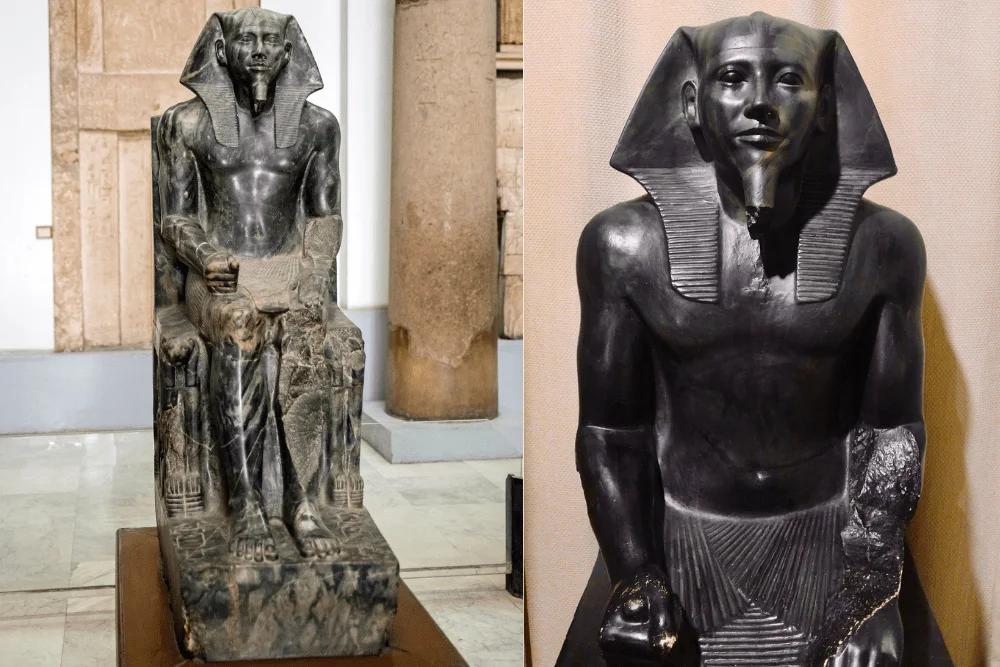
King Khafre’s Statue
When Was the Pyramid of Khafre Built?
The Pyramid of Khafre was built around 2550 BCE during Pharaoh Khafre’s reign in Egypt’s Fourth Dynasty, traditionally dated to approximately 2558–2532 BCE. Its construction formed part of the major royal building program that transformed the Giza Plateau during the Old Kingdom.
This era emphasized monumental tombs as gateways to the afterlife and eternal symbols of royal power. Khafre’s pyramid reflects both religious devotion and Egypt’s engineering mastery during the Fourth Dynasty.
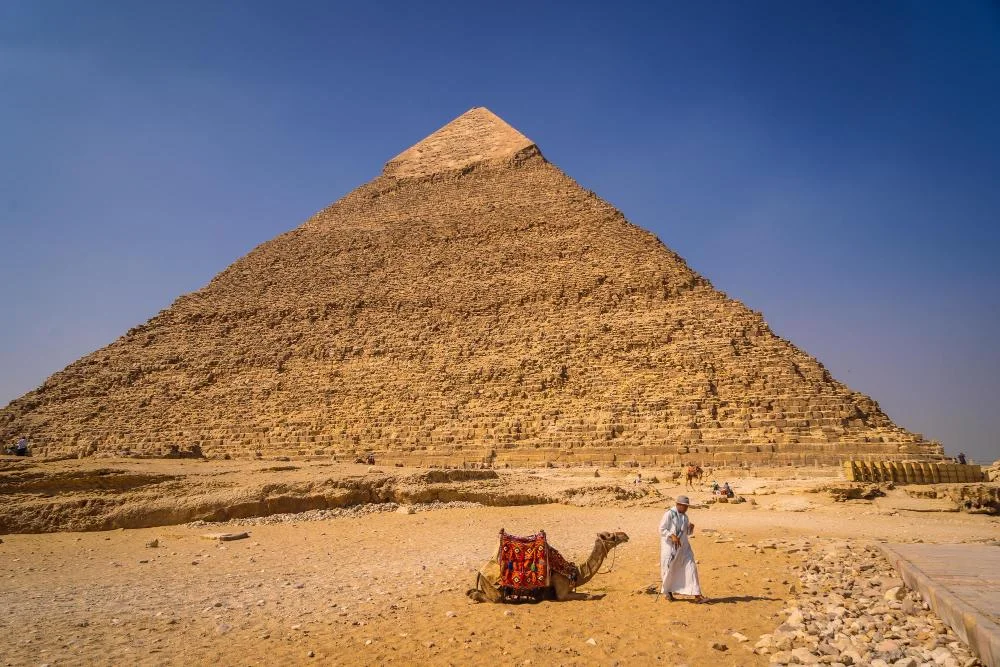
Khafre Pyramid
Where Is the Pyramid of Khafre Located? (Giza, Egypt)
The Pyramid of Khafre stands on the Giza Plateau, just outside Cairo, Egypt. This site, once part of ancient Kemet, overlooks the desert and the Great Sphinx, forming one of the world’s most iconic archaeological landscapes.
The plateau’s elevated terrain enhanced the pyramid’s prominence, creating the illusion that Khafre’s pyramid surpasses Khufu’s in height. Today, it remains a centerpiece of Egypt’s most visited heritage site.
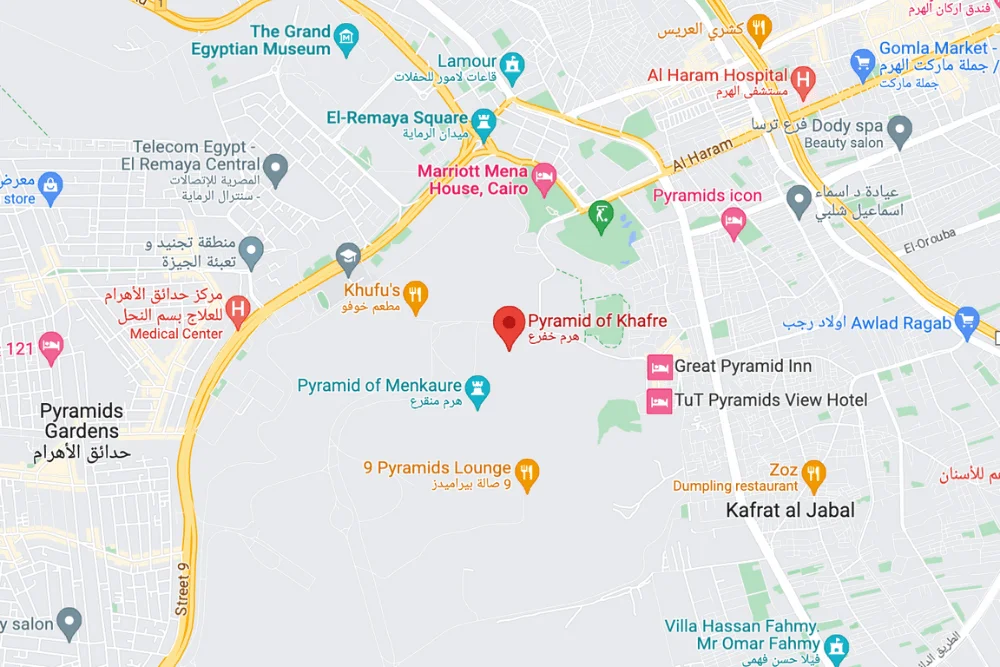
Khafre Pyramid’s Geographic Position
Khafre and the Great Sphinx
The Great Sphinx was carved directly from the bedrock of the Giza Plateau and is widely believed to date from the reign of Pharaoh Khafre. Its facial features show notable similarities to surviving statues of the king, although its exact identity continues to be discussed by scholars.
Located beside Khafre’s Valley Temple and the lower section of the causeway leading to his pyramid, the Sphinx formed part of the wider monumental landscape associated with his funerary complex. Although its precise original purpose remains uncertain, its colossal scale and royal symbolism reflect the power and authority of the pharaoh.
How Tall Is the Pyramid of Khafre?
The Pyramid of Khafre originally measured about 471 feet with its capstone. Today, it stands at roughly 448 feet, making it slightly smaller than Khufu’s Great Pyramid but still monumental in scale.
Its base spans 706 feet on each side, and the sides rise at a steep 53-degree angle. Its estimated volume is approximately 2.21 million cubic meters, demonstrating precise engineering and design.
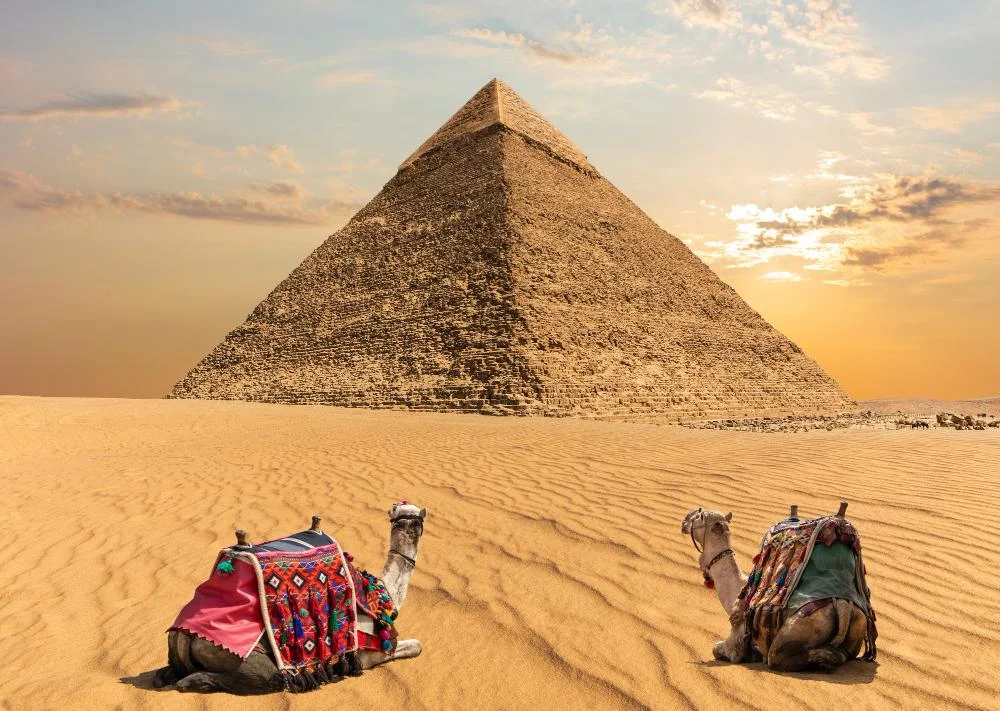
Towering Structure of Khafre Pyramid
How Was the Pyramid of Khafre Built? Construction Theories
The Pyramid of Khafre was built by a highly organized workforce using carefully selected materials and techniques developed during Egypt’s Old Kingdom. Although the exact construction process remains uncertain, archaeological evidence provides a clear picture of many stages involved.
- Foundation: The builders incorporated part of the natural bedrock into the pyramid’s core and leveled the surrounding ground to create a stable base.
- Core Material: Most of the pyramid’s core was constructed from limestone quarried locally on the Giza Plateau.
- Outer Casing: Fine white limestone from Tura originally covered most of the exterior, while pink granite was used for the lowest course of the casing.
- Stone Transport: Heavy materials, including granite from southern Egypt, were transported by boat along the Nile and moved across the plateau on wooden sledges.
- Tools: Workers likely used copper chisels, stone pounders, wooden levers, ropes, and other simple but effective tools to shape and position the blocks.
- Workforce: The project required skilled stonecutters, haulers, engineers, surveyors, and support workers operating in organized teams.
- Lifting the Blocks: Most archaeologists believe some form of ramp system was used, although the exact shape and arrangement of the ramps remain debated.
Despite extensive research, archaeologists still do not know every detail of the construction process. What is clear is that building the Pyramid of Khafre required advanced planning, skilled labor, and an efficient system for quarrying, transporting, and positioning enormous quantities of stone.
Inside the Pyramid of Khafre: Chambers and Discoveries
The interior of Khafre’s pyramid contains descending passages leading to a burial chamber carved partly into the bedrock. Its internal layout is simpler than that of the Great Pyramid of Khufu, but it still reflects the precision and skill of its ancient builders.
The burial chamber measures approximately 14.15 by 5 meters and contains a polished granite sarcophagus set partly into the floor. When the Italian explorer Giovanni Belzoni entered the chamber in 1818, he found that it had already been looted.
No royal mummy or significant funerary treasures were discovered inside. Only animal bones were reportedly found, leaving the fate of Khafre’s remains and original burial goods unknown.
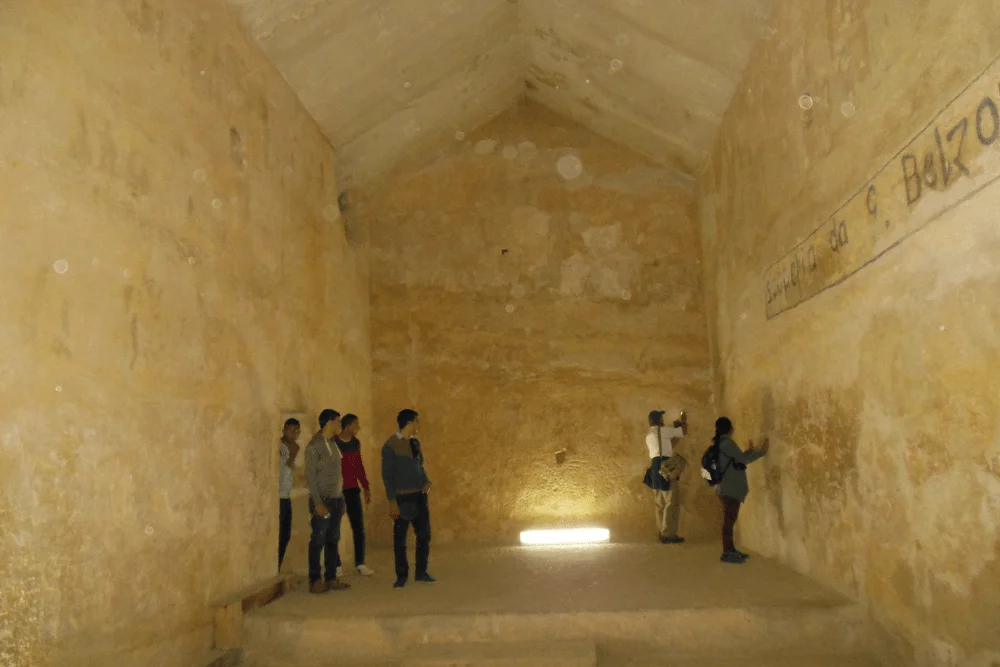
Interior Wonders
Why Is the Pyramid of Khafre Important?
The Pyramid of Khafre is significant as both a royal tomb and a symbol of divine kingship. Its scale and precision highlight ancient Egypt’s spiritual beliefs and architectural mastery.
To the south once stood a smaller satellite pyramid, which is now mostly destroyed. Khafre’s funerary complex also included the Valley Temple, connected to the mortuary temple by a causeway approximately 494 meters long. Inscriptions around the temple’s entrances mention Khafre’s royal titles and refer to goddesses such as Hathor and Bastet.
Life-size statues of Khafre were found within the complex, while its temples were constructed using massive limestone and granite blocks, showcasing the ambition and skill of Old Kingdom builders.
Together, the pyramid, temples, and causeway formed a unified funerary complex where priests performed rituals and presented offerings intended to sustain Khafre in the afterlife.
Symbolism and Religious Meaning
The Pyramid of Khafre was more than a tomb—it represented the pharaoh’s journey to eternity. Its steep sides symbolized rays of the sun, guiding Khafre’s soul toward the sky and the god Ra.
The pyramid’s alignment with the cardinal points and its connection to nearby temples reflect the Egyptians’ belief in balance between earth and cosmos. It was designed not only as a burial place but as a monument of divine kingship and eternal life.
Design and Dimensions of the Pyramid of Khafre
The builders of the Pyramid of Khafre carefully adapted its design to the natural landscape of the Giza Plateau. Part of the pyramid’s core was built around an existing bedrock outcrop, while sections of the uneven ground were cut down or built up to create a stable foundation. This intelligent use of the site helped support the enormous structure and gave it a commanding position above the surrounding plateau.
The pyramid originally stood about 143.5 meters high and had a base measuring approximately 215.5 meters on each side. Although it was shorter than the Great Pyramid of Khufu, it was built on ground around 10 meters higher and has a steeper angle of roughly 53 degrees. Together, these features make the Pyramid of Khafre appear taller than the Great Pyramid when viewed from certain parts of Giza.
Most of the pyramid was constructed from local limestone. The lowest course of its outer casing was made from pink granite, while the remaining exterior was covered with fine white limestone brought from Tura. Much of this smooth casing was removed over the centuries, but a distinctive section still survives near the summit, offering visitors a glimpse of how the entire pyramid once appeared.
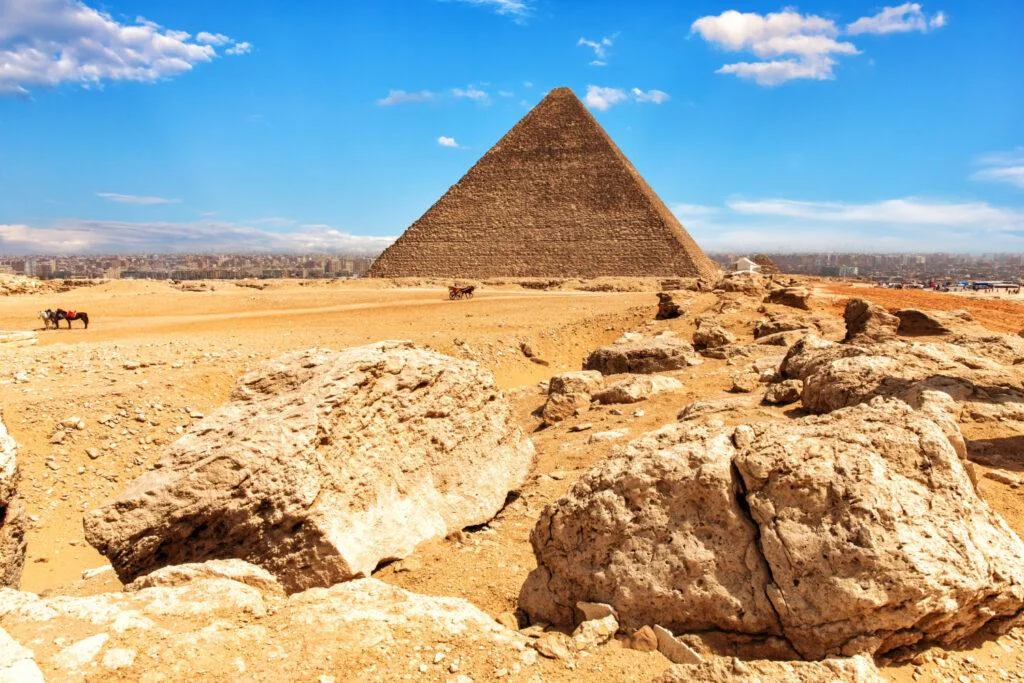
Pyramid’s Origins
Travel Tips for Visiting the Pyramid of Khafre in Giza
Planning a visit to the Pyramid of Khafre can be an unforgettable experience. These practical tips will help you prepare, save time, and make the most of your trip to the Giza Plateau.
- Opening Hours: The Giza Plateau is open daily from 7:00 AM, with the last entry at 4:00 PM. During Ramadan, opening hours are usually from 8:00 AM, with the last entry at 3:30 PM. Operating hours may change on public holidays or for special events, so checking the official booking platform before your visit is recommended.
- Ticket Price: General admission to the Giza Plateau costs 700 EGP for foreign adults and 350 EGP for eligible foreign students. The general admission ticket does not include entry inside the pyramids. Access to the Pyramid of Khafre may rotate or close temporarily for conservation, and a separate interior ticket is required whenever it is open to visitors. Check availability and current prices for your chosen date before visiting.
- Best Time to Visit: Arriving between 7:00 and 9:00 AM is usually best for cooler weather, softer morning light, and fewer crowds, especially during the warmer months.
- Pyramid Access: The Ministry of Tourism and Antiquities sometimes rotates visitor access between the Pyramid of Khafre and the Pyramid of Menkaure for conservation work, so availability may vary on the day of your visit.
- Getting Around: Free shuttle buses operate throughout the Giza Plateau, making it easier to move between the pyramids and major viewpoints.
- Payment Methods: Most ticket purchases at the Giza Plateau now require payment by bank card, while cash is often not accepted.
- What to Wear: Light, breathable clothing, sunglasses, and a hat are highly recommended.
- Footwear: Comfortable walking shoes are essential for navigating sandy and uneven terrain.
- Stay Hydrated: Bring water, especially during the warmer months.
- Photography: Early morning offers cooler weather, softer light, and fewer crowds.
- Guides: A licensed guide can add valuable historical context and local insight.
- Transport: Taxis and ride-hailing services such as Uber remain the easiest way to reach Giza from central Cairo.
For a hassle-free experience, many travelers choose guided Giza Pyramids tours that include transportation, tickets assistance, and expert Egyptologist guides.
Khafre vs Khufu: Which Pyramid Should You Go Inside?
If you only have time or budget to enter one pyramid at Giza, here’s how Khafre compares to the Great Pyramid of Khufu. Going inside Khafre is generally the easier, calmer, and more affordable experience. Its entrance sits closer to ground level, the passageways are less steep, and because most visitors head straight to the Great Pyramid, Khafre’s interior is usually much quieter.
The Great Pyramid offers the more famous interior experience, including the Grand Gallery and King’s Chamber, but it is physically more demanding, significantly busier, and usually requires a more expensive ticket.
| Feature | Pyramid of Khafre | Great Pyramid (Khufu) |
|---|---|---|
Interior Access | Separate add-on ticket required; check the current price | Separate ticket when available; check current availability and price |
Passages | Wider, less steep, easier entry | Narrower, steeper, longer climb |
Crowds | Usually quieter | Often the busiest pyramid |
Best For | A calmer, budget-friendly interior experience | The iconic bucket-list pyramid visit |
The verdict: Khafre can be a good choice if you want a simpler and often quieter pyramid interior experience. However, both pyramids contain narrow, enclosed passages and may not be suitable for visitors with claustrophobia, back problems, or limited mobility.
Recommended Tours Including the Pyramid of Khafre
If you’d rather explore the Pyramid of Khafre with an expert guide, the following tours combine the Giza Plateau’s most important attractions with hassle-free transportation and local insight.
| Tour | Duration | Highlights |
|---|---|---|
5 Days | Giza Pyramids including Khafre’s pyramid, Luxor temples, Abu Simbel | |
10 Days Egypt Classic Tour – Cairo, Alexandria, Luxor, Aswan & Abu Simbel | 10 Days | Includes Khafre’s pyramid, Alexandria, Nile Cruise, Abu Simbel |
Giza Pyramids Day Tour from Port Said – Private Shore Excursion | Day Tour | Focused visit to Khafre’s pyramid, Great Sphinx |
Cairo Day Tour from Alexandria Port – Visit Pyramids & Museum | Day Tour | Khafre’s pyramid, Great Pyramid, Egyptian Museum |
Day Tour | Private visit to Khafre’s pyramid and Cairo highlights | |
Cairo Pyramids Day Tour from Sokhna Port – Private Shore Excursion | Day Tour | Guided tour of Khafre’s pyramid, Sphinx, and Giza Plateau |
Day Tour | Explore the Giza Pyramids Complex, stand beside the Great Sphinx, and visit the Valley Temple before continuing to Saqqara |
Or you can easily tailor-make your own tour to include the Pyramid of Khafre.
Conclusion
The Pyramid of Khafre remains one of the most impressive monuments on the Giza Plateau. Its enormous scale, elevated position, carefully aligned structure, and surviving limestone casing reflect the remarkable planning and engineering skills of ancient Egyptian builders.
More than 4,500 years after its construction, the pyramid continues to offer visitors a powerful connection to Egypt’s Old Kingdom. Whether viewed from across the plateau or explored from the inside, it stands as an enduring symbol of Pharaoh Khafre’s reign and the lasting legacy of ancient Egyptian architecture.
Pyramid of Khafre FAQs
Can you enter the Pyramid of Khafre today?
Yes, visitors can enter the Pyramid of Khafre, though access may change depending on preservation work. A separate ticket is usually required.
How tall is the Pyramid of Khafre now?
The Pyramid of Khafre originally stood approximately 143.5 meters (471 feet) high. Today, it reaches about 136.4 meters (448 feet) after losing part of its summit and outer casing over the centuries.
Why does Khafre’s pyramid still have casing stones at the top?
The upper part of the pyramid still preserves sections of the fine white limestone casing that once covered most of its exterior. Most of the remaining casing was removed and reused over the centuries, but exactly why the stones near the summit survived is not known with certainty.
Why Does Khafre’s Pyramid Look Taller Than Khufu’s?
Khafre’s pyramid appears taller from certain angles because it stands on higher ground and has a slightly steeper profile. However, the Great Pyramid of Khufu is both taller and larger.
How long did it take to build the Pyramid of Khafre?
It likely took about 20 years to build, similar to Khufu’s pyramid, using thousands of laborers and millions of limestone blocks.
What tools did ancient Egyptians use to build Khafre’s pyramid?
Workers used copper chisels, wooden sledges, stone hammers, levers, and ramps to cut, move, and position massive blocks.
Is the Pyramid of Khafre aligned with stars?
Yes, it is aligned with the cardinal points and may reflect solar and stellar cycles, showing the Egyptians’ advanced astronomy.
What was found inside the Pyramid of Khafre?
Explorer Giovanni Belzoni found a granite sarcophagus in 1818, but no mummy or treasures, as it was looted in antiquity.
How much would it cost to build Khafre’s pyramid today?
Modern estimates suggest hundreds of millions of dollars would be needed for materials, labor, and engineering.
How much does it cost to go inside the Pyramid of Khafre?
Entering the Pyramid of Khafre requires a separate interior ticket in addition to the general Giza Plateau admission ticket. Please confirm the current price before your visit, as ticket rates may change. It is generally cheaper than entering the Great Pyramid.
Is the Pyramid of Khafre open to go inside?
Yes, the Pyramid of Khafre is usually open to visitors. However, access sometimes rotates with the Pyramid of Menkaure for conservation purposes, so availability should be confirmed upon arrival. A separate interior ticket is required.
Is it worth going inside the Pyramid of Khafre?
Yes, it is worth going inside if you want a quieter and less physically demanding pyramid interior experience. While the burial chamber is mostly empty, the atmosphere, ancient engineering, and lower visitor numbers make it a memorable part of a Giza visit.