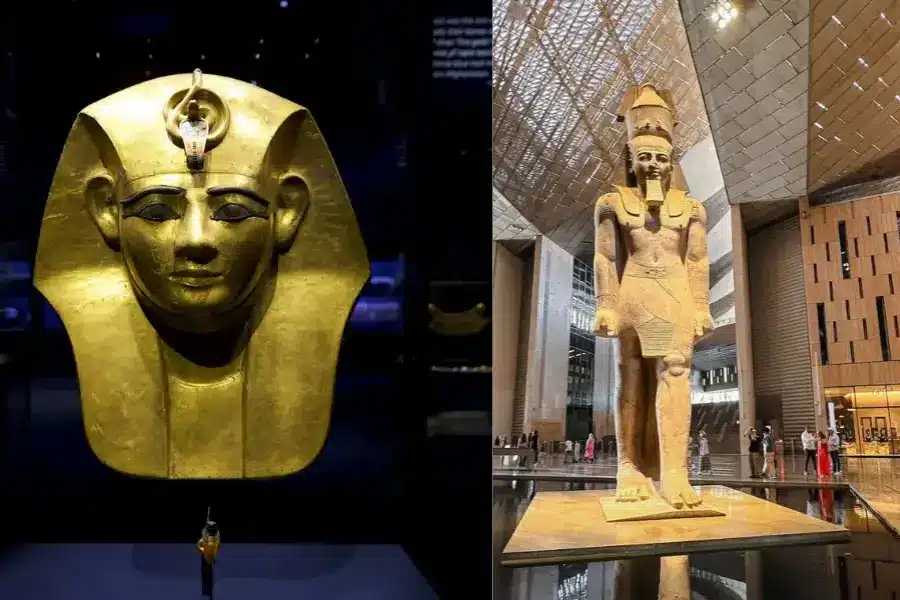
Canopic Jars in Ancient Egypt: A Complete Guide
Canopic Jars in Ancient Egypt: Meaning, Purpose, and the Four Sons of Horus
Walk into any tomb in Ancient Egypt and you’ll realize pretty quickly that these people didn’t take death lightly. It was a massive, carefully planned process, and right at the heart of it were the ancient Egyptian canopic jars.
Today, we usually see canopic jars as fascinating museum pieces, but in their own time, they were a practical necessity for anyone hoping to reach the afterlife. The entire goal of mummification was to preserve the body, yet the internal organs were the first parts to decay.
To solve that problem, the Egyptians removed those organs and placed them inside canopic jars. This wasn’t just about preservation; it was a deeply spiritual act rooted in their beliefs about life after death.
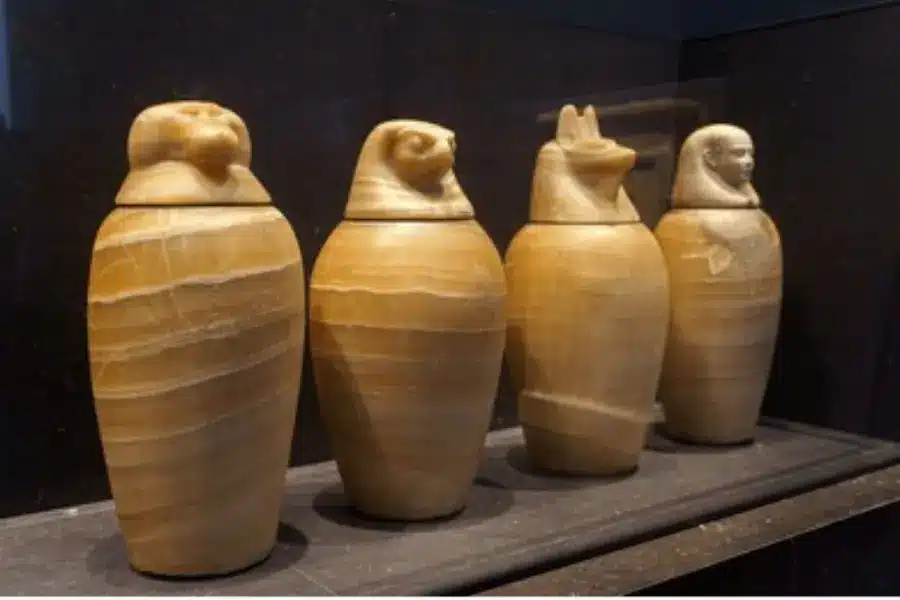
What’s especially interesting is that these jars were never used alone. They always came in a set of four, each one protected by a specific divine guardian known as one of the Sons of Horus.
Throughout the history of canopic jars in ancient Egypt, their design, materials, and symbolism changed significantly, reflecting how Egyptian religious beliefs evolved over time.
In this guide, we’ll explore why mummification canopic jars were so essential, the gods assigned to protect each organ, and some of the most famous canopic jar sets that have survived for thousands of years.
What Are Canopic Jars?
If you’re looking for a simple way to define them, you can think of them as ritual containers used specifically during the burial process. But what are canopic jars in a more practical sense? Essentially, they were the vessels designed to hold the internal organs that were removed from a body during mummification.
The canopic jars meaning goes beyond just storage, though; they were a vital part of the “kit” every Egyptian needed to stay “whole” in the eyes of the gods. Usually, a set consists of four jars, each dedicated to a specific organ: the stomach, the intestines, the lungs, and the liver.
You might notice one major organ is missing from that list; the heart. The Egyptians actually left the heart inside the body (or sometimes replaced it with a stone scarab) because they believed it was the seat of the soul and the intelligence.
They figured you’d definitely need your heart for the “weighing ceremony” in the afterlife, so it never ended up in a jar.
Why Were Canopic Jars Important in Ancient Egypt?
It might seem a bit strange to us today to put so much effort into saving organs in separate jars, but for the Egyptians, the purpose of canopic jars was a matter of spiritual life and death.
Their entire culture was built around the idea of the “Ka” and the “Ba” (parts of the soul) needing a physical body to return to. If the body decayed or was incomplete, the soul was basically homeless. This is why we canopic jars were used so consistently, they were the only way to keep the “soft” parts of the body preserved without letting the whole corpse rot
Beyond the physical side of things, there was a huge layer of divine protection involved. It wasn’t just about the stone or clay the jars were made of; it was about the fact that each organ was placed under the wings of a specific deity. By keeping the organs safe and sound in these jars, the family of the deceased felt they were giving their loved one the best possible shot at navigating the dangers of the underworld and reaching eternal paradise.
Canopic Jars and the Mummification Process
To really get how these vessels fit into the picture, you have to look at the messy reality of the embalming tent. The connection between canopic jars and mummification wasn’t just symbolic; it was a timed step in a very long process.
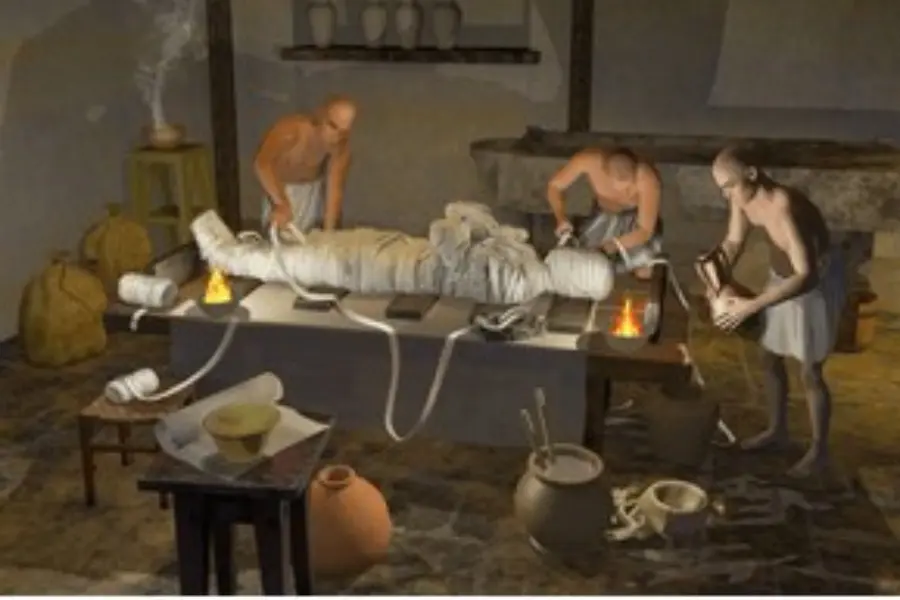
Once the body was brought in, the first thing the priests did was make an incision to remove the organs. They knew that if they left the “wet” parts inside, the body would be gone in days.
After the organs were out, they were washed and treated with natron, which is a type of natural salt that acts like a super-dryer to pull out all the moisture. Once the organs were dried out, they were wrapped in clean linen strips, almost like mini-mummies themselves.
This is where the canopic jar contents come into play. Depending on how much money the family had, these wrapped organs were either tucked into individual jars or placed into a specialized “canopic chest,” which was basically a fancy stone or wooden box with four compartments.
It was a meticulous process, but in their minds, it was the only way to ensure the deceased was “packed and ready” for eternity.
What Was Inside the Canopic Jars?
So, what exactly were the priests looking for when they opened up a body? When we talk about canopic jars organs, we’re specifically talking about the “Big Four”: the stomach, the lungs, the intestines, and the liver. Each one had its own dedicated jar.
It’s a common mistake to think they just threw everything in there randomly, but the Egyptians were incredibly precise. They believed each of these specific parts was essential for the body to function in the next world.
A question that pops up all the time is: what was inside canopic jars besides those four? The answer is usually nothing else. People often assume the brain was saved too, but actually, the Egyptians didn’t think much of the brain; they usually just pulled it out through the nose and tossed it.
And as we mentioned before, the heart was the big exception. Even though it’s an organ, it was far too important to be put in a jar. They kept it in the chest because it was the only part of you that could “speak” for you during the final judgment.
The Four Canopic Jars and the Sons of Horus
When you look at a complete set of these jars, you’re not just looking at storage containers; you’re looking at a divine bodyguard squad. The connection between the four sons of Horus canopic jars is one of the most iconic parts of Egyptian mythology.
Who Were the Four Sons of Horus?
It’s easy to get confused here, but these four deities weren’t God Horus himself. Instead, they were his children, specifically tasked with a very grim but important job: protecting the internal organs of the dead.
While Horus was a god of the sky and kingship, his sons were purely funerary figures. They were the ones who stood between the deceased’s vital organs and the forces of decay or spiritual hunger.
Without them, the Egyptians believed the “body” in the afterlife would be incomplete and vulnerable.
The Four Sons of Horus and Their Protected Organs
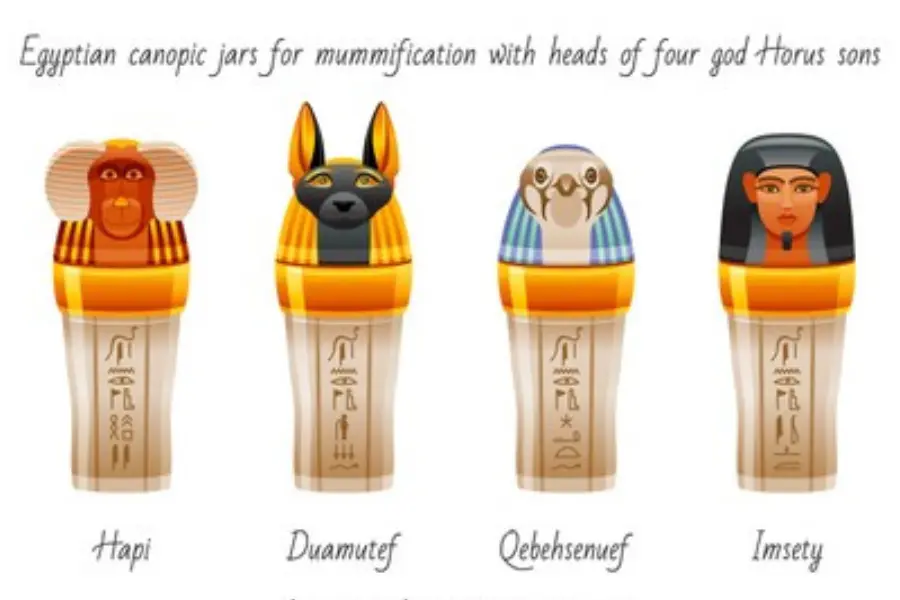
By the time the New Kingdom rolled around, each of the canopic jars’ names became associated with a specific look and a specific organ. It’s actually a pretty clever system once you see it laid out.
Each son was also paired with a powerful goddess to add an extra layer of protection.
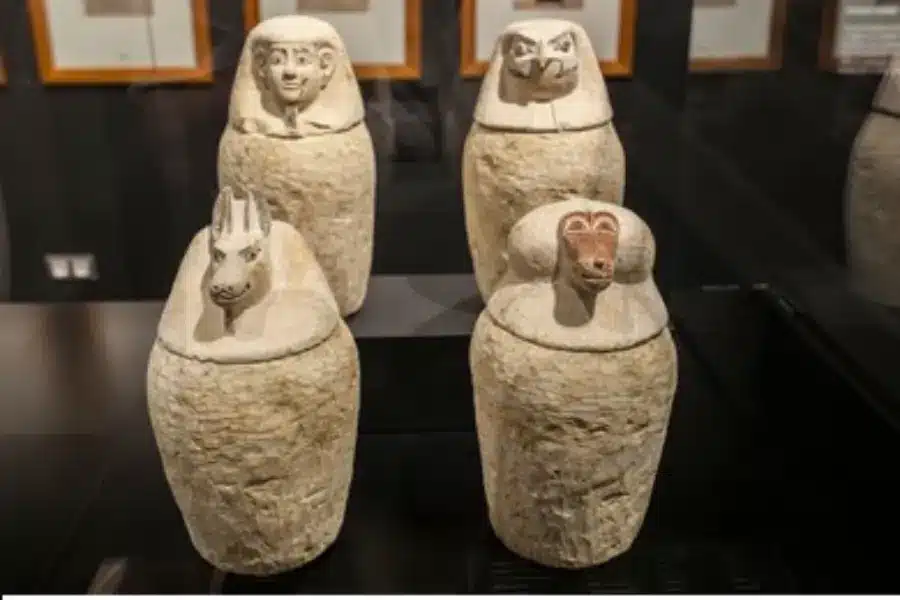
Son of Horus Organ Protected Head Shape Protective Goddess Imsety Liver Human Isis Hapy Lungs Baboon Nephthys Duamutef Stomach Jackal Neith Qebehsenuef Intestines Falcon Serket
Some traditions even linked them to the four cardinal points (North, South, East, and West), basically surrounding the deceased with a 360-degree shield of divine power.
How Did Canopic Jars Change Over Time?
Like anything else in a culture that lasted thousands of years, the style of these jars didn’t stay the same. If you compare old kingdom canopic jars to those from the later periods, the difference is night and day.
Old Kingdom Canopic Jars
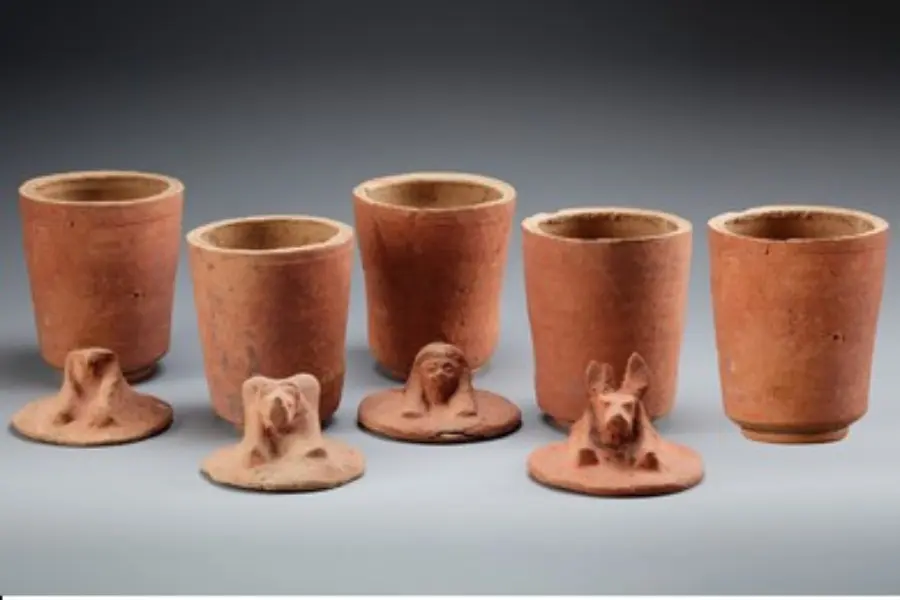
In the beginning, things were pretty minimalist. The very first Old Kingdom canopic jars were usually made of plain limestone or even pottery. They had simple, flat, or slightly domed lids and almost never had any writing or carvings on them. They were purely functional, just a safe place to put the organs.
Middle Kingdom Developments
As we move into the Middle Kingdom, things started getting a bit more “personal.” This is when we start seeing lids carved into the shape of human heads. The idea was likely to represent the deceased person themselves. You also start seeing the first bits of hieroglyphic inscriptions, usually prayers asking for protection.
New Kingdom Canopic Jars
This is the era that most people recognize. The new kingdom canopic jars are the ones where the four different heads (the human, baboon, jackal, and falcon) became the standard. This was the peak of the “Sons of Horus” symbolism, where each jar was clearly identifiable by its protector’s face.
Late & Ptolemaic Period
Interestingly, toward the end of Egyptian history, the practice took a weird turn. In some cases, they actually started putting the wrapped organs back inside the body after treating them. But because tradition was so strong, they still buried the person with jars; they were just “dummy” jars that were solid stone or empty inside.
They also started using elaborate, shrine-like chests to hold these symbolic jars, keeping the ritual alive even when the practical use had changed.
Materials and Design of Canopic Jars
If you’re wondering “what canopic jars are made of”, the answer really depends on who was being buried and how much they could afford. For the elite and the pharaohs, no expense was spared. You’d often see jars carved from beautiful, translucent alabaster or solid limestone.
These stone versions were built to last forever, which was exactly the point. For those with a slightly smaller budget, pottery or wood were common alternatives. Some of the wooden ones were even painted to look like expensive stone, proving that “faking it until you make it” is a concept as old as time.
The design details were just as varied. You might find jars that were brightly painted with vivid colors, while others were left with the natural, polished finish of the stone. In terms of size, they weren’t massive, usually around 10 to 15 inches tall, but they were often housed in something much larger: the canopic chest.
These chests were essentially “outer security” for the jars, sometimes made of wood and covered in gold leaf, or carved from a single massive block of stone. It’s this combination of materials and craftsmanship that makes them some of the most beautiful objects ever found in Egyptian tombs.
Symbolic vs Functional Use of Canopic Jars
It’s easy to assume that every jar found in a tomb was stuffed with organs, but archaeology has shown us that wasn’t always the case. As the centuries rolled by, the way Egyptians handled mummification actually shifted.
In later periods, they started wrapping the organs and just tucking them back inside the body itself. You’d assume they’d just stop making the jars altogether, but they didn’t, and that’s where things get interesting. Instead of ditching the tradition, they started burying people with “dummy” jars.
These were solid blocks of stone or wood that looked perfect on the outside but were completely solid inside. It’s a fascinating look into their mindset. It seems they just couldn’t wrap their heads around a burial without those four jars being there.
They were so used to seeing them as part of the “ritual setup” that they kept including them just for the sake of tradition, even when the jars didn’t have a single thing inside them.
Famous Examples of Canopic Jars in Ancient Egypt
When you start looking at actual finds from the desert, you realize just how much variety there was. Some of the earliest examples have come from the tombs of royal women like Queen Hetepheres and Meresankh III.
These weren’t the elaborate animal-headed jars most people picture; they were much simpler, often just plain stone, but they show us exactly when this tradition started to take root in the royal court.
Of course, the most mind-blowing discovery is the set belonging to King Tut. The canopic jars of Tutankhamun weren’t just sitting on a shelf; they were housed inside an incredible alabaster chest, which was then placed inside a massive, gold-covered wooden shrine guarded by four goddesses.
Each of his jars had a lid carved with a stunningly detailed human face, likely his own. It’s probably the best example we have of how much craftsmanship went into these objects when a Pharaoh was involved.
You can find other great sets scattered through history, from the beautifully inscribed jars of the Middle Kingdom to the mass-produced pottery versions found in later, less wealthy burials.
Where Can Canopic Jars Be Seen Today?
If you want to see these things in person, you’re in luck because they are all over the place. The obvious starting point is the Egyptian Museum in Cairo, which holds some of the most famous sets ever found, including those from Tutankhamun’s tomb in Luxor.
It’s one thing to see a photo, but standing in front of a 3,000-year-old stone jar really puts the scale of Egyptian history into perspective. Beyond Egypt, you’ll find them in almost every major world museum, from the British Museum in London to the Met in New York.
While it’s cool to see them in a glass case in a modern city, it’s always worth remembering the context they were found in. They weren’t meant to be art; they were part of a very specific, very private religious setup designed to last for eternity.
Seeing them today is like getting a tiny, stolen glimpse into the most personal beliefs of a civilization that’s been gone for millennia.
Canopic Jars Explained for Kids and Beginners
If you’re just learning about Ancient Egypt, you might wonder why they used these strange jars. Think of canopic jars for kids as “special suitcases” for the body. When the Egyptians made a mummy, they didn’t just wrap the body in bandages.
They had to take out the parts inside that would rot, like the stomach and the lungs. But they didn’t want to throw them away! They believed you would need those parts in the next life. So, they put each part into its own jar. Most of these jars had lids that looked like heads.
There was a human head, a baboon, a jackal, and a falcon. Each one was like a superhero guarding a different organ. They were always kept near the mummy in the tomb, so everything stayed together. It sounds a bit gross, but for the Egyptians, it was just their way of making sure their loved ones were safe and ready for a new adventure after they died.
Origin of the Term “Canopic”
Here’s a weird fact: the Ancient Egyptians didn’t actually call these things “canopic jars.” That name came much later, and it’s actually based on a bit of a historical mix-up. It all goes back to a place called Canopus (which is modern-day Abu Qir).
There was a Greek legend about a sailor named Canopus who was buried there, and people ended up worshipping him in the form of a jar that had a human head on top. Fast forward a few thousand years, and early explorers started digging up these Egyptian jars.
Because many of them had heads on the lids, those explorers made a quick but wrong connection to the old Greek story. They started calling them “canopic,” and the name just stuck. Even though we now know the jars were actually for the Sons of Horus and had nothing to do with that Greek sailor, the term had already become the standard.
It’s just one of those historical mistakes that everyone agreed to keep using.
Frequently Asked Questions About Canopic Jars
How many canopic jars were used?
In a standard burial, there were almost always four. This wasn’t a random number; it was because they needed one for each of the four specific organs; the liver, lungs, stomach, and intestines, and each one had its own protector.
Did all mummies have canopic jars?
Not necessarily. While they were a huge part of the “ideal” burial, they were also expensive. Wealthy families and royalty definitely had them, but poorer people might have used cheaper versions or, in some cases, none at all. It really came down to what you could afford for the afterlife.
Was there a canopic jar for the heart?
Nope. This is a big one that people often get mixed up. The heart was the only major organ left inside the body. The Egyptians believed the heart was where your soul and memory lived, and you’d need it to be weighed by the gods later on, so it was never put in a jar.
Are canopic jars still found today?
Actually, yes. Even though tomb raiders cleared out a lot of burials over the centuries, archaeologists are still digging them up in new discoveries. Since they’re usually made of tough stuff like stone or thick pottery, they tend to hold up way better than the mummies or the wooden coffins. Every time a new set is found, it’s like finding another piece of the puzzle of how that specific person was sent off into the afterlife.
Conclusion
It’s honestly pretty wild to think that something as simple as a jar for holding organs could tell us this much about a civilization. But that’s the thing about Ancient Egypt; nothing was “just” a jar.
These pieces are like a direct line into how they handled the whole concept of life and death. They show us their religious side, their medical knowledge from mummification, and just how far they were willing to go to make sure their loved ones were “set for life” in the next world.
If you ever find yourself in Egypt, standing in front of these in museums or down in a tomb in Luxor, you really feel the weight of all that history. They’re more than just artifacts; they’re a reminder of a people who were obsessed with the idea of eternity.
Whether it’s a simple clay pot or a royal alabaster masterpiece, these jars are still one of the coolest ways we have to connect with the people who built the pyramids and spent their lives preparing for what came next.
If this topic caught your interest, seeing these objects in person adds a new layer to the story. Authentic canopic jars and mummification artifacts can be seen today in Egyptian museums, especially at the Grand Egyptian Museum in Cairo.
While the jars themselves are preserved in museums, visits to tombs and temples in Luxor help explain the original burial setting where these rituals once took place.
If you’re planning a trip, you may enjoy browsing Egypt tour packages, Nile Cruise itineraries, or tours that include the Egyptian Museum — simply to explore different routes and experiences, not as a sales pitch.