Top Cities in Ancient Egypt – Major Ancient Egyptian Cities Explained
The cities in ancient Egypt were far more than mere urban settlements—they served as political capitals, sacred religious centres, bustling trading hubs, and the lifeblood of one of history’s most remarkable civilizations. Each ancient city in Egypt carries its own unique story, from periods of immense prosperity to cultural peaks, and sometimes mysterious declines into ruin.
In this guide, we delve into the major ancient cities in Egypt, including iconic power centers like Thebes, Memphis, and Alexandria, sacred spiritual hubs such as Abydos, and revolutionary centres exemplified by Amarna. To help you visualize and navigate these historic locations, we also provide a map of ancient Egyptian cities alongside a detailed historical timeline, offering context for how these cities shaped Egypt over thousands of years.
Whether you are a student of ancient civilizations, a traveler planning your journey, or simply fascinated by Egypt’s past, this article provides a comprehensive, well-structured, and engaging overview of the world of ancient cities in Egypt.
Key Takeaways – Cities in Ancient Egypt
- Egypt had multiple major capitals over its long history, including Memphis, Thebes, Pi-Ramesses, and Alexandria.
- Each ancient Egyptian city had a distinct role: political, religious, commercial, or military.
- Heliopolis and Abydos were important religious centres that shaped Egyptian mythology.
- Amarna was the centre of one of Egypt’s most dramatic religious revolutions.
- Trade cities like Elephantine connected Egypt with Nubia and Africa.
- The urban map of ancient Egypt reveals how civilization expanded along the Nile and shifted over time.
Map of Ancient Egyptian Cities
To better understand where the major ancient cities of Egypt were located, this map shows their positions along the Nile Valley — from the Nile Delta in the north to Upper Egypt in the south. This visual reference helps you see how Egypt’s political and religious power shifted over time.
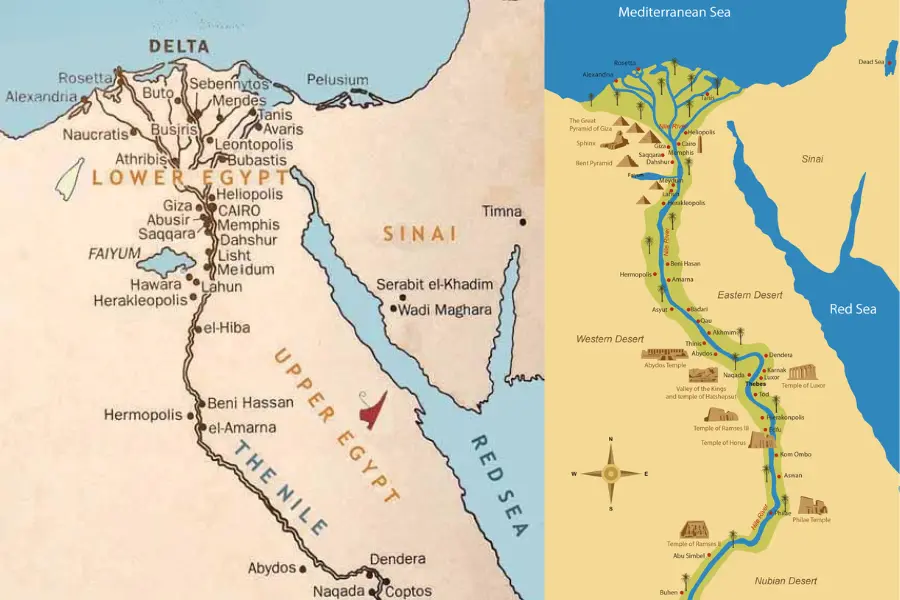
From Memphis in Lower Egypt to Thebes, Abydos, and Elephantine in Upper Egypt, the map visually highlights how civilization stretched across the Nile for thousands of years.
Thebes – The Spiritual & Political Heart of Ancient Egypt
Thebes was one of the most influential cities in ancient Egypt, acting as the capital during the Middle and New Kingdoms. Located 675 km south of Cairo, it served as the center of royal authority from 2055 to 1650 BC and rose again to prominence during Egypt’s Golden Age (1550–1077 BC).
Known to the Greeks as Thebai, meaning “the city of a thousand gates,” Thebes was both a political stronghold and a spiritual hub. It is home to monumental sites such as the Karnak Temple Complex and the royal tombs in the Valley of the Kings, making it a symbol of ancient Egyptian power, religion, and architectural achievement.

Memphis – The First Capital of Ancient Egypt
Memphis was the very first major capital of ancient Egypt, flourishing from approximately 2950 to 2180 BC. Strategically positioned just south of modern Cairo, this ancient city became a bustling political center and a major religious hub, devoted to the triad of gods: Ptah, Sekhmet, and Nefertem.
Even after Thebes rose to prominence as Egypt’s new capital, Memphis retained its importance as a monumental religious site. Today, travelers can explore impressive remnants such as the Colossus of Ramses II and the Alabaster Sphinx, bearing witness to its enduring legacy in Egyptian history.

Amarna – The City of the Sun Disk
Amarna, or Akhetaten, was founded by Pharaoh Akhenaten during one of the most revolutionary periods in Egyptian history. Built between 1353 and 1336 BC, it became the centre of Egypt’s monotheistic experiment — the worship of the Aten, the radiant Sun Disk.
Located on the east bank of the Nile River, Amarna was designed as a brand-new capital, filled with palaces, temples, and administrative buildings. Although short-lived, it remains one of the most studied ancient cities of Egypt due to its unique art style and religious reforms.

Avaris – Capital of the Hyksos
Located near Tell El-Dab’a in the Nile Delta, Avaris served as the capital of Egypt during the Hyksos period (c. 1650–1550 BC). It was a major trading hub connecting Egypt to the Levant and the wider eastern Mediterranean.
Excavations reveal foreign-style burials, imported pottery, and evidence of a multicultural society — making Avaris one of the most fascinating cities in ancient Egypt for archaeologists.
Pi-Ramesses – The Royal City of Ramesses II
Built by Ramses II (1279–1213 BC), Pi-Ramesses was a vast royal capital in the northeastern Delta. It included palaces, stables, weapon workshops, and monumental gateways — truly a “House of Millions of Years” for Egypt’s most famous pharaoh.
The city was divided into four districts, each honouring a deity: Amun, Astarte, Wadjet, and Seth. Its strategic location made it essential for Egypt’s military campaigns.

Thinis – The Forgotten First Capital
Thinis, located near Abydos, was one of Egypt’s earliest capitals during the first dynasties. Although very little of it survives today, ancient texts describe it as a powerful political and religious centre.
The city is also tied to mythology — particularly the cult of Osiris — making it one of the lesser-known yet important ancient Egyptian cities.
Alexandria – The Crown Jewel of the Mediterranean
Founded in 332 BC by Alexander the Great, Alexandria became the capital of Egypt during the Ptolemaic and Roman eras. Stretching 32 km along the Mediterranean, it became the intellectual capital of the ancient world.
Its Great Library once held hundreds of thousands of scrolls, while the Pharos Lighthouse — one of the Seven Wonders of the Ancient World — guided sailors from across the known world.

Heliopolis – City of the Sun God
Known in ancient Egypt as Iunu or On, Heliopolis was the primary centre of worship for the sun god Ra. Located in Lower Egypt near modern Cairo, it was one of the most influential religious cities in ancient Egypt.
Heliopolis was revered as the mythical birthplace of the gods Geb, Nut, Shu, Tefnut, Isis, Osiris, and Nephthys — the foundations of Egyptian cosmology.
- Isis
- Geb
- Atum (Ra)
- Nut
- Osiris
- Set
- Tefnut
- Nephthys
- Shu
Abydos – Sacred City of Osiris
Abydos in Upper Egypt was one of the most sacred ancient cities of Egypt, believed to be the burial place of Osiris, god of the afterlife. For thousands of years, pilgrims travelled here seeking blessings and eternal connection with the divine.
Its temples — including the magnificent Temple of Seti I — contain some of the finest reliefs and inscriptions in all of Egypt, documenting kings, rituals, and creation myths.

Elephantine – Gateway Between Egypt & Africa
Located on a Nile island near modern Aswan, Elephantine was a strategic trade and military city. Its location made it the southern gateway of Egypt, connecting the kingdom with Nubia and central Africa.
The island was home to the Temple of Khnum and the cult of Satet, guardians of the Nile’s flood — essential for Egypt’s survival.
Historical Timeline of Egypt’s Major Ancient Cities
Understanding when each ancient city flourished helps you see how political power, religion, and culture shifted through Egypt’s long history. This timeline highlights the rise of the most important Cities in ancient Egypt across key eras — from the Early Dynastic Period to the Ptolemaic age.
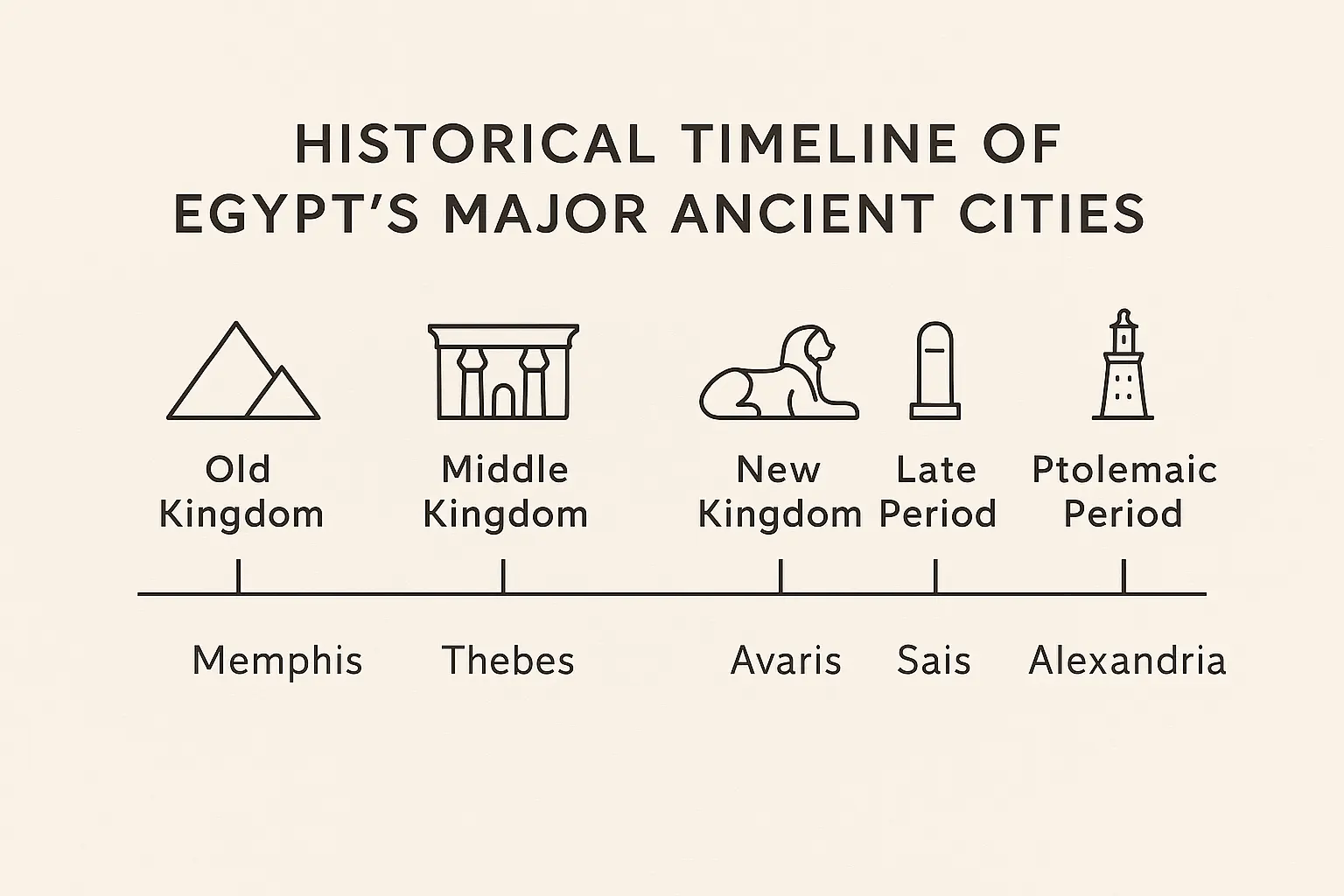
Early Dynastic Period (c. 3100–2686 BC)
- Thinis – earliest capital of unified Egypt.
- Abydos – spiritual burial centre of the first kings.
Old Kingdom (2686–2181 BC)
- Memphis – political capital, home of the god Ptah.
- Rise of pyramid construction around the Memphis region.
Middle Kingdom (2055–1650 BC)
- Thebes – emerging religious and political power.
- Faiyum (Crocodilopolis) thrives under agricultural expansion.
Second Intermediate Period (1650–1550 BC)
- Avaris – capital of the Hyksos and major trade hub.
New Kingdom (1550–1077 BC)
- Thebes – Egypt’s golden-age capital.
- Abydos – royal pilgrimage destination.
- Pi-Ramesses founded by Ramses II.
Late Period (664–332 BC)
- Revival of Memphis and Heliopolis as religious centres.
Ptolemaic & Roman Period (332 BC – 641 AD)
- Alexandria – the new capital and intellectual centre of the Mediterranean.
- Birthplace of the Great Library and the Pharos Lighthouse.
Conclusion – Why These Cities Still Matter Today
The major cities in ancient Egypt were far more than settlements — they were engines of political power, religious evolution, trade, agriculture, and intellectual transformation. From the deep spirituality of Abydos to the scientific brilliance of Alexandria, each ancient city in Egypt played a defining role in shaping one of history’s greatest civilizations.
Exploring these cities today offers a rare opportunity to walk through 5,000 years of human achievement, architectural genius, and mythological heritage. Whether you’re a historian, an archaeology enthusiast, or a traveler planning your next adventure, ancient Egyptian cities remain an unmatched window into the past.
Let our expert team help you plan the perfect Egypt trip — combining ancient cities, Nile cruises, pyramids, and local culture into one unforgettable journey.
FAQs – Cities in Ancient Egypt
What were the main cities in ancient Egypt?
The key ancient Egyptian cities include Memphis, Thebes (Luxor), Alexandria, Avaris, Pi-Ramesses, Abydos, Amarna, Heliopolis, Elephantine, and Crocodilopolis.
What was the capital city of ancient Egypt?
Egypt’s capital changed across eras: Memphis in the Old Kingdom, Thebes in the Middle & New Kingdoms, and Alexandria during the Ptolemaic Period.
Which ancient Egyptian city is the oldest?
Abydos is considered one of the oldest continuously inhabited ancient Egyptian cities, dating back to Egypt’s earliest dynasties.
Which ancient Egyptian city was the most religious?
Abydos was the spiritual heart of Egypt; Heliopolis was the centre of the solar cult and worship of Ra.
Which ancient city in Egypt can I visit today?
The best-preserved ancient cities to visit today are Luxor (Thebes), Cairo, Alexandria, Abydos, and Aswan.