Scarab Meaning in Ancient Egypt: History, Symbolism & Beliefs
Scarab: Meaning, History, Symbolism & Ancient Egyptian Beliefs
Imagine yourself walking through the ancient Egyptian temples or discovering the archaeological monuments in museums, you will notice a certain symbol that is frequently repeated in front of your eyes: the Scarab.
This symbol is small just in its shape, but it carries a deep story stretching for thousands of years of beliefs and ideas that formed the vision of the ancient Egyptians about life, death, and renewal.
Scarab wasn’t just a beetle in their vision, it was a great cultural and religious symbol reflecting a deep understanding of the cycle of creation and eternal continuity.
For travelers and visitors of Egypt today, the Egyptian scarab appears nearly everywhere, carved on the walls of temples, made in the shape of amulets and jewelry, and even shown among the most important archaeological pieces in global museums.
Understanding the real meaning of scarabs doesn’t just add historical information for you. It provides you with the ability to read the symbols and realize the messages that ancient Egyptians left behind.
This makes the experience of visiting the archaeological sites deeper and more connected to the civilization itself.
What Is a Scarab?
The scarab is a symbol taken from a real species of beetle, known as the scarab beetle. Historically and culturally, it isn’t meant by the beetle itself, but the symbolic meaning that is connected to it.
When we ask what is a scarab? The answer isn’t limited to the biological definition; it confirms a deep religious and philosophical connection, especially in ancient Egyptian civilization.
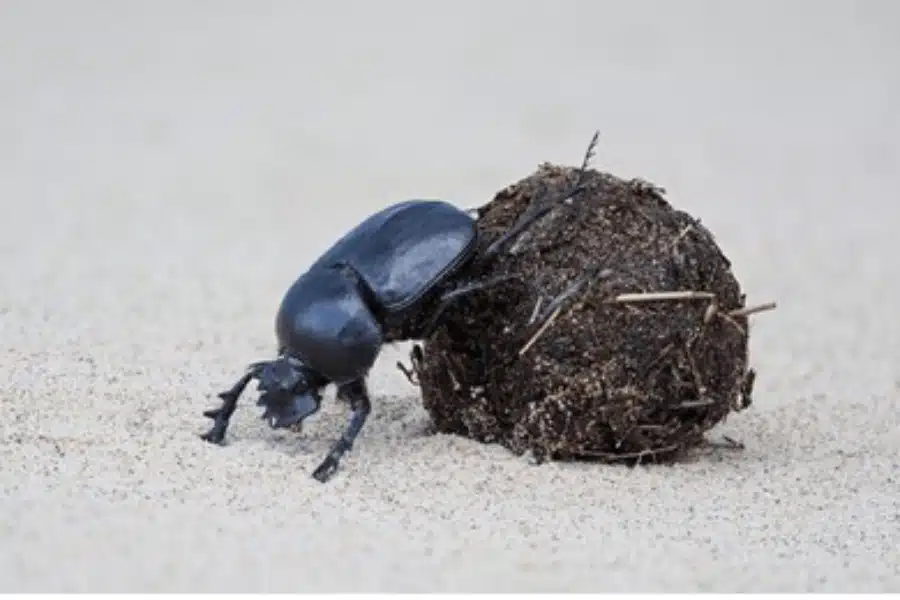
Scientifically, the scarab beetle is a species of beetle that lives in different environments all over the world. It’s distinguished by its skill of forming balls of organic matter.
Symbolically, the scarab represents the thoughts of ancient Egyptians, which were taken from its unique behavior. Ancient Egyptians connected this behavior with ideas of creation, renewal, and eternal continuity.
So, the term scarab isn’t always used to refer to the beetle itself. It’s used as a symbol that became a religious and cultural icon. By that time, the scarab had become an independent symbol carved on the walls. It was also made in the shape of amulets and used in rituals.
Regardless of its biological meaning, the scarab was treated as a symbol that carried a deep message of the cycle of life, rebirth, and continuity.
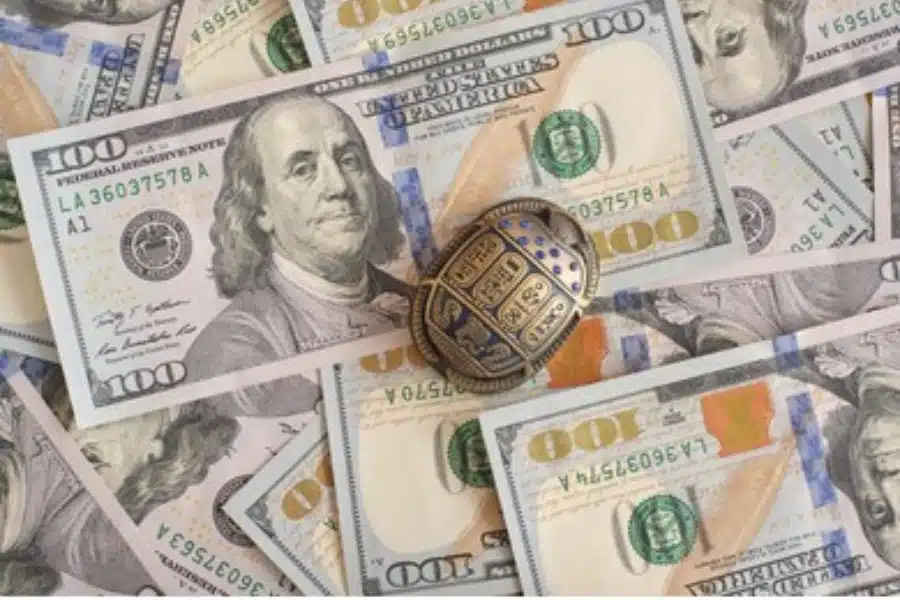
Scarab Beetles in Nature
The scarab isn’t an imaginary symbol. It has an origin. The scarab beetle is a real insect belonging to the scarab family. These beetles aren’t just a normal part of nature; they have unique behaviors that distinguish them from the other types of insects.
Scarab beetles in nature:
- The scarab beetles live in different environments around the world, from deserts to jungles and farms.
- When it comes to “what do scarabs eat?”, their food is the decomposing organic matter, like animal dung and decaying plants.
- In this way, they have a vital role in cleaning nature and renewing the soil.
- In answer to the question, “Are scarab beetles dangerous?” The answer is no; they don’t represent any danger to humans.
- The scarab beetles don’t bite and they also don’t have any venom.
These environmental behaviors were the reason why ancient Egyptians chose the scarab to be a symbol of creation, resurrection, and eternity.
For all these reasons, the scarab beetle became a sacred symbol in ancient Egyptian civilization.
Scarabs in Ancient Egypt
In ancient Egypt, the scarab wasn’t just known as an insect in the surrounding environment; it was among sacred symbols that had a special position in religious belief and thought.
The ancient Egyptians connected the scarab and the sun’s daily movement. They saw a similarity between its behavior and the journey of the sun disc. This movement was associated with the sun god, especially Khepri, who represented the rising sun and daily rebirth.
So, it became a symbol for creation, change, and resurrection. This connection made the ancient Egyptian scarab a symbol for continuous life and rebirth after death. These were key concepts in ancient Egyptian beliefs.
The Egyptian scarab appeared in religious and daily life. It was used as an amulet for protection and bringing good luck, carved on the walls and made into jewelry and seals.
It was also used in funeral rituals, especially the shape of “heart scarab” which was placed with the mummy to guarantee safety for its soul in its journey to the underworld.
The scarab became a symbol combining both religious belief and daily life in ancient Egypt. It also reflected the ancient Egyptians’ vision of the world, as nature intertwined with belief and eternity.
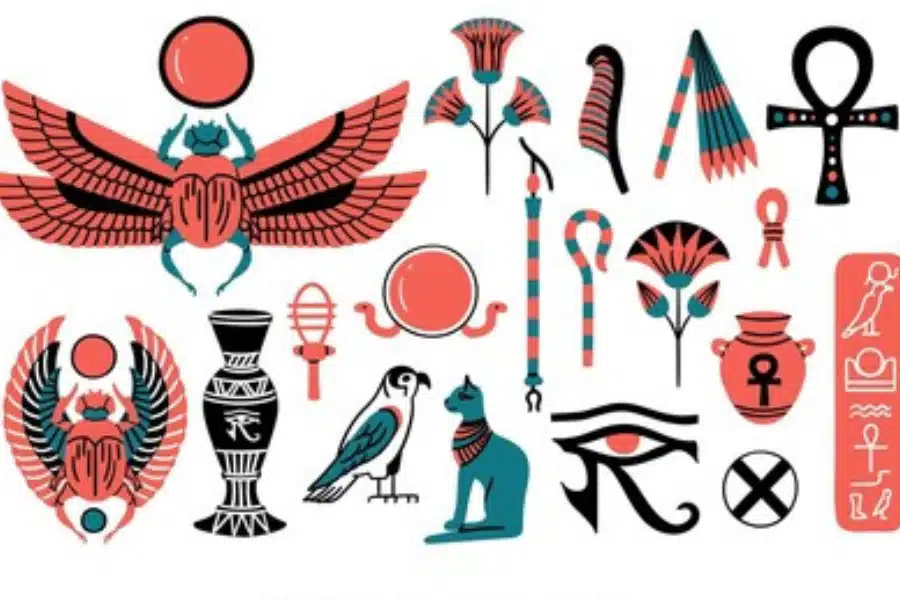
What Did the Scarab Symbolize in Ancient Egypt?
The scarab wasn’t just a repeated shape in ancient Egyptian art. It was a core symbol that carried deep meanings in Egyptian religious beliefs.
When we ask about the scarabs’ meaning or “what does a scarab symbolize” the answer is directly related to the ancient Egyptians’ understanding of the life cycle and the universe. The scarab’s behavior in nature inspired them with a philosophical vision that made it a complete symbol expressing several meanings, not just one.
The ancient Egyptian scarab’s significance was represented in some main meanings, like:
1. Rebirth
The ancient Egyptians connected the scarab to the idea of rebirth. They saw that its daily appearance from the earth symbolized a new beginning and the renewal of life after death. This idea was strongly connected to the sun god and the daily rebirth of the sun.
2. Protection
The scarabs were used as an amulet for protection or in the funerary rituals. Ancient Egyptians thought that they protected people from evil powers and gave them safety in the underworld.
3. Creation
The scarab was connected with the idea of the first creation. Especially, from its relation to the sun’s movement. It was considered a symbol of the power that recreates the world every day.
4. Eternal life
The scarab gathered the definitions of resurrection and creation to become a symbol for eternal life and continuity after death. This was the core of the ancient Egyptian belief.
By this, the scarab meaning in Egyptian civilization wasn’t just symbolic. It was a reflection of a complete philosophy about the universe, human and eternity. This explains the continuous appearance of the scarab in tombs, amulets and carvings until today.
Scarabs as Amulets & Artifacts
The scarab’s importance in ancient Egypt wasn’t limited as being just a religious symbol. It appeared clearly in the shape of amulets and artifacts that were used in daily life and the funerary rituals.
The amulets of scarabs spread widely among the different classes of society. They were thought to provide protection, bring good luck and pull the evils away from their carriers. For this reason, scarabs Egypt are strongly found in our archeology; inside the tombs or even among the personal belongings.
Scarabs as amulets and artifacts:
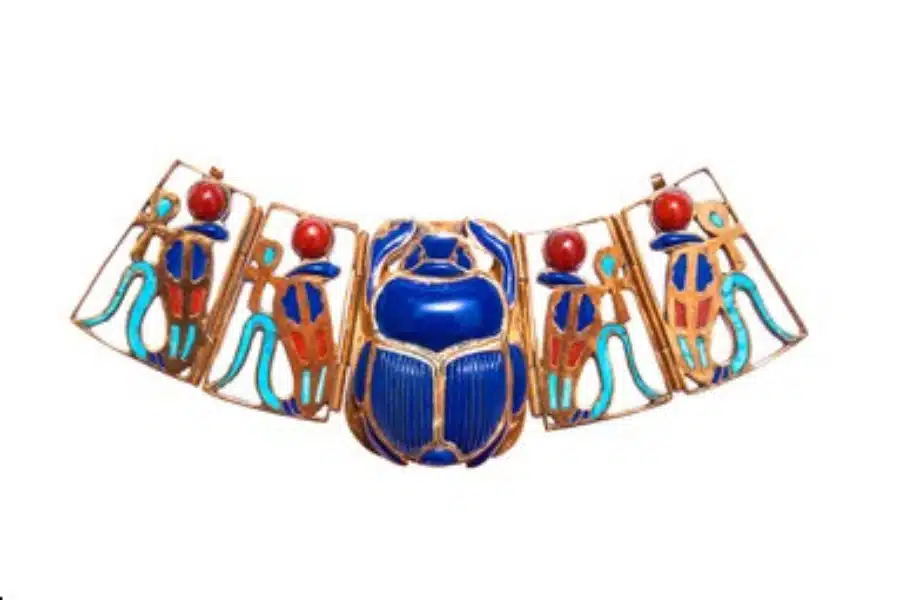
- The scarabs were made of several materials like stone, faience and carnelian.
- They were used in jewelry like necklaces and rings.
- They were used as formal seals carved with the names of persons or short religious phrases.
- These seals had an important management role in documenting transactions.
- One of the most common archaeological scarabs was the heart scarab which was a special type used in funerary rituals. It was placed on the chest of the mummy or among its layers as it was thought to protect the dead’s heart during the judgment of the underworld.
These pieces are considered the most important ancient Egyptian scarab beetle facts. They show how the scarab turned from a live creature into a core symbol of recreation, renewing, and eternity.
Scarabs in Museums Today
Today, the scarabs are no longer symbols of the past. They became some of the most important artifacts that visitors are eager to see in museums all over the world.
Travelers can explore original scarabs dating back to different periods of the ancient Egyptian civilization. These include funerary scarabs, seals, and jewelry used in daily life or funerary rituals.
These artifacts represent a direct connection between the visitor and ancient Egyptian beliefs, in addition to revealing how a small natural creature became an eternal symbol of faith and continuity.
Massive museums all over the world, like the Egyptian Museum, the British Museum, and the Louvre, include stunning collections of scarabs that are made of faience, stone, and carnelian. They are always displayed with explanations showing their religious and social role.
Exploring these artifacts in person helps the visitor to understand the real meaning of scarabs, not just as beautiful engravings, but as tools that carry meanings of protection, creation, and eternal life.
For all these reasons, scarabs are considered among the main artifacts that enrich the experience of visiting museums and make the journey to Egypt deeper and meaningful.
Are All Beetles Scarabs?
Not all beetles are scarabs. This is one of the most common concepts that is not well understood. Scarab is just a single group of beetles, not all the types of beetles in nature.
Scientifically, scarabs belong to one specific family of beetles. These are distinguished by their behaviors and different shapes from the other types. The main difference between scarabs and the other beetles appears in their behavior and environmental role.
Some types of scarabs, especially the dung ones, have a unique skill of forming balls of organic matter to use for nutrition and reproduction. The other types don’t have this behavior. So, not all the beetles are scarabs.
Culturally, misunderstanding increases because scarab in ancient Egypt wasn’t just an insect, it was a religious and philosophical symbol. This made any beetle that looked similar to a scarab sometimes inaccurately called scarab.
In fact, the answer to the question “are all beetles scarabs?” is no. Scarabs are a species in the beetle family that has biological and symbolic characteristics that made it a unique symbol in ancient Egyptian civilization.
Scarabs in Modern Culture & Spiritual Meaning
Although scarabs were originally connected to the ancient Egyptian civilization, their symbolism didn’t disappear over time.
Today, scarabs became a spiritual symbol expressing change, renewal of power, and protection. For these reasons, many people are attracted to scarabs even outside the religious context.
The scarab’s spiritual meaning is connected to the idea of positive change and the ability to restart after hard times. For all of this, scarab appeared in tattoos and modern jewelry. It’s used to express inner power and personal growth, not just as a beautiful element.
The continuous appearance of scarabs in the modern era confirms that the ancient symbols don’t lose their meaning over time. Their meanings renew to stay expressive about the idea of change and continuity in human’s life.
Frequently Asked Questions about Scarabs
What is a scarab?
A scarab is a symbol inspired by a real type of beetle. In ancient Egypt, it represented ideas beyond the insect itself, especially beliefs about life, renewal, and the cycle of existence.
What does a scarab symbolize?
A scarab symbolizes rebirth, protection, creation, and eternal life. These meanings came from how ancient Egyptians observed the beetle’s behavior and linked it to the movement of life and nature.
Are scarab beetles dangerous?
No, scarab beetles are not dangerous. They do not bite humans and have no venom. They are harmless insects with an important role in the environment.
Why are scarabs important in Egypt?
Scarabs are important in Egypt because they were sacred symbols in ancient Egyptian belief. They were used as amulets, seals, and funerary objects, representing protection, rebirth, and life after death.
Conclusion
Scarab wasn’t just an insect in the ancient Egyptian environment. It was a deep symbol that combined nature, belief, and philosophy.
Ancient Egyptians were inspired by the meanings of creation, renewal, and continuity from the behavior in nature. They turned it into a sacred symbol connected to life, death, and the afterlife. Because of all this, the scarab became a main part of daily life and religious rituals.
Although thousands of years have passed, the scarab has not lost its symbolic power.
It’s still seen as a symbol of protection and restarting. This is what explains its continuity in modern culture and global museums.
For travelers and visitors to Egypt, understanding the meaning of scarabs doesn’t just add historical information; it also opens a deep door into reading the symbols and understanding the message that the ancient Egyptians left behind. Hence, visiting the archaeological sites turns from a silent viewing to a meaningful experience that is connected to the civilization itself.
Understanding ancient symbols like the scarab changes the way you experience Egypt.
What once seemed like silent stones become stories, beliefs, and messages waiting to be discovered—inside temples, tombs, and museums across the country.