Dendera Temple – Exploring the Temple of Hathor in Egypt
The magnificent Dendera Temple complex, a truly unique gem of ancient Egyptian architecture, stands proudly in Upper Egypt. Strategically located near the city of Qena and easily accessible as a transformative Luxor day trip, this monumental site is often hailed as the best-preserved temple in the entire country. Dedicated to the powerful goddess Hathor (deity of love, music, and fertility), Dendera offers visitors an unparalleled journey through Egyptian, Ptolemaic, and Roman history, showcasing vivid original colors and stunning mythological detail that survived millennia almost untouched.
What sets the Temple of Hathor apart is not merely its grandeur, but the staggering preservation of its inner sanctums and unique features. The Great Hypostyle Hall still captivates with ceilings that retain their original celestial blue pigments, while the walls are covered in detailed, perfectly carved reliefs. The complex is globally famous for its iconic astronomical ceiling, which once featured the magnificent Dendera Zodiac (a crucial artifact of ancient celestial art). This synthesis of sophisticated astronomy, mythology, and deep history provides the most comprehensive and complete ancient temple experience available in the Nile Valley today.
Unlike many ancient Egyptian monuments often reduced to ruins, the vast Dendera Temple Egypt remains remarkably intact. From its enigmatic underground crypts and ceremonial rooftop chapels to the towering Hathor-headed columns, the complex serves as a layered chronicle of civilization, bearing the fingerprints of Pharaohs, Ptolemaic Greeks, and Roman Emperors. This exceptional architectural integrity offers historians and modern travelers an intimate window into the evolution of sacred space and the vibrant practices of religious life in ancient Egypt across various eras, making it an essential destination for cultural immersion.
The Temple of Hathor is a spectacular architectural document of layered history. Although the monumental structure you see today was predominantly built during the late Ptolemaic period and completed by powerful Roman emperors, including Tiberius and Nero, its roots run far deeper. It stands upon the sacred ground of much older sanctuaries, with evidence dating back to the Old Kingdom (c. 2700–2200 BC).
This unique combination of a massive structure built in the Greco-Roman style on top of ancient Pharaonic foundations explains why visitors immediately sense that Dendera is more than just a temple—it is a complete, tangible timeline of Egyptian culture and civilization in one magnificent complex. It showcases the enduring power of Hathor’s cult over millennia, merging traditional Egyptian beliefs with new imperial influences.
If you are determined to explore the Temple of Hathor in the most immersive, comfortable, and efficient way possible, Egypt Tours Group highly recommends our signature tour. Join our highly-rated Dendera & Abydos Day Tour from Luxor, which covers both of these essential, beautifully preserved temples in a single unforgettable journey, complete with expert guides, private transport, and ample time for exploration. Booking this tour ensures you unlock the full historical and archaeological depth of Upper Egypt with maximum convenience.
Key Takeaways – Dendera Temple
- ✅ Dendera Temple Complex is dedicated to Hathor — the Egyptian goddess of love, joy, music, beauty, and motherhood.
- ✅ The current Temple of Hathor was built mainly during the Ptolemaic and Roman periods, making it one of the best-preserved temples from that era.
- ✅ Dendera is famous for its astronomical ceilings, especially the renowned Dendera Zodiac, one of ancient Egypt’s most iconic sky maps.
- ✅ The complex includes several secondary structures such as the Temple of Isis, the Mamisi (Birth House), and rooftop chapels.
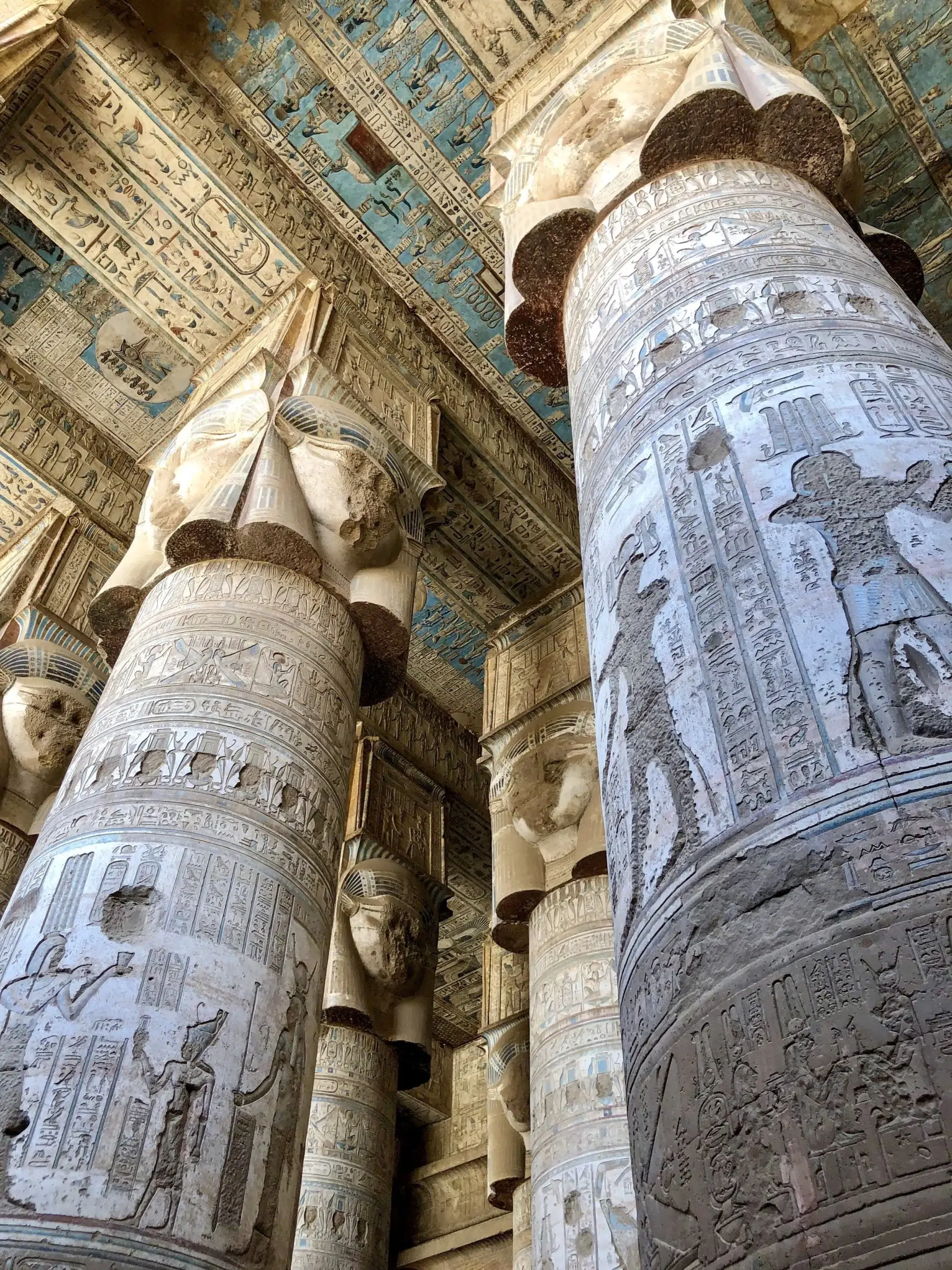
- ✅ The Hypostyle Hall stands out with 24 massive Hathor-headed columns supporting its vividly painted ceiling.
The Dendera Temple Complex: History and Location
The magnificent Dendera Temple Complex is strategically situated on the west bank of the Nile River, approximately 60 km north of Luxor and a short distance northwest of Qena. This prime location established Dendera as one of ancient Egypt’s most vital religious centers for thousands of years.
While the remarkable stone temple you explore today is a masterpiece of the late Ptolemaic and Roman periods, its foundation is ancient. The site’s sacred history predates the current structure, with archaeological evidence confirming that successive temples stood on this exact spot as far back as the Old Kingdom, Middle Kingdom, and New Kingdom eras. This includes a shrine believed to have been built by Pharaoh Pepi I of the 6th Dynasty around 2250 BC.
The longevity of Dendera as a cult site—a place of continuous worship across three millennia, culminating in the beautifully preserved Greco-Roman structure—makes the Dendera Temple Complex a unique portal into the evolution of Egyptian civilization.

Origins of the Temple of Hathor at Dendera
Dendera’s status as a sacred site dedicated to Hathor, the revered goddess of love, joy, music, and motherhood, has endured for over 4,000 years, with the earliest shrine references dating back to the Old Kingdom. Through successive eras, various rulers restored, rebuilt, and expanded the complex, culminating in one of Egypt’s most complete surviving temple structures.
The magnificent temple structure we see today began under the patronage of Ptolemy XII (father of the famous Cleopatra VII) around 54 BC. Construction was later continued and completed by Roman emperors, including Augustus, Tiberius, and Nero. This ambitious, long building period created a striking architectural style that masterfully blends the colossal scale and iconographic elements of traditional Egyptian temples with the subtle decorative finesse of Greco-Roman influences.
Evolution of Dendera Temple Architecture
Over nearly two centuries, Dendera was transformed into a full, self-contained religious city. The complex encompasses much more than just the main sanctuary, featuring uniquely preserved elements such as underground crypts, ceremonial birth houses (Mammisis), open courts, vast halls, and the historically significant rooftop chapels. The later spread of Christianity also left its mark on the site, with the remains of a Coptic church once standing near the main temple of Hathor.
Despite its vast timeline and subsequent historical overlays, the Dendera Temple complex remains exceptionally intact. This unique state of preservation—preserving layers of history from its Old Kingdom foundations to the Roman era—makes it one of the absolute best places in Egypt to experience the richness of ancient religious architecture exactly as it once looked.
Who is Hathor?
Hathor is one of the most celebrated and beloved figures in ancient Egyptian mythology. She was revered as the multifaceted goddess of love, beauty, joy, music, dance, fertility, motherhood, and the sky. Her compassionate and nurturing nature made her a universal divine protector—a spiritual mother figure for both the living and those transitioning to the afterlife. This pervasive adoration ensured she was one of the most widely worshipped deities across all of Egypt for thousands of years.
Why Was the Temple of Dendera Dedicated to Hathor?
The people of ancient Egypt viewed Hathor as the ultimate divine guide, responsible for bringing blessings, healing, and joy to earthly existence. Mythologically, she also commanded respect and fear as the “Eye of Ra“—the fierce, powerful extension of the sun god Ra used to defend him from his enemies and maintain cosmic order. Because of her immense importance—as both nurturer and protector—the grand Temple of Dendera was constructed and dedicated entirely to her honor, cementing its status as one of the most sacred and beautifully decorated temples in Egypt.
What Is Hathor’s Relation to Horus?
In the intricate tapestry of Egyptian mythology, Hathor was recognized as the sacred wife and consort of Horus, the falcon-headed god of kingship. Their symbolic union represented profound concepts: renewal, fertility, and the continuation of life—the foundation of dynastic stability. This relationship was the focus of the joyous annual “Beautiful Reunion Festival.” During this spectacular event, Hathor’s sacred statue traveled by ceremonial barge from Dendera, sailing down the Nile to meet Horus at his magnificent temple in Edfu—a symbolic marriage that restored harmony to the cosmos and ensured the land’s fertility.
Dendera Temple of Hathor Structure

The grand Hypostyle Hall serves as the central circulatory area of the temple, designed not just for entry but for the preparation of sacred rites. This majestic hall is surrounded by six specialized chambers, each meticulously designated for the presentation of specific categories of offerings to the goddess Hathor, such as food, incense, and liquids.
The purpose of these rooms is beautifully detailed in the surviving reliefs, which depict the King performing the solemn duty of presenting offerings to the goddess.
-
Chambers of Offerings: The rooms immediately surrounding the Hypostyle Hall were clearly categorized. The first chamber on the right held silver ornaments, while the second focused on liquid libations. On the left side, the first chamber was reserved for incense, and the second for food offerings. Two additional rooms at the rear functioned as essential storage areas for temple supplies.
-
The Offering Hall: Directly behind the Hypostyle Hall lies a secured area, the Offering Hall, once protected by a massive wooden and metal door. Reliefs here continue the narrative of the King’s devotion to Hathor.
As the central passage continues, visitors encounter the Divine Ennead Hall, an inner sanctuary surrounded by smaller, critical chambers. These secondary rooms were vital for storing the ritual garments and sacred ornaments used in ceremonies. For instance, the first room on the left was designated the “Linen Room,” and the adjacent chamber on the right served as the “Treasure Room.”
Adjacent to the Divine Ennead Hall courtyard, a staircase ascends to the sacred rooftop chapel. This elevated, secluded space was where the most significant rituals were performed, including ceremonies for Hathor’s birthday and the New Year’s Day Festival, honoring her role as a solar deity.
Reliefs Inside the Hathor Temple
The temple’s structure is defined by its incredibly detailed reliefs, which cover every surface of the walls and columns. The inner chambers provide a unique historical record, displaying ritual scenes where Roman rulers—beginning with the general Augustus, and later followed by emperors such as Tiberius and Nero—are depicted performing sacred sacrifices to the Egyptian gods, continuing the pharaonic tradition.
Upon entering Hathor’s Temple, visitors are immediately greeted by the overwhelming scale of the Grand Hypostyle Hall. Initiated by Augustus and completed by Nero, this monumental hall is a forest of twenty-four massive columns, arranged in four impressive rows. This structure is architecturally significant, boasting immense dimensions: approximately 27 meters (88 feet) in height and 43 meters (141 feet) in length, designed to inspire awe.
Beyond this great entrance lie the temple’s inner sanctuaries, including eleven carefully preserved side rooms and three additional halls of varying scales. The sheer size of the complex is remarkable; the entire main temple spans 81 meters (265 feet) in length and 34 meters (111 feet) in width. The temple’s architectural brilliance was brought back into the light when excavation and restoration efforts began in 1807, revealing the temple’s magnificent features for the modern world.
Temple of Isis and the House of Mamisi

The small Temple of Isis stands near the western corner of the Great Hathor Temple.
It was built by the Roman emperor Nero and lies 130 meters away from the main temple complex.
To the north, it sits about 70 meters from Hathor’s sanctuary, forming part of the sacred ritual landscape.
This temple was dedicated to the goddess Hathor, honoring her role in motherhood, protection, and divine balance.
Dendera Temple Crypts
One of Dendera’s most fascinating architectural features is the extensive network of Dendera Temple Crypts. Located directly beneath the temple’s floor and concealed behind sliding slabs and secret openings, these chambers were essential to the temple’s operations. The crypts were designed specifically for the secure storage of highly sacred items, including ceremonial tools, ritual objects, precious offerings, and particularly the sacred statues of the deities. The narrow, concealed design of the Dendera Temple Crypts clearly highlights the profound importance placed on protecting and preserving these most valuable religious artifacts.
The Dendera Light Relief
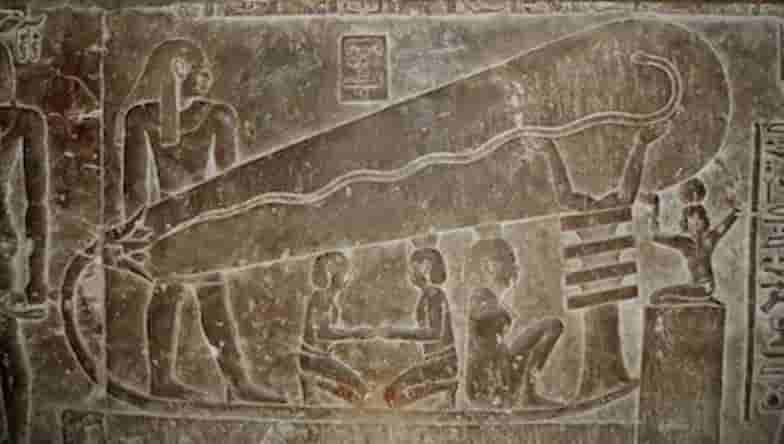
Inside one of the crypts is the famous Dendera Light Relief, which depicts an elongated oval shape with a serpent emerging from a lotus flower, surrounded by priests. The unique imagery led to many interpretations, including modern theories comparing it to a light bulb.
Architecture of the Temple of Dendera, Egypt
The Temples of Edfu and Dendera share a similar architectural layout and symbolism, reflecting the ancient bond between Hathor of Dendera and Horus of Edfu. Their design reflects rituals, offerings, and the sacred union celebrated in the ancient festivals.

The temple façade is one of the most impressive in Upper Egypt—12.5 meters high and 35 meters wide. Six massive Hathor-headed columns dominate the front, each bearing the goddess’s distinctive face and sistrum-shaped capitals.
Above the entrance is a three-line Greek inscription from AD 35 declaring Emperor Tiberius as the rightful patron of the temple. A decorative half-wall, resembling a hanging curtain, separates architectural levels and adds visual depth to the façade.

The Hypostyle Hall and Its Secrets
The Hypostyle Hall of Dendera is supported by twenty-four towering Hathor-headed columns. The hall is considered one of the best-preserved structures of the Ptolemaic era, with its vivid astronomical ceiling restored to near-original clarity.
The left wall depicts the emperor leaving the palace wearing the crown of Lower Egypt, performing purification rituals for Horus and Thoth. The right wall shows scenes of constructing and dedicating the temple to Hathor.

The Zodiac Ceiling of Dendera
Dendera’s painted astronomical ceiling is one of Egypt’s finest archaeological treasures. It depicts zodiac constellations, planetary cycles, and the sky goddess Nut arching across the heavens—a masterpiece of Ptolemaic astronomy.
Behind the hall lies the Hall of Views, built with sandstone columns and granite bases. Reliefs show the king offering gifts to Hathor, reflecting the deep spiritual symbolism of the temple.
Visitor Guide: Visiting Dendera Temple
Planning your visit in advance ensures a smooth and enjoyable trip. Here are the essential tips every traveler needs before exploring Dendera Temple.
Opening Hours
Dendera Temple is open daily from 7:00 AM to 5:00 PM. Last entry is at 4:00 PM. Early morning visits are ideal to avoid heat and crowds.
Ticket Prices
- Adult ticket: ~$6.30 USD
- Student ticket: ~$3.15 USD
Best Time to Visit
The best time to visit is between October and April, when temperatures are cooler and more comfortable.
How to Get There from Luxor
Dendera is located 60–70 km north of Luxor (about 1.5 hours by car). Transportation options include:
- Private guided tour: the easiest and most comfortable option, including transport and expert guide — Book it here: Dendera & Abydos Day Tour
- Private taxi: flexible but requires negotiation.
- Train: budget-friendly but slower and less direct.
Conclusion
The Temple of Dendera is one of Egypt’s most beautifully preserved monuments. Its colors, inscriptions, and architecture offer a vivid journey back into ancient Egyptian religion, astronomy, and art.
If you’re planning a trip to Luxor, Aswan, or more, explore more ideas inside our full guide to Egypt Day Tours.
Let our expert team plan your perfect visit to Dendera Temple and the best attractions across Egypt — fully guided, comfortable, and hassle-free.
FAQs About Dendera Temple Complex
1. Where is the Dendera Temple Complex located?
The Dendera Temple is located in the town of Dendera, about 5 km northwest of Qena City and approximately 60 km north of Luxor in Egypt.
2. Which goddess is the Dendera Temple dedicated to?
The main temple at Dendera is dedicated to Hathor, the ancient Egyptian goddess of love, beauty, joy, motherhood, music, and the sky.
3. When was the current temple structure built?
Earlier temples existed on the site as far back as 2500 BC, but the current Temple of Hathor dates mainly to the Ptolemaic and Roman eras, beginning around 54 BC and completed under Roman emperors such as Nero and Tiberius.
4. What is the significance of the Hypostyle Hall?
The Hypostyle Hall is supported by 24 Hathor-headed columns and is renowned for its vivid astronomical ceiling featuring the zodiac signs and the sky goddess Nut.